

membrane. The inner membrane would be the plasmalemma
(cytoplasmic membrane) of the cyanobacteria and the outer
one the membrane of the vacuole in which the cyanobacterium was included. In secondary endosymbiosis, a second
double membrane will surround the chloroplast; it comes
from the plasmalemma of eukaryotic endosymbiont,
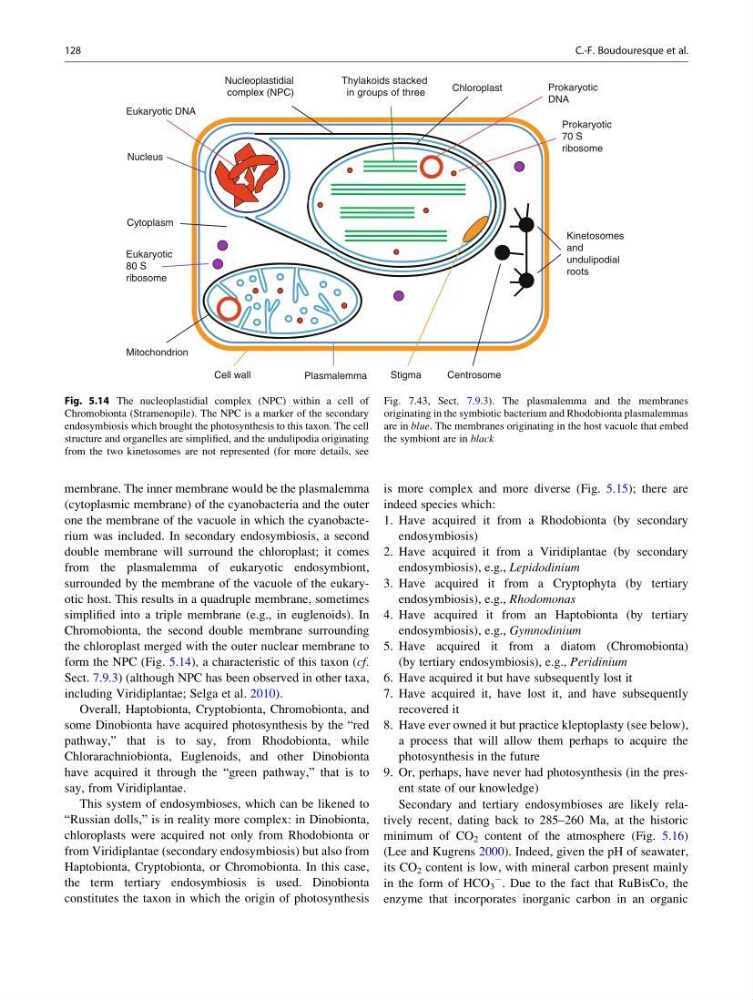
surrounded by the membrane of the vacuole of the eukaryotic host. This results in a quadruple membrane, sometimes
simplified into a triple membrane (e.g., in euglenoids). In
Chromobionta, the second double membrane surrounding
the chloroplast merged with the outer nuclear membrane to
form the NPC (Fig. 5.14), a characteristic of this taxon (cf.
Sect. 7.9.3) (although NPC has been observed in other taxa,
including Viridiplantae; Selga et al. 2010).
Overall, Haptobionta, Cryptobionta, Chromobionta, and
some Dinobionta have acquired photosynthesis by the “red
pathway,” that is to say, from Rhodobionta, while
Chlorarachniobionta, Euglenoids, and other Dinobionta
have acquired it through the “green pathway,” that is to
say, from Viridiplantae.
This system of endosymbioses, which can be likened to
“Russian dolls,” is in reality more complex: in Dinobionta,
chloroplasts were acquired not only from Rhodobionta or
from Viridiplantae (secondary endosymbiosis) but also from
Haptobionta, Cryptobionta, or Chromobionta. In this case,
the term tertiary endosymbiosis is used. Dinobionta
constitutes the taxon in which the origin of photosynthesis
is more complex and more diverse (Fig. 5.15); there are
indeed species which:
1. Have acquired it from a Rhodobionta (by secondary
endosymbiosis)
2. Have acquired it from a Viridiplantae (by secondary
endosymbiosis), e.g., Lepidodinium
3. Have acquired it from a Cryptophyta (by tertiary
endosymbiosis), e.g., Rhodomonas
4. Have acquired it from an Haptobionta (by tertiary
endosymbiosis), e.g., Gymnodinium
5. Have acquired it from a diatom (Chromobionta)
(by tertiary endosymbiosis), e.g., Peridinium
6. Have acquired it but have subsequently lost it
7. Have acquired it, have lost it, and have subsequently
recovered it
8. Have ever owned it but practice kleptoplasty (see below),
a process that will allow them perhaps to acquire the
photosynthesis in the future
9. Or, perhaps, have never had photosynthesis (in the present state of our knowledge)
Secondary and tertiary endosymbioses are likely relatively recent, dating back to 285–260 Ma, at the historic
minimum of CO 2 content of the atmosphere (Fig. 5.16)
(Lee and Kugrens 2000). Indeed, given the pH of seawater,
its CO 2 content is low, with mineral carbon present mainly
in the form of HCO 3
À
. Due to the fact that RuBisCo, the
enzyme that incorporates inorganic carbon in an organic
Cell wall
Plasmalemma
Nucleus
Eukaryotic DNA
Mitochondrion
Eukaryotic
80 S
ribosome
Chloroplast
Nucleoplastidial
complex (NPC)
Thylakoids stacked
in groups of three
Prokaryotic
DNA
Prokaryotic
70 S
ribosome
Stigma
Centrosome
Kinetosomes
and
undulipodial
roots
Cytoplasm
Fig. 5.14 The nucleoplastidial complex (NPC) within a cell of
Chromobionta (Stramenopile). The NPC is a marker of the secondary
endosymbiosis which brought the photosynthesis to this taxon. The cell
structure and organelles are simplified, and the undulipodia originating
from the two kinetosomes are not represented (for more details, see
Fig. 7.43, Sect. 7.9.3). The plasmalemma and the membranes
originating in the symbiotic bacterium and Rhodobionta plasmalemmas
are in blue. The membranes originating in the host vacuole that embed
the symbiont are in black
128
C.-F. Boudouresque et al.
(cytoplasmic membrane) of the cyanobacteria and the outer
one the membrane of the vacuole in which the cyanobacterium was included. In secondary endosymbiosis, a second
double membrane will surround the chloroplast; it comes
from the plasmalemma of eukaryotic endosymbiont,
surrounded by the membrane of the vacuole of the eukaryotic host. This results in a quadruple membrane, sometimes
simplified into a triple membrane (e.g., in euglenoids). In
Chromobionta, the second double membrane surrounding
the chloroplast merged with the outer nuclear membrane to
form the NPC (Fig. 5.14), a characteristic of this taxon (cf.
Sect. 7.9.3) (although NPC has been observed in other taxa,
including Viridiplantae; Selga et al. 2010).
Overall, Haptobionta, Cryptobionta, Chromobionta, and
some Dinobionta have acquired photosynthesis by the “red
pathway,” that is to say, from Rhodobionta, while
Chlorarachniobionta, Euglenoids, and other Dinobionta
have acquired it through the “green pathway,” that is to
say, from Viridiplantae.
This system of endosymbioses, which can be likened to
“Russian dolls,” is in reality more complex: in Dinobionta,
chloroplasts were acquired not only from Rhodobionta or
from Viridiplantae (secondary endosymbiosis) but also from
Haptobionta, Cryptobionta, or Chromobionta. In this case,
the term tertiary endosymbiosis is used. Dinobionta
constitutes the taxon in which the origin of photosynthesis
is more complex and more diverse (Fig. 5.15); there are
indeed species which:
1. Have acquired it from a Rhodobionta (by secondary
endosymbiosis)
2. Have acquired it from a Viridiplantae (by secondary
endosymbiosis), e.g., Lepidodinium
3. Have acquired it from a Cryptophyta (by tertiary
endosymbiosis), e.g., Rhodomonas
4. Have acquired it from an Haptobionta (by tertiary
endosymbiosis), e.g., Gymnodinium
5. Have acquired it from a diatom (Chromobionta)
(by tertiary endosymbiosis), e.g., Peridinium
6. Have acquired it but have subsequently lost it
7. Have acquired it, have lost it, and have subsequently
recovered it
8. Have ever owned it but practice kleptoplasty (see below),
a process that will allow them perhaps to acquire the
photosynthesis in the future
9. Or, perhaps, have never had photosynthesis (in the present state of our knowledge)
Secondary and tertiary endosymbioses are likely relatively recent, dating back to 285–260 Ma, at the historic
minimum of CO 2 content of the atmosphere (Fig. 5.16)
(Lee and Kugrens 2000). Indeed, given the pH of seawater,
its CO 2 content is low, with mineral carbon present mainly
in the form of HCO 3
À
. Due to the fact that RuBisCo, the
enzyme that incorporates inorganic carbon in an organic
Cell wall
Plasmalemma
Nucleus
Eukaryotic DNA
Mitochondrion
Eukaryotic
80 S
ribosome
Chloroplast
Nucleoplastidial
complex (NPC)
Thylakoids stacked
in groups of three
Prokaryotic
DNA
Prokaryotic
70 S
ribosome
Stigma
Centrosome
Kinetosomes
and
undulipodial
roots
Cytoplasm
Fig. 5.14 The nucleoplastidial complex (NPC) within a cell of
Chromobionta (Stramenopile). The NPC is a marker of the secondary
endosymbiosis which brought the photosynthesis to this taxon. The cell
structure and organelles are simplified, and the undulipodia originating
from the two kinetosomes are not represented (for more details, see
Fig. 7.43, Sect. 7.9.3). The plasmalemma and the membranes
originating in the symbiotic bacterium and Rhodobionta plasmalemmas
are in blue. The membranes originating in the host vacuole that embed
the symbiont are in black
128
C.-F. Boudouresque et al.