

These genetic alterations are of great importance: in fact,
from the moment bacteria hosted in the cytoplasm of
eukaryotes did lose much of their genes, they were no longer
autonomous. From this point of view, as rightly remarked by
Cavalier-Smith (2002b), the term endosymbiosis, if used in the
sense of mutualism, is not appropriate. Indeed, the mutualistic
symbiosis involves an association with mutual benefit for two
species, each of which is generally able to survive independently. From the moment most of the genes essential to their
functioning, particularly those controlling their division, are
present in the nucleus, these bacteria are no longer mutualistic
symbionts but slaves, and the term helotism* is the most
appropriate for the endosymbiotic-derived organelles.
5.4.3.2 Secondary and Tertiary Endosymbioses
The endosymbioses described previously (cf. Sect. 5.4.3) are
primary endosymbioses: the hypothetical origin of the kinetic
apparatus, the origin of the mitochondria, and the origin of
chloroplasts in the kingdom of Archaeplastida. In the case of
the first two types of organelles, only primary endosymbioses
are known. In the case of the chloroplast, however, photosynthesis has developed, through secondary and tertiary
endosymbioses, into up to four kingdoms of eukaryotes
(Rhizaria, Alveolata, Stramenopiles, and Discicristata) and
into two lineages whose phylogenetic position is not clear:
the Haptobionta and the Cryptobionta (cf. Sect. 7.11).
But between the primary endosymbiosis that gave rise
to the chloroplast and the secondary endosymbiosis in
question, the chloroplast has changed considerably in
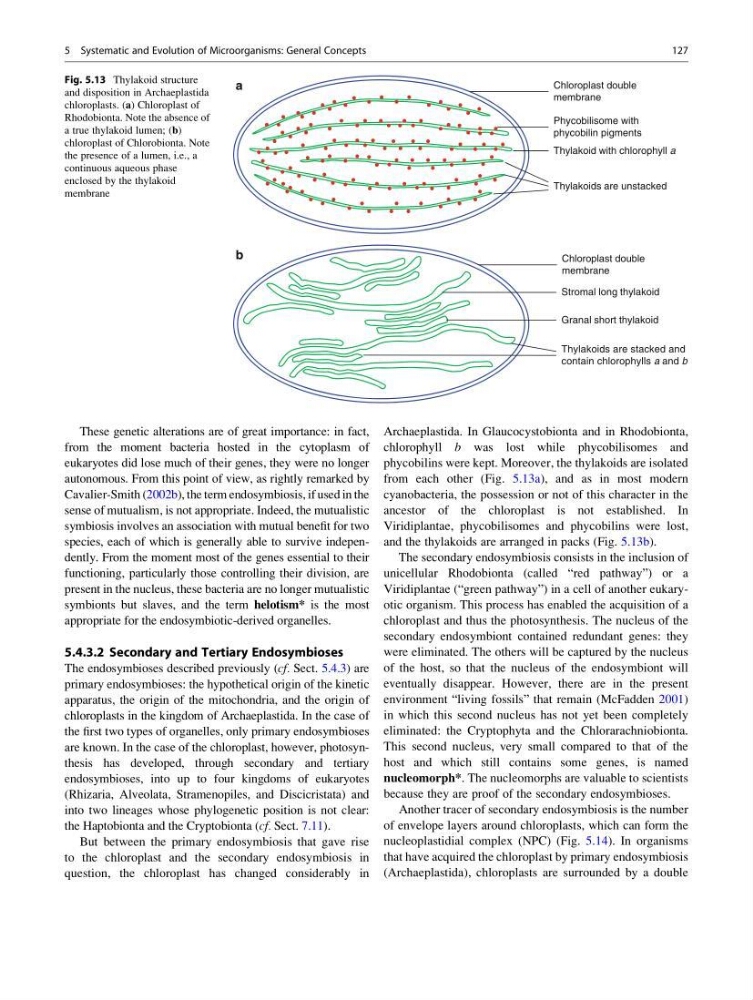
Archaeplastida. In Glaucocystobionta and in Rhodobionta,
chlorophyll b was lost while phycobilisomes and
phycobilins were kept. Moreover, the thylakoids are isolated
from each other (Fig. 5.13a), and as in most modern
cyanobacteria, the possession or not of this character in the
ancestor of the chloroplast is not established. In
Viridiplantae, phycobilisomes and phycobilins were lost,
and the thylakoids are arranged in packs (Fig. 5.13b).
The secondary endosymbiosis consists in the inclusion of
unicellular Rhodobionta (called “red pathway”) or a
Viridiplantae (“green pathway”) in a cell of another eukaryotic organism. This process has enabled the acquisition of a
chloroplast and thus the photosynthesis. The nucleus of the
secondary endosymbiont contained redundant genes: they
were eliminated. The others will be captured by the nucleus
of the host, so that the nucleus of the endosymbiont will
eventually disappear. However, there are in the present
environment “living fossils” that remain (McFadden 2001)
in which this second nucleus has not yet been completely
eliminated: the Cryptophyta and the Chlorarachniobionta.
This second nucleus, very small compared to that of the
host and which still contains some genes, is named
nucleomorph*. The nucleomorphs are valuable to scientists
because they are proof of the secondary endosymbioses.
Another tracer of secondary endosymbiosis is the number
of envelope layers around chloroplasts, which can form the
nucleoplastidial complex (NPC) (Fig. 5.14). In organisms
that have acquired the chloroplast by primary endosymbiosis
(Archaeplastida), chloroplasts are surrounded by a double
a
b
Chloroplast double
membrane
Phycobilisome with
phycobilin pigments
Thylakoid with chlorophyll a
Thylakoids are unstacked
Chloroplast double
membrane
Stromal long thylakoid
Granal short thylakoid
Thylakoids are stacked and
contain chlorophylls a and b
Fig. 5.13 Thylakoid structure
and disposition in Archaeplastida
chloroplasts. (a) Chloroplast of
Rhodobionta. Note the absence of
a true thylakoid lumen; (b)
chloroplast of Chlorobionta. Note
the presence of a lumen, i.e., a
continuous aqueous phase
enclosed by the thylakoid
membrane
5 Systematic and Evolution of Microorganisms: General Concepts
127
from the moment bacteria hosted in the cytoplasm of
eukaryotes did lose much of their genes, they were no longer
autonomous. From this point of view, as rightly remarked by
Cavalier-Smith (2002b), the term endosymbiosis, if used in the
sense of mutualism, is not appropriate. Indeed, the mutualistic
symbiosis involves an association with mutual benefit for two
species, each of which is generally able to survive independently. From the moment most of the genes essential to their
functioning, particularly those controlling their division, are
present in the nucleus, these bacteria are no longer mutualistic
symbionts but slaves, and the term helotism* is the most
appropriate for the endosymbiotic-derived organelles.
5.4.3.2 Secondary and Tertiary Endosymbioses
The endosymbioses described previously (cf. Sect. 5.4.3) are
primary endosymbioses: the hypothetical origin of the kinetic
apparatus, the origin of the mitochondria, and the origin of
chloroplasts in the kingdom of Archaeplastida. In the case of
the first two types of organelles, only primary endosymbioses
are known. In the case of the chloroplast, however, photosynthesis has developed, through secondary and tertiary
endosymbioses, into up to four kingdoms of eukaryotes
(Rhizaria, Alveolata, Stramenopiles, and Discicristata) and
into two lineages whose phylogenetic position is not clear:
the Haptobionta and the Cryptobionta (cf. Sect. 7.11).
But between the primary endosymbiosis that gave rise
to the chloroplast and the secondary endosymbiosis in
question, the chloroplast has changed considerably in
Archaeplastida. In Glaucocystobionta and in Rhodobionta,
chlorophyll b was lost while phycobilisomes and
phycobilins were kept. Moreover, the thylakoids are isolated
from each other (Fig. 5.13a), and as in most modern
cyanobacteria, the possession or not of this character in the
ancestor of the chloroplast is not established. In
Viridiplantae, phycobilisomes and phycobilins were lost,
and the thylakoids are arranged in packs (Fig. 5.13b).
The secondary endosymbiosis consists in the inclusion of
unicellular Rhodobionta (called “red pathway”) or a
Viridiplantae (“green pathway”) in a cell of another eukaryotic organism. This process has enabled the acquisition of a
chloroplast and thus the photosynthesis. The nucleus of the
secondary endosymbiont contained redundant genes: they
were eliminated. The others will be captured by the nucleus
of the host, so that the nucleus of the endosymbiont will
eventually disappear. However, there are in the present
environment “living fossils” that remain (McFadden 2001)
in which this second nucleus has not yet been completely
eliminated: the Cryptophyta and the Chlorarachniobionta.
This second nucleus, very small compared to that of the
host and which still contains some genes, is named
nucleomorph*. The nucleomorphs are valuable to scientists
because they are proof of the secondary endosymbioses.
Another tracer of secondary endosymbiosis is the number
of envelope layers around chloroplasts, which can form the
nucleoplastidial complex (NPC) (Fig. 5.14). In organisms
that have acquired the chloroplast by primary endosymbiosis
(Archaeplastida), chloroplasts are surrounded by a double
a
b
Chloroplast double
membrane
Phycobilisome with
phycobilin pigments
Thylakoid with chlorophyll a
Thylakoids are unstacked
Chloroplast double
membrane
Stromal long thylakoid
Granal short thylakoid
Thylakoids are stacked and
contain chlorophylls a and b
Fig. 5.13 Thylakoid structure
and disposition in Archaeplastida
chloroplasts. (a) Chloroplast of
Rhodobionta. Note the absence of
a true thylakoid lumen; (b)
chloroplast of Chlorobionta. Note
the presence of a lumen, i.e., a
continuous aqueous phase
enclosed by the thylakoid
membrane
5 Systematic and Evolution of Microorganisms: General Concepts
127