

5.4.3 The Current Theory of Endosymbiosis
5.4.3.1 Primary Endosymbioses
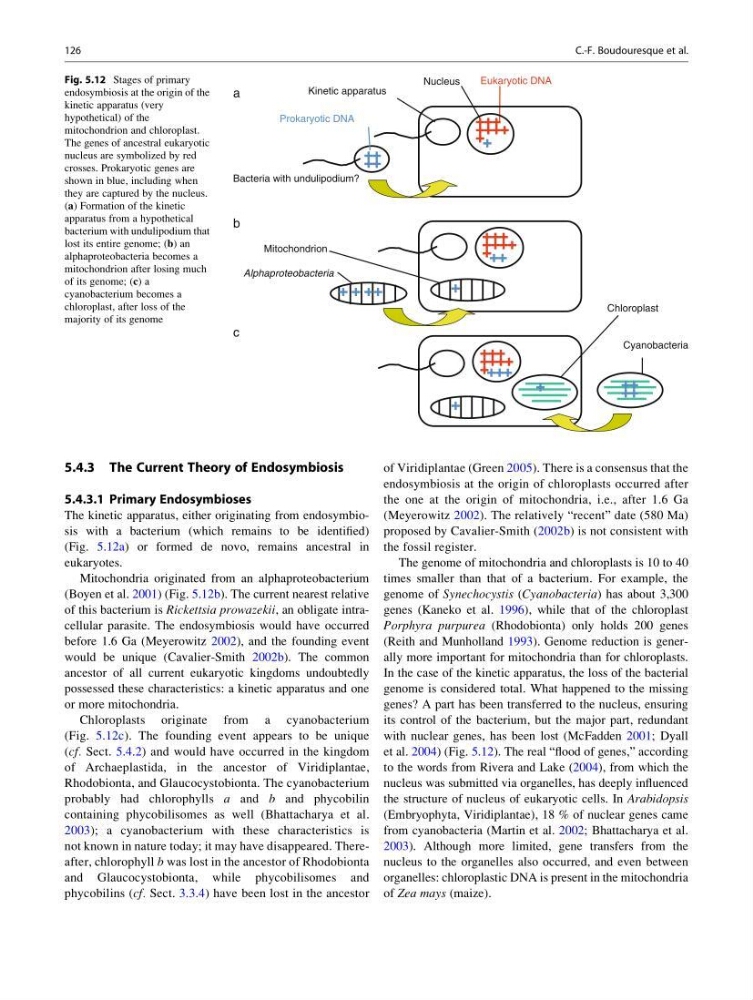
The kinetic apparatus, either originating from endosymbiosis with a bacterium (which remains to be identified)
(Fig. 5.12a) or formed de novo, remains ancestral in
eukaryotes.
Mitochondria originated from an alphaproteobacterium
(Boyen et al. 2001) (Fig. 5.12b). The current nearest relative
of this bacterium is Rickettsia prowazekii, an obligate intracellular parasite. The endosymbiosis would have occurred
before 1.6 Ga (Meyerowitz 2002), and the founding event
would be unique (Cavalier-Smith 2002b). The common
ancestor of all current eukaryotic kingdoms undoubtedly
possessed these characteristics: a kinetic apparatus and one
or more mitochondria.
Chloroplasts originate from a cyanobacterium
(Fig. 5.12c). The founding event appears to be unique
(cf. Sect. 5.4.2) and would have occurred in the kingdom
of Archaeplastida, in the ancestor of Viridiplantae,
Rhodobionta, and Glaucocystobionta. The cyanobacterium
probably had chlorophylls a and b and phycobilin
containing phycobilisomes as well (Bhattacharya et al.
2003); a cyanobacterium with these characteristics is
not known in nature today; it may have disappeared. Thereafter, chlorophyll b was lost in the ancestor of Rhodobionta
and Glaucocystobionta, while phycobilisomes and
phycobilins (cf. Sect. 3.3.4) have been lost in the ancestor
of Viridiplantae (Green 2005). There is a consensus that the
endosymbiosis at the origin of chloroplasts occurred after
the one at the origin of mitochondria, i.e., after 1.6 Ga
(Meyerowitz 2002). The relatively “recent” date (580 Ma)
proposed by Cavalier-Smith (2002b) is not consistent with
the fossil register.
The genome of mitochondria and chloroplasts is 10 to 40
times smaller than that of a bacterium. For example, the
genome of Synechocystis (Cyanobacteria) has about 3,300
genes (Kaneko et al. 1996), while that of the chloroplast
Porphyra purpurea (Rhodobionta) only holds 200 genes
(Reith and Munholland 1993). Genome reduction is generally more important for mitochondria than for chloroplasts.
In the case of the kinetic apparatus, the loss of the bacterial
genome is considered total. What happened to the missing
genes? A part has been transferred to the nucleus, ensuring
its control of the bacterium, but the major part, redundant
with nuclear genes, has been lost (McFadden 2001; Dyall
et al. 2004) (Fig. 5.12). The real “flood of genes,” according
to the words from Rivera and Lake (2004), from which the
nucleus was submitted via organelles, has deeply influenced
the structure of nucleus of eukaryotic cells. In Arabidopsis
(Embryophyta, Viridiplantae), 18 % of nuclear genes came
from cyanobacteria (Martin et al. 2002; Bhattacharya et al.
2003). Although more limited, gene transfers from the
nucleus to the organelles also occurred, and even between
organelles: chloroplastic DNA is present in the mitochondria
of Zea mays (maize).
Bacteria with undulipodium?
Prokaryotic DNA
Kinetic apparatus
Nucleus
Eukaryotic DNA
a
Alphaproteobacteria
Mitochondrion
b
Cyanobacteria
Chloroplast
c
Fig. 5.12 Stages of primary
endosymbiosis at the origin of the
kinetic apparatus (very
hypothetical) of the
mitochondrion and chloroplast.
The genes of ancestral eukaryotic
nucleus are symbolized by red
crosses. Prokaryotic genes are
shown in blue, including when
they are captured by the nucleus.
(a) Formation of the kinetic
apparatus from a hypothetical
bacterium with undulipodium that
lost its entire genome; (b) an
alphaproteobacteria becomes a
mitochondrion after losing much
of its genome; (c) a
cyanobacterium becomes a
chloroplast, after loss of the
majority of its genome
126
C.-F. Boudouresque et al.
5.4.3.1 Primary Endosymbioses
The kinetic apparatus, either originating from endosymbiosis with a bacterium (which remains to be identified)
(Fig. 5.12a) or formed de novo, remains ancestral in
eukaryotes.
Mitochondria originated from an alphaproteobacterium
(Boyen et al. 2001) (Fig. 5.12b). The current nearest relative
of this bacterium is Rickettsia prowazekii, an obligate intracellular parasite. The endosymbiosis would have occurred
before 1.6 Ga (Meyerowitz 2002), and the founding event
would be unique (Cavalier-Smith 2002b). The common
ancestor of all current eukaryotic kingdoms undoubtedly
possessed these characteristics: a kinetic apparatus and one
or more mitochondria.
Chloroplasts originate from a cyanobacterium
(Fig. 5.12c). The founding event appears to be unique
(cf. Sect. 5.4.2) and would have occurred in the kingdom
of Archaeplastida, in the ancestor of Viridiplantae,
Rhodobionta, and Glaucocystobionta. The cyanobacterium
probably had chlorophylls a and b and phycobilin
containing phycobilisomes as well (Bhattacharya et al.
2003); a cyanobacterium with these characteristics is
not known in nature today; it may have disappeared. Thereafter, chlorophyll b was lost in the ancestor of Rhodobionta
and Glaucocystobionta, while phycobilisomes and
phycobilins (cf. Sect. 3.3.4) have been lost in the ancestor
of Viridiplantae (Green 2005). There is a consensus that the
endosymbiosis at the origin of chloroplasts occurred after
the one at the origin of mitochondria, i.e., after 1.6 Ga
(Meyerowitz 2002). The relatively “recent” date (580 Ma)
proposed by Cavalier-Smith (2002b) is not consistent with
the fossil register.
The genome of mitochondria and chloroplasts is 10 to 40
times smaller than that of a bacterium. For example, the
genome of Synechocystis (Cyanobacteria) has about 3,300
genes (Kaneko et al. 1996), while that of the chloroplast
Porphyra purpurea (Rhodobionta) only holds 200 genes
(Reith and Munholland 1993). Genome reduction is generally more important for mitochondria than for chloroplasts.
In the case of the kinetic apparatus, the loss of the bacterial
genome is considered total. What happened to the missing
genes? A part has been transferred to the nucleus, ensuring
its control of the bacterium, but the major part, redundant
with nuclear genes, has been lost (McFadden 2001; Dyall
et al. 2004) (Fig. 5.12). The real “flood of genes,” according
to the words from Rivera and Lake (2004), from which the
nucleus was submitted via organelles, has deeply influenced
the structure of nucleus of eukaryotic cells. In Arabidopsis
(Embryophyta, Viridiplantae), 18 % of nuclear genes came
from cyanobacteria (Martin et al. 2002; Bhattacharya et al.
2003). Although more limited, gene transfers from the
nucleus to the organelles also occurred, and even between
organelles: chloroplastic DNA is present in the mitochondria
of Zea mays (maize).
Bacteria with undulipodium?
Prokaryotic DNA
Kinetic apparatus
Nucleus
Eukaryotic DNA
a
Alphaproteobacteria
Mitochondrion
b
Cyanobacteria
Chloroplast
c
Fig. 5.12 Stages of primary
endosymbiosis at the origin of the
kinetic apparatus (very
hypothetical) of the
mitochondrion and chloroplast.
The genes of ancestral eukaryotic
nucleus are symbolized by red
crosses. Prokaryotic genes are
shown in blue, including when
they are captured by the nucleus.
(a) Formation of the kinetic
apparatus from a hypothetical
bacterium with undulipodium that
lost its entire genome; (b) an
alphaproteobacteria becomes a
mitochondrion after losing much
of its genome; (c) a
cyanobacterium becomes a
chloroplast, after loss of the
majority of its genome
126
C.-F. Boudouresque et al.