

nucleus? Are they derived from the mitochondria, through
loss of its genetic material? This last hypothesis is now
the most accepted for hydrogenosomes (Hrdy et al. 2004;
Carlton et al. 2007). In the case of peroxisomes present in all
eukaryotic cells, it was thought that they could result from an
endosymbiosis with prokaryotes, distinct from that which
gave rise to the mitochondria, and have appeared very early
in the history of eukaryotes. Peroxisomes could have served
to protect the cell against the superoxidizing forms of oxygen, while the mitochondrial endosymbiosis had not yet
occurred. However, the autogenous origin, by differentiation
of the endoplasmic reticulum, is actually the most accepted
hypothesis.
The debate also has focused on eukaryotes devoid of
mitochondria (Microsporidia, Parabasalia, etc.): Did they
appear before endosymbiosis as has long been thought? Or
have they lost their mitochondria secondarily? The discovery, in the nucleus of these organisms, of genes whose origin
is undoubtedly mitochondrial suggests that they have possessed mitochondria that were subsequently lost, as shown,
for example, by Germot et al. (1997) for the Microsporidia
Nosema locustae.
So far, the kinetic apparatus has not been addressed
since its endosymbiotic origin is highly disputed or even
refuted (Cavalier-Smith 2002b); the latter author considers
that the kinetic apparatus was formed de novo, from the
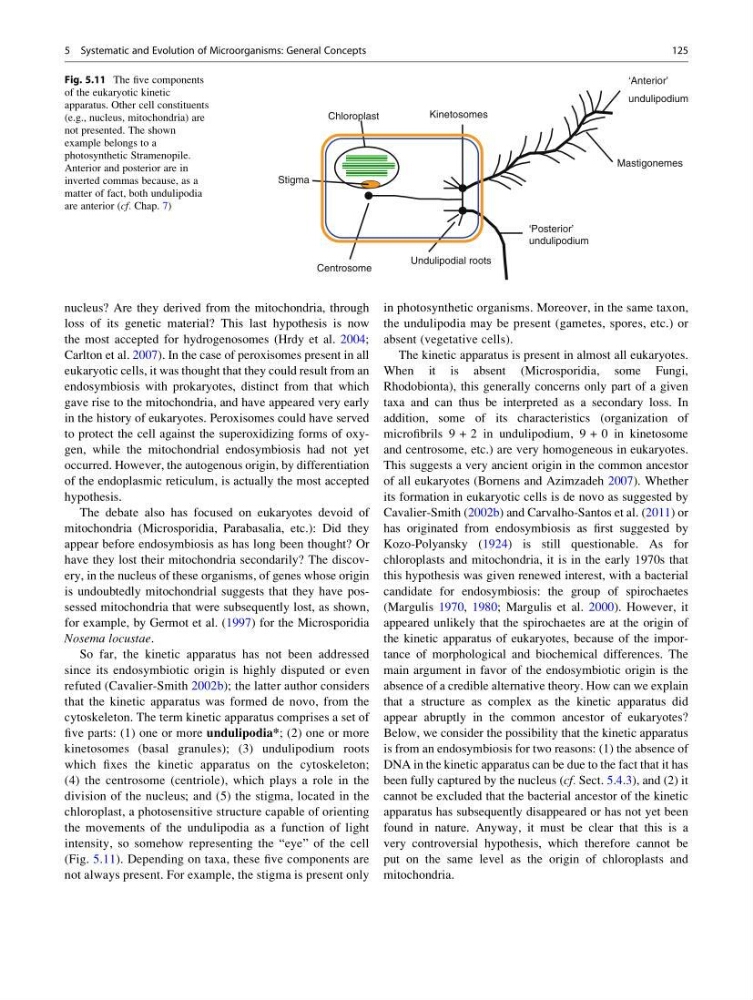
cytoskeleton. The term kinetic apparatus comprises a set of
five parts: (1) one or more undulipodia*; (2) one or more
kinetosomes (basal granules); (3) undulipodium roots
which fixes the kinetic apparatus on the cytoskeleton;
(4) the centrosome (centriole), which plays a role in the
division of the nucleus; and (5) the stigma, located in the
chloroplast, a photosensitive structure capable of orienting
the movements of the undulipodia as a function of light
intensity, so somehow representing the “eye” of the cell
(Fig. 5.11). Depending on taxa, these five components are
not always present. For example, the stigma is present only
in photosynthetic organisms. Moreover, in the same taxon,
the undulipodia may be present (gametes, spores, etc.) or
absent (vegetative cells).
The kinetic apparatus is present in almost all eukaryotes.
When it is absent (Microsporidia, some Fungi,
Rhodobionta), this generally concerns only part of a given
taxa and can thus be interpreted as a secondary loss. In
addition, some of its characteristics (organization of
microfibrils 9 + 2 in undulipodium, 9 + 0 in kinetosome
and centrosome, etc.) are very homogeneous in eukaryotes.
This suggests a very ancient origin in the common ancestor
of all eukaryotes (Bornens and Azimzadeh 2007). Whether
its formation in eukaryotic cells is de novo as suggested by
Cavalier-Smith (2002b) and Carvalho-Santos et al. (2011) or
has originated from endosymbiosis as first suggested by
Kozo-Polyansky (1924) is still questionable. As for
chloroplasts and mitochondria, it is in the early 1970s that
this hypothesis was given renewed interest, with a bacterial
candidate for endosymbiosis: the group of spirochaetes
(Margulis 1970, 1980; Margulis et al. 2000). However, it
appeared unlikely that the spirochaetes are at the origin of
the kinetic apparatus of eukaryotes, because of the importance of morphological and biochemical differences. The
main argument in favor of the endosymbiotic origin is the
absence of a credible alternative theory. How can we explain
that a structure as complex as the kinetic apparatus did
appear abruptly in the common ancestor of eukaryotes?
Below, we consider the possibility that the kinetic apparatus
is from an endosymbiosis for two reasons: (1) the absence of
DNA in the kinetic apparatus can be due to the fact that it has
been fully captured by the nucleus (cf. Sect. 5.4.3), and (2) it
cannot be excluded that the bacterial ancestor of the kinetic
apparatus has subsequently disappeared or has not yet been
found in nature. Anyway, it must be clear that this is a
very controversial hypothesis, which therefore cannot be
put on the same level as the origin of chloroplasts and
mitochondria.
Stigma
‘Posterior’
undulipodium
Undulipodial roots
Centrosome
Chloroplast
Kinetosomes
‘Anterior’
undulipodium
Mastigonemes
Fig. 5.11 The five components
of the eukaryotic kinetic
apparatus. Other cell constituents
(e.g., nucleus, mitochondria) are
not presented. The shown
example belongs to a
photosynthetic Stramenopile.
Anterior and posterior are in
inverted commas because, as a
matter of fact, both undulipodia
are anterior (cf. Chap. 7)
5 Systematic and Evolution of Microorganisms: General Concepts
125
loss of its genetic material? This last hypothesis is now
the most accepted for hydrogenosomes (Hrdy et al. 2004;
Carlton et al. 2007). In the case of peroxisomes present in all
eukaryotic cells, it was thought that they could result from an
endosymbiosis with prokaryotes, distinct from that which
gave rise to the mitochondria, and have appeared very early
in the history of eukaryotes. Peroxisomes could have served
to protect the cell against the superoxidizing forms of oxygen, while the mitochondrial endosymbiosis had not yet
occurred. However, the autogenous origin, by differentiation
of the endoplasmic reticulum, is actually the most accepted
hypothesis.
The debate also has focused on eukaryotes devoid of
mitochondria (Microsporidia, Parabasalia, etc.): Did they
appear before endosymbiosis as has long been thought? Or
have they lost their mitochondria secondarily? The discovery, in the nucleus of these organisms, of genes whose origin
is undoubtedly mitochondrial suggests that they have possessed mitochondria that were subsequently lost, as shown,
for example, by Germot et al. (1997) for the Microsporidia
Nosema locustae.
So far, the kinetic apparatus has not been addressed
since its endosymbiotic origin is highly disputed or even
refuted (Cavalier-Smith 2002b); the latter author considers
that the kinetic apparatus was formed de novo, from the
cytoskeleton. The term kinetic apparatus comprises a set of
five parts: (1) one or more undulipodia*; (2) one or more
kinetosomes (basal granules); (3) undulipodium roots
which fixes the kinetic apparatus on the cytoskeleton;
(4) the centrosome (centriole), which plays a role in the
division of the nucleus; and (5) the stigma, located in the
chloroplast, a photosensitive structure capable of orienting
the movements of the undulipodia as a function of light
intensity, so somehow representing the “eye” of the cell
(Fig. 5.11). Depending on taxa, these five components are
not always present. For example, the stigma is present only
in photosynthetic organisms. Moreover, in the same taxon,
the undulipodia may be present (gametes, spores, etc.) or
absent (vegetative cells).
The kinetic apparatus is present in almost all eukaryotes.
When it is absent (Microsporidia, some Fungi,
Rhodobionta), this generally concerns only part of a given
taxa and can thus be interpreted as a secondary loss. In
addition, some of its characteristics (organization of
microfibrils 9 + 2 in undulipodium, 9 + 0 in kinetosome
and centrosome, etc.) are very homogeneous in eukaryotes.
This suggests a very ancient origin in the common ancestor
of all eukaryotes (Bornens and Azimzadeh 2007). Whether
its formation in eukaryotic cells is de novo as suggested by
Cavalier-Smith (2002b) and Carvalho-Santos et al. (2011) or
has originated from endosymbiosis as first suggested by
Kozo-Polyansky (1924) is still questionable. As for
chloroplasts and mitochondria, it is in the early 1970s that
this hypothesis was given renewed interest, with a bacterial
candidate for endosymbiosis: the group of spirochaetes
(Margulis 1970, 1980; Margulis et al. 2000). However, it
appeared unlikely that the spirochaetes are at the origin of
the kinetic apparatus of eukaryotes, because of the importance of morphological and biochemical differences. The
main argument in favor of the endosymbiotic origin is the
absence of a credible alternative theory. How can we explain
that a structure as complex as the kinetic apparatus did
appear abruptly in the common ancestor of eukaryotes?
Below, we consider the possibility that the kinetic apparatus
is from an endosymbiosis for two reasons: (1) the absence of
DNA in the kinetic apparatus can be due to the fact that it has
been fully captured by the nucleus (cf. Sect. 5.4.3), and (2) it
cannot be excluded that the bacterial ancestor of the kinetic
apparatus has subsequently disappeared or has not yet been
found in nature. Anyway, it must be clear that this is a
very controversial hypothesis, which therefore cannot be
put on the same level as the origin of chloroplasts and
mitochondria.
Stigma
‘Posterior’
undulipodium
Undulipodial roots
Centrosome
Chloroplast
Kinetosomes
‘Anterior’
undulipodium
Mastigonemes
Fig. 5.11 The five components
of the eukaryotic kinetic
apparatus. Other cell constituents
(e.g., nucleus, mitochondria) are
not presented. The shown
example belongs to a
photosynthetic Stramenopile.
Anterior and posterior are in
inverted commas because, as a
matter of fact, both undulipodia
are anterior (cf. Chap. 7)
5 Systematic and Evolution of Microorganisms: General Concepts
125