

606
Isolation
Bacteria were isolated from the kidney, liver and spleen following inoculation onto
BHIA supplemented with 3 % (w/v) sodium chloride, with incubation at an unspecifi ed temperature (presumed to be ≤37 °C) for an undetermined period (Saeed et al.
1987 ).
Characteristics of the Pathogen
From the results of the API 20E rapid identifi cation system, it was considered
that the pathogen was Ps. (=Alteromonas) putrefaciens, a taxon which has been
subsequently re-classifi ed as Shewanella putrefaciens (MacDonell et al. 1986 ). The
Polish isolates were confi rmed as She. putrefaciens by sequencing (Pekala et al.
2015 ).
Epizootiology
It is assumed that the organism was derived from the coastal marine environment.
Possibly, the organism comprises part of the normal microfl ora of fi sh (see Lee et al.
1977 ; Gillespie 1981 ).
Pathogenicity
Following i.p. injection, fi sh (average weight = 50 g) developed clinical disease,
with 80 % mortalities within 48 h. The organism was recovered from the kidney,
liver and spleen of dead fi sh. Infection was not achieved following immersion in a
dense suspension of the organism (Saeed et al. 1987 ).
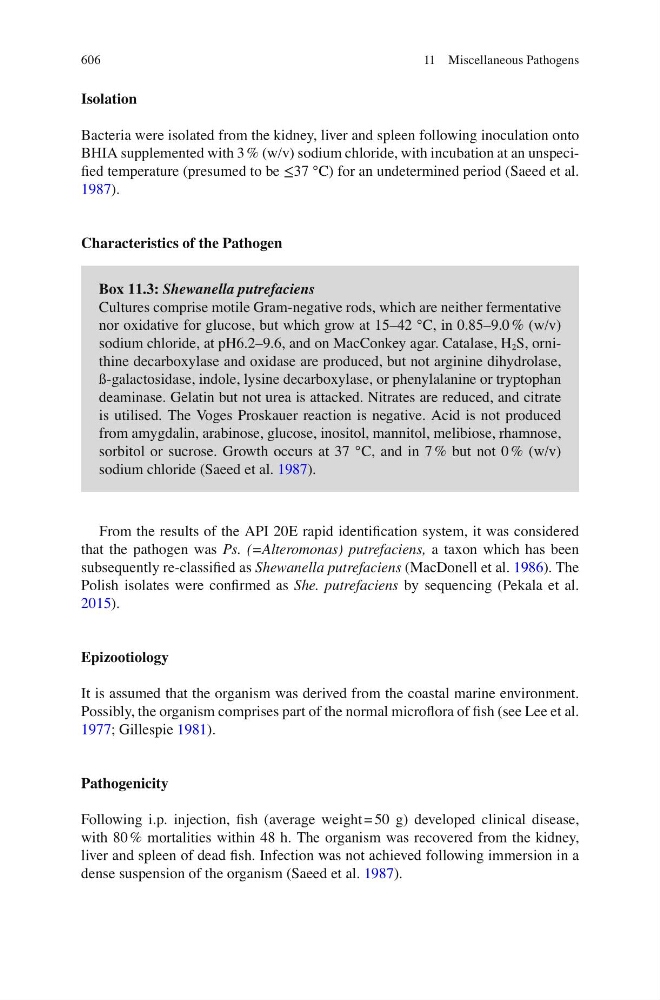
Box 11.3: Shewanella putrefaciens
Cultures comprise motile Gram-negative rods, which are neither fermentative
nor oxidative for glucose, but which grow at 15–42 °C, in 0.85–9.0 % (w/v)
sodium chloride, at pH6.2–9.6, and on MacConkey agar. Catalase, H 2 S, ornithine decarboxylase and oxidase are produced, but not arginine dihydrolase,
ß-galactosidase, indole, lysine decarboxylase, or phenylalanine or tryptophan
deaminase. Gelatin but not urea is attacked. Nitrates are reduced, and citrate
is utilised. The Voges Proskauer reaction is negative. Acid is not produced
from amygdalin, arabinose, glucose, inositol, mannitol, melibiose, rhamnose,
sorbitol or sucrose. Growth occurs at 37 °C, and in 7 % but not 0 % (w/v)
sodium chloride (Saeed et al. 1987 ).
11 Miscellaneous Pathogens