

486
Characteristics of the Pathogen
All the published descriptions of the organism (e.g. Bullock 1965 ; Csaba et al.
1981 ; Ahne et al. 1982 ) agree closely with the defi nition of Ps. fl uorescens (Stanier
et al. 1966 ; Palleroni 2005 ).
It seems likely that other fi sh pathogenic pseudomonads, as discussed by Li and
Flemming ( 1967 ) and Li and Traxler ( 1971 ), correspond to Ps. fl uorescens .
Epizootiology
In view of its widespread occurrence in the aquatic environment, Ps. fl uorescens is
likely to be spread through water, which will serve as the primary reservoir of infection. The disease is especially troublesome at low water temperatures, i.e. at
~1 °C. In one experiment, Ahne et al. ( 1982 ) achieved 100 % mortality in tench fry
within 10 days at a water temperature of 10 °C. Challenge was by i.p. injection of a
bacterial suspension.
Ahne and co-workers noted that initial occurrence of disease, with 30 % of the
population developing skin haemorrhages, was 7 days after transfer of the tench to
laboratory aquaria. Mortalities began on day 14, and by 2 weeks later, 90 % of the
fi sh had died. It is noteworthy that the problem in silver carp and bighead developed
after a stressful period during winter, when the water temperature fl uctuated around
freezing. In this outbreak, the mortality rate was at 5 % of the population per day
(Csaba et al. 1981 ).
Pathogenicity
Following invasion of the fi sh, extracellular proteases are probably responsible for
the ensuing damage (Li and Fleming 1967 ; Li and Jordan 1968 ). Sakai et al. ( 1989 )
reported the LD 50 for rainbow trout as 4.2 × 10
5 cells at 18 °C and 1.1 × 10
5 cells at
12 °C.
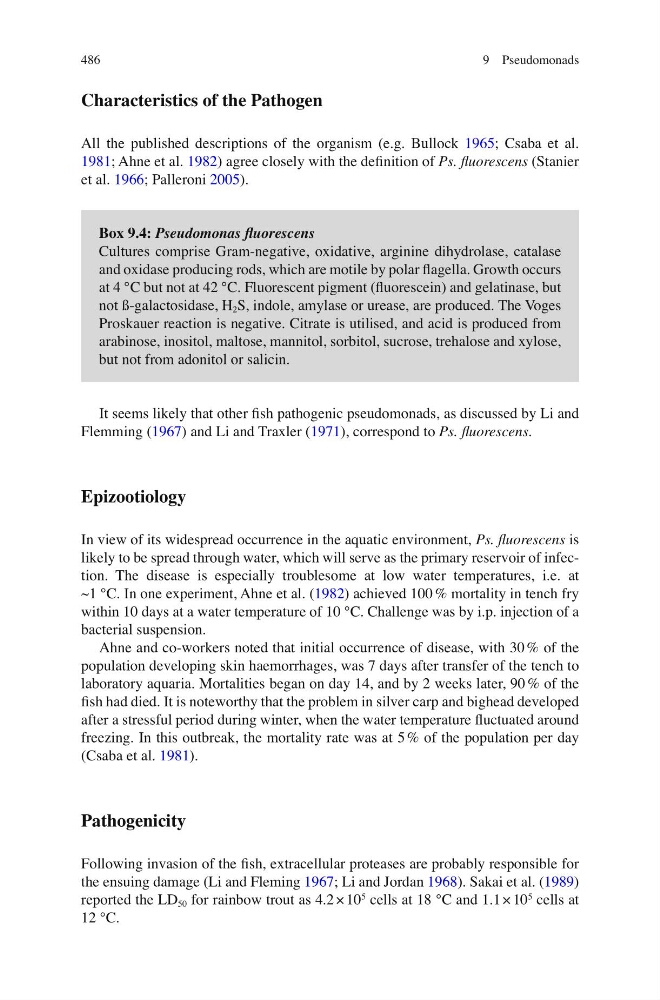
Box 9.4: Pseudomonas fl uorescens
Cultures comprise Gram-negative, oxidative, arginine dihydrolase, catalase
and oxidase producing rods, which are motile by polar fl agella. Growth occurs
at 4 °C but not at 42 °C. Fluorescent pigment (fl uorescein) and gelatinase, but
not ß-galactosidase, H 2 S, indole, amylase or urease, are produced. The Voges
Proskauer reaction is negative. Citrate is utilised, and acid is produced from
arabinose, inositol, maltose, mannitol, sorbitol, sucrose, trehalose and xylose,
but not from adonitol or salicin.
9 Pseudomonads
Characteristics of the Pathogen
All the published descriptions of the organism (e.g. Bullock 1965 ; Csaba et al.
1981 ; Ahne et al. 1982 ) agree closely with the defi nition of Ps. fl uorescens (Stanier
et al. 1966 ; Palleroni 2005 ).
It seems likely that other fi sh pathogenic pseudomonads, as discussed by Li and
Flemming ( 1967 ) and Li and Traxler ( 1971 ), correspond to Ps. fl uorescens .
Epizootiology
In view of its widespread occurrence in the aquatic environment, Ps. fl uorescens is
likely to be spread through water, which will serve as the primary reservoir of infection. The disease is especially troublesome at low water temperatures, i.e. at
~1 °C. In one experiment, Ahne et al. ( 1982 ) achieved 100 % mortality in tench fry
within 10 days at a water temperature of 10 °C. Challenge was by i.p. injection of a
bacterial suspension.
Ahne and co-workers noted that initial occurrence of disease, with 30 % of the
population developing skin haemorrhages, was 7 days after transfer of the tench to
laboratory aquaria. Mortalities began on day 14, and by 2 weeks later, 90 % of the
fi sh had died. It is noteworthy that the problem in silver carp and bighead developed
after a stressful period during winter, when the water temperature fl uctuated around
freezing. In this outbreak, the mortality rate was at 5 % of the population per day
(Csaba et al. 1981 ).
Pathogenicity
Following invasion of the fi sh, extracellular proteases are probably responsible for
the ensuing damage (Li and Fleming 1967 ; Li and Jordan 1968 ). Sakai et al. ( 1989 )
reported the LD 50 for rainbow trout as 4.2 × 10
5 cells at 18 °C and 1.1 × 10
5 cells at
12 °C.
Box 9.4: Pseudomonas fl uorescens
Cultures comprise Gram-negative, oxidative, arginine dihydrolase, catalase
and oxidase producing rods, which are motile by polar fl agella. Growth occurs
at 4 °C but not at 42 °C. Fluorescent pigment (fl uorescein) and gelatinase, but
not ß-galactosidase, H 2 S, indole, amylase or urease, are produced. The Voges
Proskauer reaction is negative. Citrate is utilised, and acid is produced from
arabinose, inositol, maltose, mannitol, sorbitol, sucrose, trehalose and xylose,
but not from adonitol or salicin.
9 Pseudomonads