

485
1965 ), tench ( Tinca tinca ) (Ahne et al. 1982 ), grass carp ( Ctenopharyngodon idella )
and black carp ( Mylopharyngodon piceus ) (Bauer et al. 1973 ), Indian major carp
( Catla catla ) (Darak and Barde 2015 ), unnamed species of carp (Schäperclaus
1959 ; Schäperclaus and Brauer 1964 ; Heuschmann-Brunner 1978 ) and rainbow
trout (Li and Flemming 1967 ; Li and Traxler 1971 ; Sakai et al. 1989 ). Generally,
Ps. fl uorescens is associated with fi n or tail rot in which the infected area is eroded
away (Schäperclaus 1979 ). In tench fry, high mortalities (up to 90 % of the population) have been reported, in which visual signs of disease included haemorrhagic
lesions on the skin and at the base of the fi ns. Ascitic fl uid accumulated in the peritoneal cavity, and petechial haemorrhages were evident in the gills, kidney, liver and
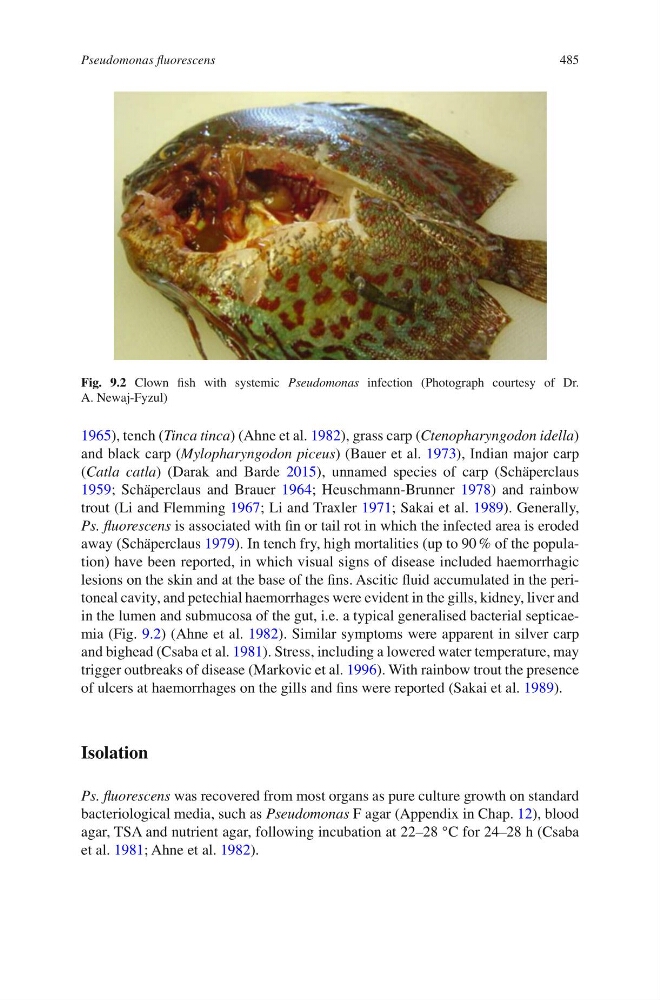
in the lumen and submucosa of the gut, i.e. a typical generalised bacterial septicaemia (Fig. 9.2 ) (Ahne et al. 1982 ). Similar symptoms were apparent in silver carp
and bighead (Csaba et al. 1981 ). Stress, including a lowered water temperature, may
trigger outbreaks of disease (Markovic et al. 1996 ). With rainbow trout the presence
of ulcers at haemorrhages on the gills and fi ns were reported (Sakai et al. 1989 ).
Isolation
Ps. fl uorescens was recovered from most organs as pure culture growth on standard
bacteriological media, such as Pseudomonas F agar (Appendix in Chap. 12 ), blood
agar, TSA and nutrient agar, following incubation at 22–28 °C for 24–28 h (Csaba
et al. 1981 ; Ahne et al. 1982 ).
Fig. 9.2 Clown fi sh with systemic Pseudomonas infection (Photograph courtesy of Dr.
A. Newaj-Fyzul)
Pseudomonas fl uorescens
1965 ), tench ( Tinca tinca ) (Ahne et al. 1982 ), grass carp ( Ctenopharyngodon idella )
and black carp ( Mylopharyngodon piceus ) (Bauer et al. 1973 ), Indian major carp
( Catla catla ) (Darak and Barde 2015 ), unnamed species of carp (Schäperclaus
1959 ; Schäperclaus and Brauer 1964 ; Heuschmann-Brunner 1978 ) and rainbow
trout (Li and Flemming 1967 ; Li and Traxler 1971 ; Sakai et al. 1989 ). Generally,
Ps. fl uorescens is associated with fi n or tail rot in which the infected area is eroded
away (Schäperclaus 1979 ). In tench fry, high mortalities (up to 90 % of the population) have been reported, in which visual signs of disease included haemorrhagic
lesions on the skin and at the base of the fi ns. Ascitic fl uid accumulated in the peritoneal cavity, and petechial haemorrhages were evident in the gills, kidney, liver and
in the lumen and submucosa of the gut, i.e. a typical generalised bacterial septicaemia (Fig. 9.2 ) (Ahne et al. 1982 ). Similar symptoms were apparent in silver carp
and bighead (Csaba et al. 1981 ). Stress, including a lowered water temperature, may
trigger outbreaks of disease (Markovic et al. 1996 ). With rainbow trout the presence
of ulcers at haemorrhages on the gills and fi ns were reported (Sakai et al. 1989 ).
Isolation
Ps. fl uorescens was recovered from most organs as pure culture growth on standard
bacteriological media, such as Pseudomonas F agar (Appendix in Chap. 12 ), blood
agar, TSA and nutrient agar, following incubation at 22–28 °C for 24–28 h (Csaba
et al. 1981 ; Ahne et al. 1982 ).
Fig. 9.2 Clown fi sh with systemic Pseudomonas infection (Photograph courtesy of Dr.
A. Newaj-Fyzul)
Pseudomonas fl uorescens