

487
Disease Control
Antimicrobial Compounds Bath treatments with benzalkonium chloride
(1–2 mg/l of water/1 h), furanace (0.5–1 mg/l of water/5–10 min) or malachite
green (1–5 mg/l of water/1 h) may help control early clinical cases of disease
(Austin 1984 ). In one study, isolates showed susceptibility to kanamycin, nalidixic
acid and tetracycline (Sakai et al. 1989 ). A second investigation reported widespread susceptibility to gentamicin, kanamycin and neomycin, less to amikacin and
oxytetracycline, and total resistance to chloramphenicol, erythromycin, penicillin
and potentiated sulphonamides (Markovic et al. 1996 ).
Pseudomonas koreensis
Ps. koreensis was described as the causal of eye lesions in golden mahseer ( Tor
putitora ) from India. Between March and May, 2012, farmed adult golden mahseer
were observed with opaque eyes, which led to mortalities. The clinical signs
included haemorrhaging in the periphery of the eyes, corneal opacity, and pale livers. Material from the diseased eyes were inoculated onto TSA with incubation at
28 °C for 48 h when dense growth of yellowish-green colonies were observed.
Identifi cation was achieved by phenotyping and by 99 % homology with Ps. koreensis by sequencing of the 16S rRNA gene. Infectivity experiments using 100 μl volumes of 7.6 × 10
6 CFU/ml, which were injected i.p. in golden mahseer fi ngerlings,
resulted in 55 % mortalities within 2-days albeit in the absence of eye pathology
(Shahi and Mallik 2014 ).
Characteristics of the Pathogen
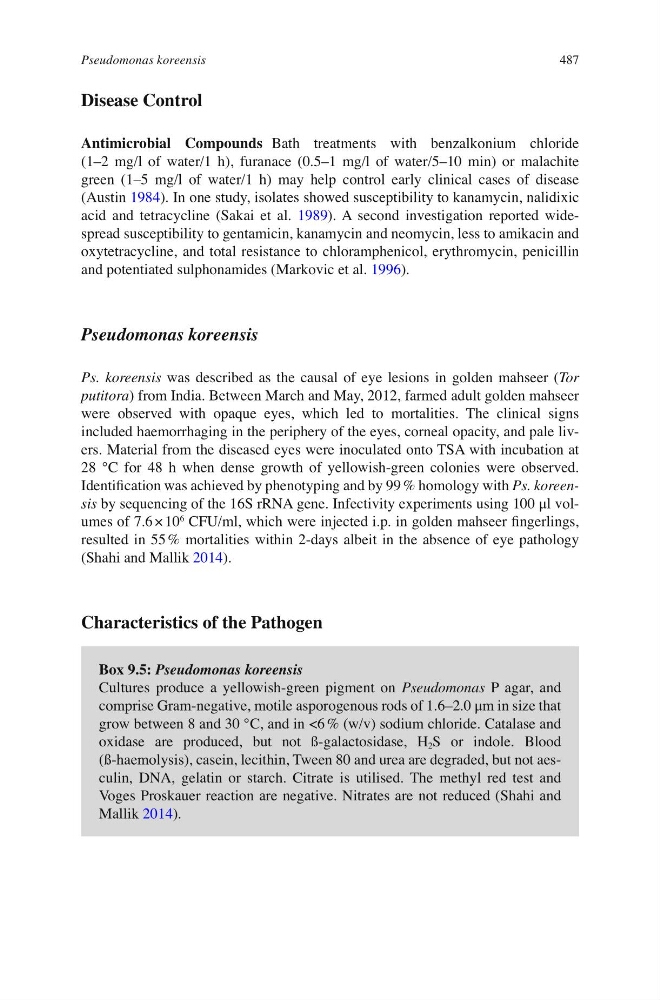
Box 9.5: Pseudomonas koreensis
Cultures produce a yellowish-green pigment on Pseudomonas P agar, and
comprise Gram-negative, motile asporogenous rods of 1.6–2.0 μm in size that
grow between 8 and 30 °C, and in <6 % (w/v) sodium chloride. Catalase and
oxidase are produced, but not ß-galactosidase, H 2 S or indole. Blood
(ß- haemolysis), casein, lecithin, Tween 80 and urea are degraded, but not aesculin, DNA, gelatin or starch. Citrate is utilised. The methyl red test and
Voges Proskauer reaction are negative. Nitrates are not reduced (Shahi and
Mallik 2014 ).
Pseudomonas koreensis
Disease Control
Antimicrobial Compounds Bath treatments with benzalkonium chloride
(1–2 mg/l of water/1 h), furanace (0.5–1 mg/l of water/5–10 min) or malachite
green (1–5 mg/l of water/1 h) may help control early clinical cases of disease
(Austin 1984 ). In one study, isolates showed susceptibility to kanamycin, nalidixic
acid and tetracycline (Sakai et al. 1989 ). A second investigation reported widespread susceptibility to gentamicin, kanamycin and neomycin, less to amikacin and
oxytetracycline, and total resistance to chloramphenicol, erythromycin, penicillin
and potentiated sulphonamides (Markovic et al. 1996 ).
Pseudomonas koreensis
Ps. koreensis was described as the causal of eye lesions in golden mahseer ( Tor
putitora ) from India. Between March and May, 2012, farmed adult golden mahseer
were observed with opaque eyes, which led to mortalities. The clinical signs
included haemorrhaging in the periphery of the eyes, corneal opacity, and pale livers. Material from the diseased eyes were inoculated onto TSA with incubation at
28 °C for 48 h when dense growth of yellowish-green colonies were observed.
Identifi cation was achieved by phenotyping and by 99 % homology with Ps. koreensis by sequencing of the 16S rRNA gene. Infectivity experiments using 100 μl volumes of 7.6 × 10
6 CFU/ml, which were injected i.p. in golden mahseer fi ngerlings,
resulted in 55 % mortalities within 2-days albeit in the absence of eye pathology
(Shahi and Mallik 2014 ).
Characteristics of the Pathogen
Box 9.5: Pseudomonas koreensis
Cultures produce a yellowish-green pigment on Pseudomonas P agar, and
comprise Gram-negative, motile asporogenous rods of 1.6–2.0 μm in size that
grow between 8 and 30 °C, and in <6 % (w/v) sodium chloride. Catalase and
oxidase are produced, but not ß-galactosidase, H 2 S or indole. Blood
(ß- haemolysis), casein, lecithin, Tween 80 and urea are degraded, but not aesculin, DNA, gelatin or starch. Citrate is utilised. The methyl red test and
Voges Proskauer reaction are negative. Nitrates are not reduced (Shahi and
Mallik 2014 ).
Pseudomonas koreensis