

324
Isolation
Pure culture growth was recovered from kidney on rabbit blood agar (Sato et al.
1982 ). Subsequently, similar organisms have been obtained from kidney homogenates spread over the surface of BHIA and TSA with incubation at 25 or 37 °C for
24–48 h.
Characteristics of the Pathogen
From these traits, mostly obtained with the API 20E rapid identifi cation system,
an identifi cation as Cit. freundii was obtained (Sato et al. 1982 ; Baya et al. 1990a ;
Sanz 1991 ). Certainly, these characteristics match the description of Cit. freundii,
except in the inability to utilise citrate (Frederiksen 2005 ).
Epizootiology
The organism is common in eutrophic freshwater, from which spread to fi sh is possible (Allen et al. 1983 ). In addition, the organism was widespread in the seawater
in the Japanese aquarium (Sato et al. 1982 ).
Pathogenicity
The pathogenicity of isolates was not confi rmed in laboratory experiments by Sato
et al. ( 1982 ). Nevertheless, Baya et al. ( 1990a ) and Karunasagar et al. ( 1992 ) demonstrated pathogenicity following i.p. injection of rainbow trout and carp, respectively. Here, the LD 50 was in the range of 10
5 –10
6 cells. Injection of cell-free extracts
did not result in mortalities (Karunasagar et al. 1992 ).
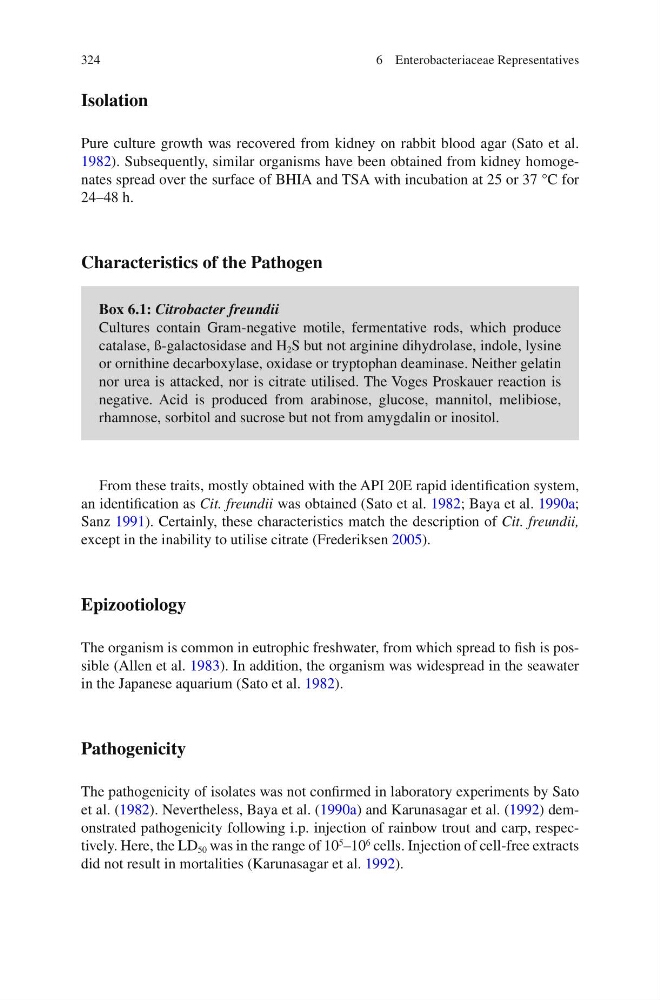
Box 6.1: Citrobacter freundii
Cultures contain Gram-negative motile, fermentative rods, which produce
catalase, ß-galactosidase and H 2 S but not arginine dihydrolase, indole, lysine
or ornithine decarboxylase, oxidase or tryptophan deaminase. Neither gelatin
nor urea is attacked, nor is citrate utilised. The Voges Proskauer reaction is
negative. Acid is produced from arabinose, glucose, mannitol, melibiose,
rhamnose, sorbitol and sucrose but not from amygdalin or inositol.
6 Enterobacteriaceae Representatives
Isolation
Pure culture growth was recovered from kidney on rabbit blood agar (Sato et al.
1982 ). Subsequently, similar organisms have been obtained from kidney homogenates spread over the surface of BHIA and TSA with incubation at 25 or 37 °C for
24–48 h.
Characteristics of the Pathogen
From these traits, mostly obtained with the API 20E rapid identifi cation system,
an identifi cation as Cit. freundii was obtained (Sato et al. 1982 ; Baya et al. 1990a ;
Sanz 1991 ). Certainly, these characteristics match the description of Cit. freundii,
except in the inability to utilise citrate (Frederiksen 2005 ).
Epizootiology
The organism is common in eutrophic freshwater, from which spread to fi sh is possible (Allen et al. 1983 ). In addition, the organism was widespread in the seawater
in the Japanese aquarium (Sato et al. 1982 ).
Pathogenicity
The pathogenicity of isolates was not confi rmed in laboratory experiments by Sato
et al. ( 1982 ). Nevertheless, Baya et al. ( 1990a ) and Karunasagar et al. ( 1992 ) demonstrated pathogenicity following i.p. injection of rainbow trout and carp, respectively. Here, the LD 50 was in the range of 10
5 –10
6 cells. Injection of cell-free extracts
did not result in mortalities (Karunasagar et al. 1992 ).
Box 6.1: Citrobacter freundii
Cultures contain Gram-negative motile, fermentative rods, which produce
catalase, ß-galactosidase and H 2 S but not arginine dihydrolase, indole, lysine
or ornithine decarboxylase, oxidase or tryptophan deaminase. Neither gelatin
nor urea is attacked, nor is citrate utilised. The Voges Proskauer reaction is
negative. Acid is produced from arabinose, glucose, mannitol, melibiose,
rhamnose, sorbitol and sucrose but not from amygdalin or inositol.
6 Enterobacteriaceae Representatives