

199
Diagnosis
Identifi cation has been achieved after examination of 14 isolates by FAME and
AFLP fi ngerprinting, and biochemical profi ling using the API 20E, API 20NE and
PhenePlate system (Rahman et al. 2002).
Pathogenicity
Aer. veronii has been implicated as a potential fi sh pathogen but only in laboratorybased experiments, where intramuscular injection of 10
7 cells/ml resulted in muscle
necrosis in Atlantic salmon (McIntosh and Austin 1990 ). Virulence has been demonstrated in rainbow trout (Orozova et al. 2009 ). Isolates have been reported to
produce adhesins, cytotoxin, enterotoxin, haemagglutination (fi sh, human and rabbit blood) and haemolysin (Rahman et al. 2002; Sreedharan et al. 2011 ; 2013 ). In
this respect, some isolates have been found to have high mucus-binding ability the
relevance of which is that such bacteria employ mucus-binding as a pre-requisite to
colonization and thus invasion of the intestine (Namba et al. 2012 ). These authors
observed Aer. veronii around the intestinal bulb and rectum within 48 h of application to carp, suggesting that these sites are primary to invasion (Namba et al. 2012 ).
Control
A Bacteriovorax isolate has been identifi ed as a potential biological control agent
(Cao et al. 2014a , b ).
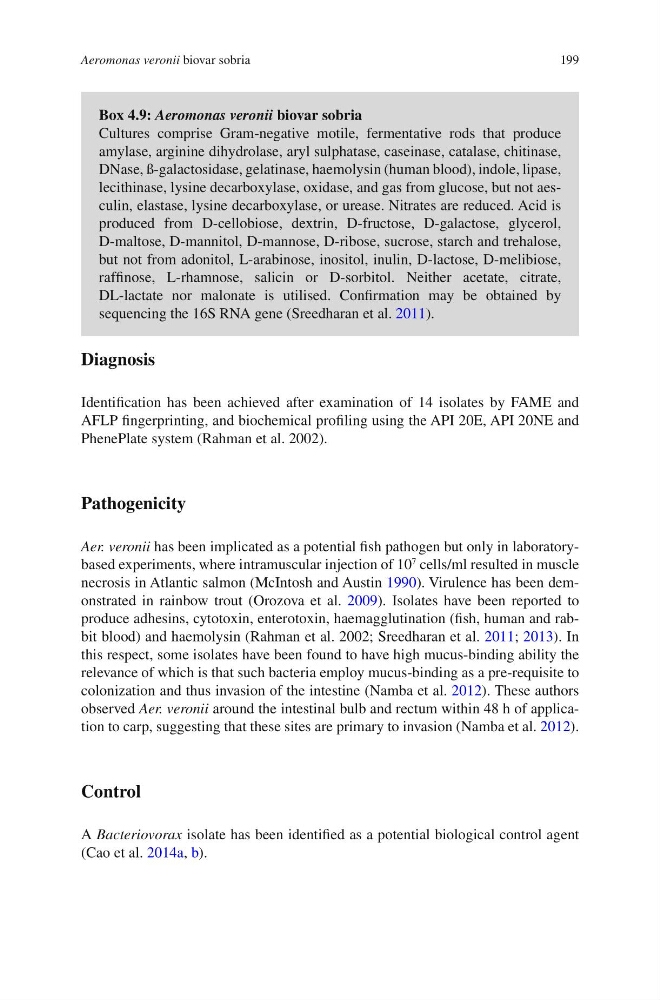
Box 4.9: Aeromonas veronii biovar sobria
Cultures comprise Gram-negative motile, fermentative rods that produce
amylase, arginine dihydrolase, aryl sulphatase, caseinase, catalase, chitinase,
DNase, ß-galactosidase, gelatinase, haemolysin (human blood), indole, lipase,
lecithinase, lysine decarboxylase, oxidase, and gas from glucose, but not aesculin, elastase, lysine decarboxylase, or urease. Nitrates are reduced. Acid is
produced from D-cellobiose, dextrin, D-fructose, D-galactose, glycerol,
D-maltose, D-mannitol, D-mannose, D-ribose, sucrose, starch and trehalose,
but not from adonitol, L-arabinose, inositol, inulin, D-lactose, D-melibiose,
raffi nose, L-rhamnose, salicin or D-sorbitol. Neither acetate, citrate,
DL-lactate nor malonate is utilised. Confi rmation may be obtained by
sequencing the 16S RNA gene (Sreedharan et al. 2011 ).
Aeromonas veronii biovar sobria
Diagnosis
Identifi cation has been achieved after examination of 14 isolates by FAME and
AFLP fi ngerprinting, and biochemical profi ling using the API 20E, API 20NE and
PhenePlate system (Rahman et al. 2002).
Pathogenicity
Aer. veronii has been implicated as a potential fi sh pathogen but only in laboratorybased experiments, where intramuscular injection of 10
7 cells/ml resulted in muscle
necrosis in Atlantic salmon (McIntosh and Austin 1990 ). Virulence has been demonstrated in rainbow trout (Orozova et al. 2009 ). Isolates have been reported to
produce adhesins, cytotoxin, enterotoxin, haemagglutination (fi sh, human and rabbit blood) and haemolysin (Rahman et al. 2002; Sreedharan et al. 2011 ; 2013 ). In
this respect, some isolates have been found to have high mucus-binding ability the
relevance of which is that such bacteria employ mucus-binding as a pre-requisite to
colonization and thus invasion of the intestine (Namba et al. 2012 ). These authors
observed Aer. veronii around the intestinal bulb and rectum within 48 h of application to carp, suggesting that these sites are primary to invasion (Namba et al. 2012 ).
Control
A Bacteriovorax isolate has been identifi ed as a potential biological control agent
(Cao et al. 2014a , b ).
Box 4.9: Aeromonas veronii biovar sobria
Cultures comprise Gram-negative motile, fermentative rods that produce
amylase, arginine dihydrolase, aryl sulphatase, caseinase, catalase, chitinase,
DNase, ß-galactosidase, gelatinase, haemolysin (human blood), indole, lipase,
lecithinase, lysine decarboxylase, oxidase, and gas from glucose, but not aesculin, elastase, lysine decarboxylase, or urease. Nitrates are reduced. Acid is
produced from D-cellobiose, dextrin, D-fructose, D-galactose, glycerol,
D-maltose, D-mannitol, D-mannose, D-ribose, sucrose, starch and trehalose,
but not from adonitol, L-arabinose, inositol, inulin, D-lactose, D-melibiose,
raffi nose, L-rhamnose, salicin or D-sorbitol. Neither acetate, citrate,
DL-lactate nor malonate is utilised. Confi rmation may be obtained by
sequencing the 16S RNA gene (Sreedharan et al. 2011 ).
Aeromonas veronii biovar sobria