

165
Aeromonas caviae
Characteristics of the Disease
In 1991, a septicaemic condition was diagnosed on four Atlantic salmon farms
located on the Black Sea in Turkey (Candan et al. 1995 ). Diseased fi sh displayed
signs of haemorrhagic septicaemia, namely haemorrhages on the body, intestine
fi lled with bloody exudate, enlarged liver and spleen, and liquefying kidney.
Subsequently, the organism has been associated with eye disease and haemorrhagic
septicaemia in farmed rainbow trout from Kenya (Ogara et al. 1998 ). An Aer.
caviae -like organism has been linked to ulcerations in Indian catfi sh ( Clarias batrachus ) (Thomas et al. 2013 ).
Isolation
Diseased tissues were homogenised in 0.1 % (w/v) peptone, before inoculation of
TSA and blood agar with incubation at 22 °C for 48 h (Candan et al. 1995 ).
Characteristics of the Pathogen
Cultures were identifi ed by recourse to the scheme in Popoff ( 1984 ):
Aeromonas dhakensis
Aer. hydrophila subsp. dhakensis was reclassifi ed in Aer. aquariorum (MartinezMurcia et al. 2009 ) and then as Aer. dhakensis (Beaz-Hidalgo et al. 2013 ). The
organism has been recovered from farmed Nile tilapia in Mexico (Soto-Rodriguez
et al. 2013 ).
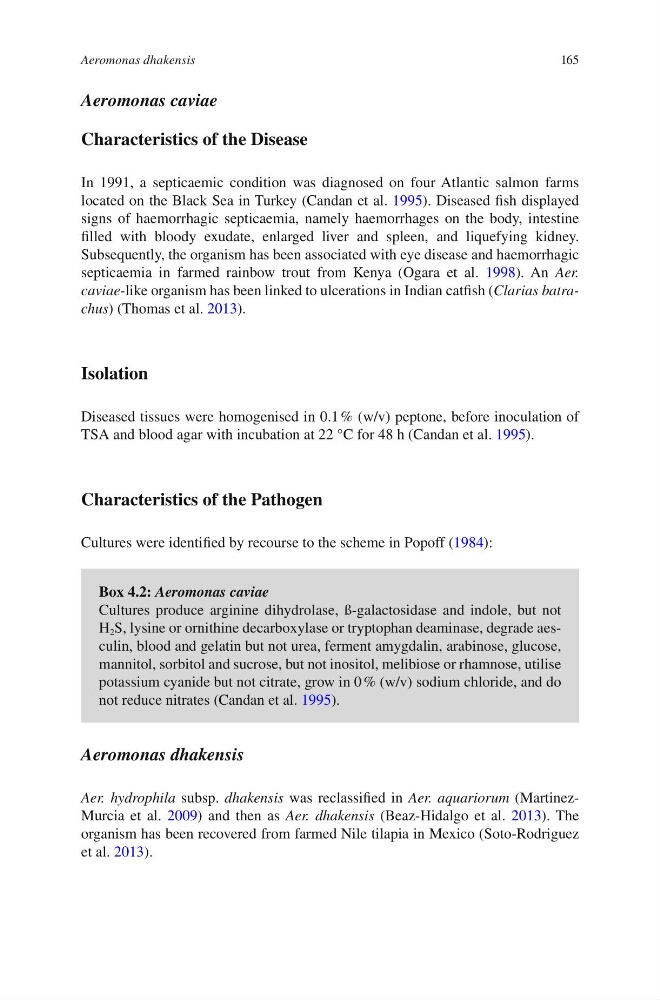
Box 4.2: Aeromonas caviae
Cultures produce arginine dihydrolase, ß-galactosidase and indole, but not
H 2 S, lysine or ornithine decarboxylase or tryptophan deaminase, degrade aesculin, blood and gelatin but not urea, ferment amygdalin, arabinose, glucose,
mannitol, sorbitol and sucrose, but not inositol, melibiose or rhamnose, utilise
potassium cyanide but not citrate, grow in 0 % (w/v) sodium chloride, and do
not reduce nitrates (Candan et al. 1995 ).
Aeromonas dhakensis
Aeromonas caviae
Characteristics of the Disease
In 1991, a septicaemic condition was diagnosed on four Atlantic salmon farms
located on the Black Sea in Turkey (Candan et al. 1995 ). Diseased fi sh displayed
signs of haemorrhagic septicaemia, namely haemorrhages on the body, intestine
fi lled with bloody exudate, enlarged liver and spleen, and liquefying kidney.
Subsequently, the organism has been associated with eye disease and haemorrhagic
septicaemia in farmed rainbow trout from Kenya (Ogara et al. 1998 ). An Aer.
caviae -like organism has been linked to ulcerations in Indian catfi sh ( Clarias batrachus ) (Thomas et al. 2013 ).
Isolation
Diseased tissues were homogenised in 0.1 % (w/v) peptone, before inoculation of
TSA and blood agar with incubation at 22 °C for 48 h (Candan et al. 1995 ).
Characteristics of the Pathogen
Cultures were identifi ed by recourse to the scheme in Popoff ( 1984 ):
Aeromonas dhakensis
Aer. hydrophila subsp. dhakensis was reclassifi ed in Aer. aquariorum (MartinezMurcia et al. 2009 ) and then as Aer. dhakensis (Beaz-Hidalgo et al. 2013 ). The
organism has been recovered from farmed Nile tilapia in Mexico (Soto-Rodriguez
et al. 2013 ).
Box 4.2: Aeromonas caviae
Cultures produce arginine dihydrolase, ß-galactosidase and indole, but not
H 2 S, lysine or ornithine decarboxylase or tryptophan deaminase, degrade aesculin, blood and gelatin but not urea, ferment amygdalin, arabinose, glucose,
mannitol, sorbitol and sucrose, but not inositol, melibiose or rhamnose, utilise
potassium cyanide but not citrate, grow in 0 % (w/v) sodium chloride, and do
not reduce nitrates (Candan et al. 1995 ).
Aeromonas dhakensis