

164
Pathogenicity
It was not concluded that the organisms were indeed pathogenic to fi sh. Yet, the
recovery from diseased elvers suggests a pathogenic role for the organism (MartinezMurcia et al. 1992 ).
Aeromonas bestiarum
Aer. bestiarum appears to be an example of a taxon which emerged from the taxonomic chaos surrounding the understanding of Aer. hydrophila (Ali et al. 1996 ).
Originally, classifi ed in DNA HG 2 (Aer. hydrophila), isolates have apparently been
recovered from diseased fi sh (Huys et al. 1996 ). There is certainly evidence that Aer.
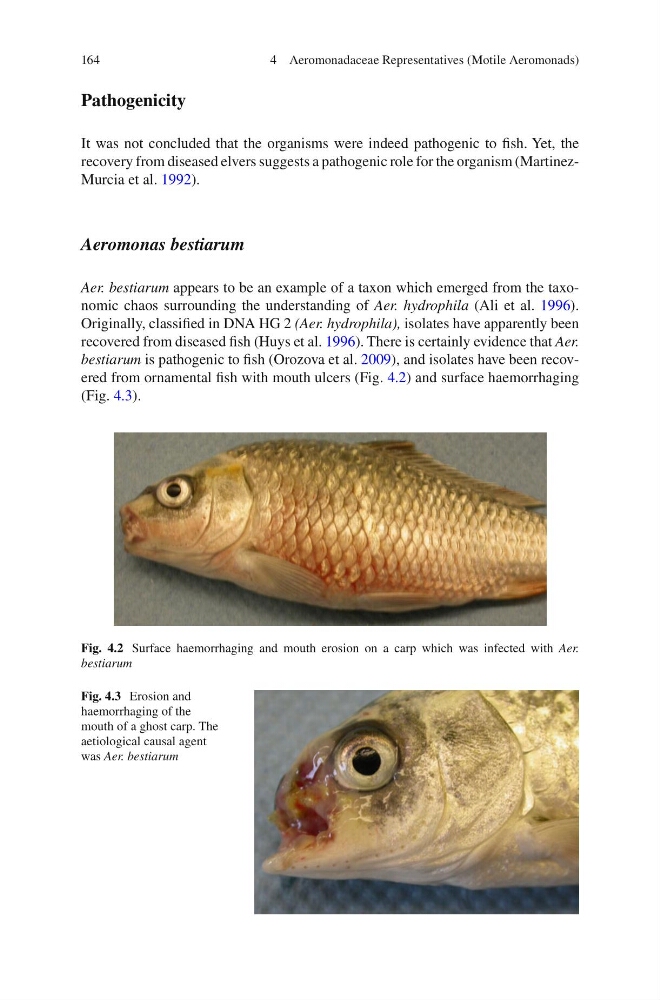
bestiarum is pathogenic to fi sh (Orozova et al. 2009 ), and isolates have been recovered from ornamental fi sh with mouth ulcers (Fig. 4.2 ) and surface haemorrhaging
(Fig. 4.3 ).
Fig. 4.2 Surface haemorrhaging and mouth erosion on a carp which was infected with Aer.
bestiarum
Fig. 4.3 Erosion and
haemorrhaging of the
mouth of a ghost carp. The
aetiological causal agent
was Aer. bestiarum
4 Aeromonadaceae Representatives (Motile Aeromonads)
Pathogenicity
It was not concluded that the organisms were indeed pathogenic to fi sh. Yet, the
recovery from diseased elvers suggests a pathogenic role for the organism (MartinezMurcia et al. 1992 ).
Aeromonas bestiarum
Aer. bestiarum appears to be an example of a taxon which emerged from the taxonomic chaos surrounding the understanding of Aer. hydrophila (Ali et al. 1996 ).
Originally, classifi ed in DNA HG 2 (Aer. hydrophila), isolates have apparently been
recovered from diseased fi sh (Huys et al. 1996 ). There is certainly evidence that Aer.
bestiarum is pathogenic to fi sh (Orozova et al. 2009 ), and isolates have been recovered from ornamental fi sh with mouth ulcers (Fig. 4.2 ) and surface haemorrhaging
(Fig. 4.3 ).
Fig. 4.2 Surface haemorrhaging and mouth erosion on a carp which was infected with Aer.
bestiarum
Fig. 4.3 Erosion and
haemorrhaging of the
mouth of a ghost carp. The
aetiological causal agent
was Aer. bestiarum
4 Aeromonadaceae Representatives (Motile Aeromonads)