

166
Characteristics of the Disease
The organism has been associated with generalized septicaemia (Orozova et al.
2009 ).
Isolation
The pathogen may be recovered using the procedures for Aer. hydrophila, with
growth on TSA at 25 °C for 24–48 h.
Characteristics of the Pathogen
Diagnosis
Cultures may be identifi ed by use of the API 20E rapid identifi cation system – profi le = 7047125 (Esteve et al. 2012 ).
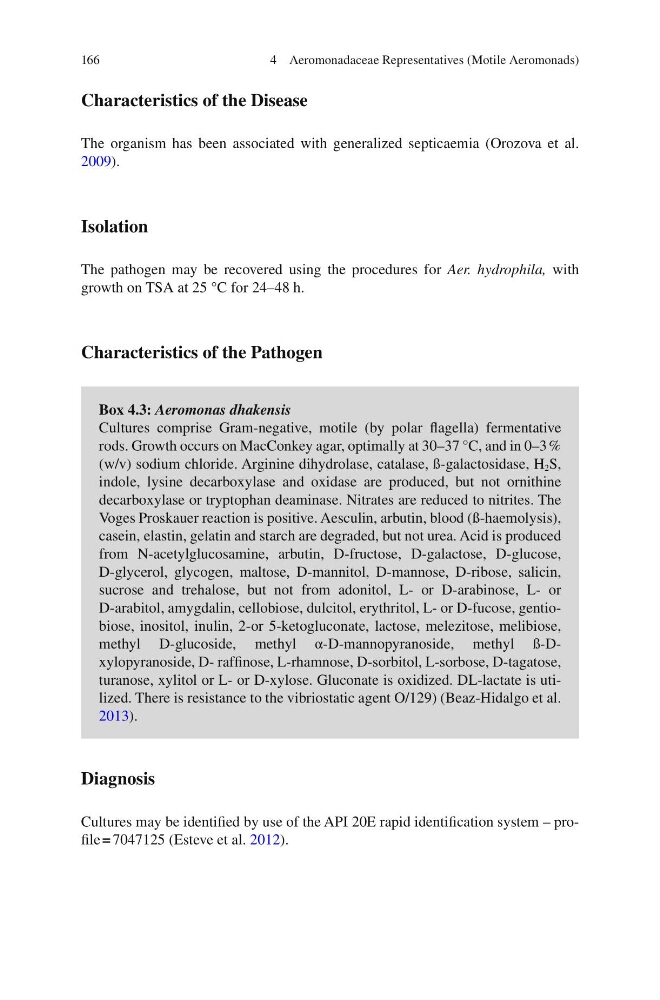
Box 4.3: Aeromonas dhakensis
Cultures comprise Gram-negative, motile (by polar fl agella) fermentative
rods. Growth occurs on MacConkey agar, optimally at 30–37 °C, and in 0–3 %
(w/v) sodium chloride. Arginine dihydrolase, catalase, ß-galactosidase, H 2 S,
indole, lysine decarboxylase and oxidase are produced, but not ornithine
decarboxylase or tryptophan deaminase. Nitrates are reduced to nitrites. The
Voges Proskauer reaction is positive. Aesculin, arbutin, blood (ß-haemolysis),
casein, elastin, gelatin and starch are degraded, but not urea. Acid is produced
from N-acetylglucosamine, arbutin, D-fructose, D-galactose, D-glucose,
D-glycerol, glycogen, maltose, D-mannitol, D-mannose, D-ribose, salicin,
sucrose and trehalose, but not from adonitol, L- or D-arabinose, L- or
D-arabitol, amygdalin, cellobiose, dulcitol, erythritol, L- or D-fucose, gentiobiose, inositol, inulin, 2-or 5-ketogluconate, lactose, melezitose, melibiose,
methyl D-glucoside, methyl α-D-mannopyranoside, methyl ß-Dxylopyranoside, D- raffi nose, L-rhamnose, D-sorbitol, L-sorbose, D-tagatose,
turanose, xylitol or L- or D-xylose. Gluconate is oxidized. DL-lactate is utilized. There is resistance to the vibriostatic agent O/129) (Beaz-Hidalgo et al.
2013 ).
4 Aeromonadaceae Representatives (Motile Aeromonads)
Characteristics of the Disease
The organism has been associated with generalized septicaemia (Orozova et al.
2009 ).
Isolation
The pathogen may be recovered using the procedures for Aer. hydrophila, with
growth on TSA at 25 °C for 24–48 h.
Characteristics of the Pathogen
Diagnosis
Cultures may be identifi ed by use of the API 20E rapid identifi cation system – profi le = 7047125 (Esteve et al. 2012 ).
Box 4.3: Aeromonas dhakensis
Cultures comprise Gram-negative, motile (by polar fl agella) fermentative
rods. Growth occurs on MacConkey agar, optimally at 30–37 °C, and in 0–3 %
(w/v) sodium chloride. Arginine dihydrolase, catalase, ß-galactosidase, H 2 S,
indole, lysine decarboxylase and oxidase are produced, but not ornithine
decarboxylase or tryptophan deaminase. Nitrates are reduced to nitrites. The
Voges Proskauer reaction is positive. Aesculin, arbutin, blood (ß-haemolysis),
casein, elastin, gelatin and starch are degraded, but not urea. Acid is produced
from N-acetylglucosamine, arbutin, D-fructose, D-galactose, D-glucose,
D-glycerol, glycogen, maltose, D-mannitol, D-mannose, D-ribose, salicin,
sucrose and trehalose, but not from adonitol, L- or D-arabinose, L- or
D-arabitol, amygdalin, cellobiose, dulcitol, erythritol, L- or D-fucose, gentiobiose, inositol, inulin, 2-or 5-ketogluconate, lactose, melezitose, melibiose,
methyl D-glucoside, methyl α-D-mannopyranoside, methyl ß-Dxylopyranoside, D- raffi nose, L-rhamnose, D-sorbitol, L-sorbose, D-tagatose,
turanose, xylitol or L- or D-xylose. Gluconate is oxidized. DL-lactate is utilized. There is resistance to the vibriostatic agent O/129) (Beaz-Hidalgo et al.
2013 ).
4 Aeromonadaceae Representatives (Motile Aeromonads)