

115
Mycobacteriaceae Representatives
Mycobacterium spp.
Characteristics of the Disease
The fi rst report of acid-fast bacteria in freshwater fi sh (carp) was published by
Bataillon et al. ( 1897 )). This was followed over a decade later by an observation in
marine fi sh (von Betegh 1910 ). Interest in infections caused by acid-fast bacteria
continued with the isolation of Myc. fortuitum from diseased neon fi sh ( Paracheirodon
innesi) in 1953, although its identifi cation was not reported until 6 years later (Ross
and Brancato 1959 ). To date, mycobacteriosis (a term suggested by Parisot and
Wood 1960 ) has been observed in >150 species of marine and freshwater fi sh
(Nigrelli and Vogel 1963 ). The disease is especially troublesome in some geographical areas, such as striped bass populations in the Chesapeake Bay, USA (Latour
et al. 2012 ).
Mycobacteriosis (fi sh tuberculosis) is a chronic progressive disease, with various
external signs, including emaciation, infl ammation of the skin, exophthalmia (Evely
et al. 2011 ), open lesions and ulceration (e.g. Lansdell et al. 1993 ) and may attack
many fi sh species, including Atlantic menhaden (Stine et al. 2005 ), rockfi sh (Whipps
et al. 2003 ), shortfi n molly (Poort et al. 2006 ), striped bass (Kaattari et al. 2005 ),
turbot (dos Santos et al. 2002 ) and ornamental fi sh (Zanani et al. 2008 ). Internally,
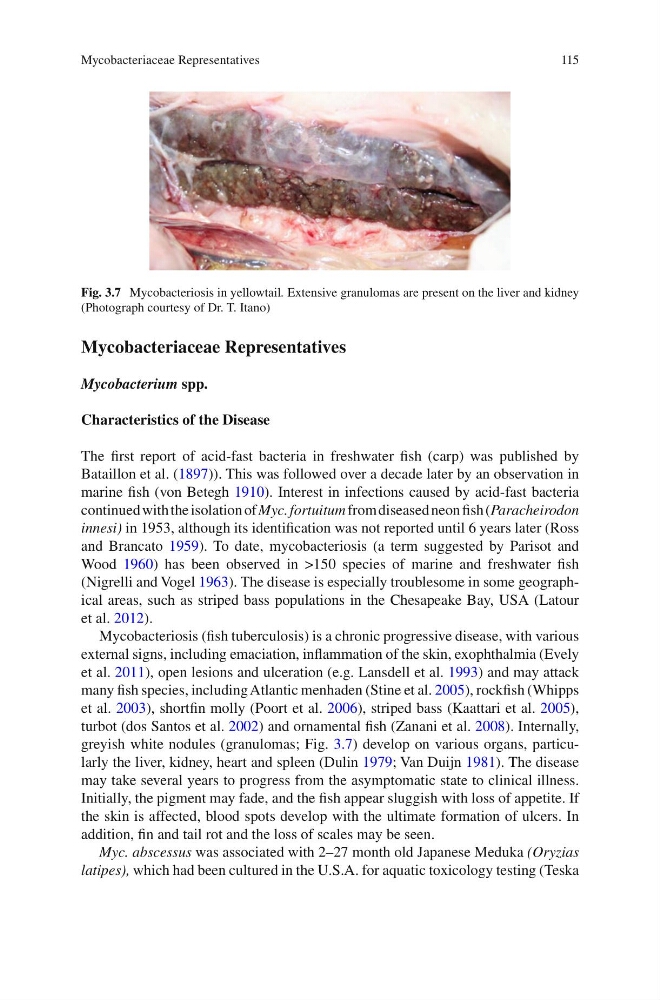
greyish white nodules (granulomas; Fig. 3.7 ) develop on various organs, particularly the liver, kidney, heart and spleen (Dulin 1979 ; Van Duijn 1981 ). The disease
may take several years to progress from the asymptomatic state to clinical illness.
Initially, the pigment may fade, and the fi sh appear sluggish with loss of appetite. If
the skin is affected, blood spots develop with the ultimate formation of ulcers. In
addition, fi n and tail rot and the loss of scales may be seen.
Myc. abscessus was associated with 2–27 month old Japanese Meduka (Oryzias
latipes), which had been cultured in the U.S.A. for aquatic toxicology testing (Teska
Fig. 3.7 Mycobacteriosis in yellowtail . Extensive granulomas are present on the liver and kidney
(Photograph courtesy of Dr. T. Itano)
Mycobacteriaceae Representatives
Mycobacteriaceae Representatives
Mycobacterium spp.
Characteristics of the Disease
The fi rst report of acid-fast bacteria in freshwater fi sh (carp) was published by
Bataillon et al. ( 1897 )). This was followed over a decade later by an observation in
marine fi sh (von Betegh 1910 ). Interest in infections caused by acid-fast bacteria
continued with the isolation of Myc. fortuitum from diseased neon fi sh ( Paracheirodon
innesi) in 1953, although its identifi cation was not reported until 6 years later (Ross
and Brancato 1959 ). To date, mycobacteriosis (a term suggested by Parisot and
Wood 1960 ) has been observed in >150 species of marine and freshwater fi sh
(Nigrelli and Vogel 1963 ). The disease is especially troublesome in some geographical areas, such as striped bass populations in the Chesapeake Bay, USA (Latour
et al. 2012 ).
Mycobacteriosis (fi sh tuberculosis) is a chronic progressive disease, with various
external signs, including emaciation, infl ammation of the skin, exophthalmia (Evely
et al. 2011 ), open lesions and ulceration (e.g. Lansdell et al. 1993 ) and may attack
many fi sh species, including Atlantic menhaden (Stine et al. 2005 ), rockfi sh (Whipps
et al. 2003 ), shortfi n molly (Poort et al. 2006 ), striped bass (Kaattari et al. 2005 ),
turbot (dos Santos et al. 2002 ) and ornamental fi sh (Zanani et al. 2008 ). Internally,
greyish white nodules (granulomas; Fig. 3.7 ) develop on various organs, particularly the liver, kidney, heart and spleen (Dulin 1979 ; Van Duijn 1981 ). The disease
may take several years to progress from the asymptomatic state to clinical illness.
Initially, the pigment may fade, and the fi sh appear sluggish with loss of appetite. If
the skin is affected, blood spots develop with the ultimate formation of ulcers. In
addition, fi n and tail rot and the loss of scales may be seen.
Myc. abscessus was associated with 2–27 month old Japanese Meduka (Oryzias
latipes), which had been cultured in the U.S.A. for aquatic toxicology testing (Teska
Fig. 3.7 Mycobacteriosis in yellowtail . Extensive granulomas are present on the liver and kidney
(Photograph courtesy of Dr. T. Itano)
Mycobacteriaceae Representatives