

114
Characteristics of the Pathogen
Conroy ( 1966 ) described a single outbreak of disease, termed micrococcosis, in
farmed rainbow trout from Argentina. However, the identifi cation of that aetiological agent is uncertain. Nevertheless, during 1990, a “micrococcus” was associated with diseased rainbow trout fry in the U.K. (Austin and Stobie 1992 ). On a
rainbow trout farm, deemed to harbour RTFS, large (~2 μm diameter) Grampositive cocci, displaying a characteristic tetrad arrangement, were recovered from
moribund fi sh.
From these characteristics, it was apparent that the organisms matched the
description of Micrococcus luteus (Kocur 1986 ).
Pathogenicity
Injection of 10
5 cells, via the i.m. and i.p. routes, led to 54 % mortalities in rainbow
trout fry within 14 days (Austin and Stobie 1992 ).
Disease Control
Use of Antimicrobial Compounds Sensitivity was recorded to chloramphenicol,
streptomycin, potentiated sulphonamides and tetracycline. These compounds may
be useful at controlling the progress of infections in rainbow trout fry (Austin and
Stobie 1992 ).
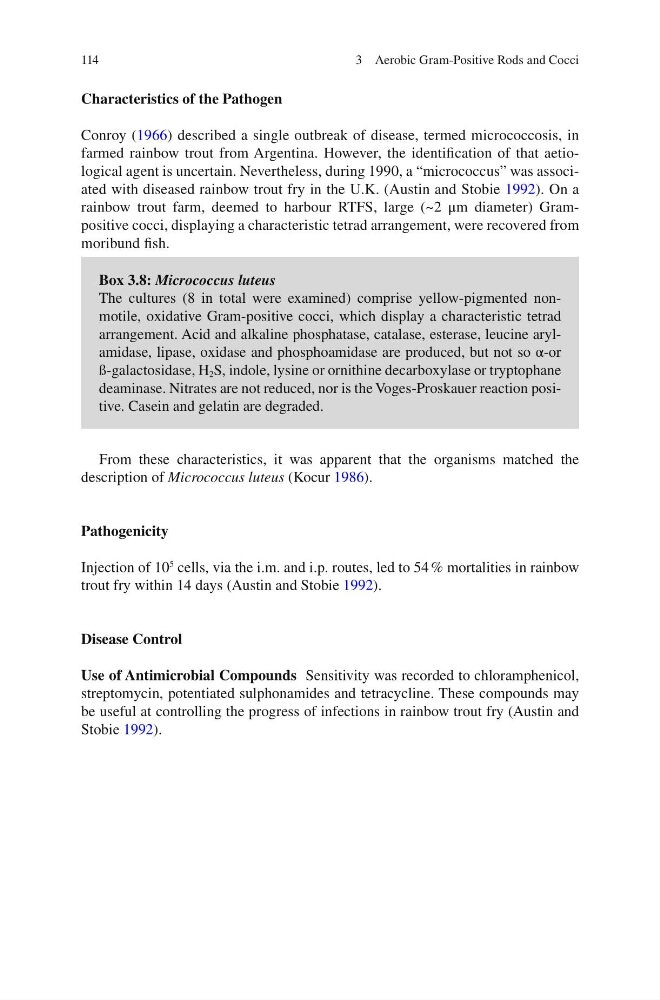
Box 3.8: Micrococcus luteus
The cultures (8 in total were examined) comprise yellow-pigmented nonmotile, oxidative Gram-positive cocci, which display a characteristic tetrad
arrangement. Acid and alkaline phosphatase, catalase, esterase, leucine arylamidase, lipase, oxidase and phosphoamidase are produced, but not so α-or
ß-galactosidase, H 2 S, indole, lysine or ornithine decarboxylase or tryptophane
deaminase. Nitrates are not reduced, nor is the Voges-Proskauer reaction positive. Casein and gelatin are degraded.
3 Aerobic Gram-Positive Rods and Cocci
Characteristics of the Pathogen
Conroy ( 1966 ) described a single outbreak of disease, termed micrococcosis, in
farmed rainbow trout from Argentina. However, the identifi cation of that aetiological agent is uncertain. Nevertheless, during 1990, a “micrococcus” was associated with diseased rainbow trout fry in the U.K. (Austin and Stobie 1992 ). On a
rainbow trout farm, deemed to harbour RTFS, large (~2 μm diameter) Grampositive cocci, displaying a characteristic tetrad arrangement, were recovered from
moribund fi sh.
From these characteristics, it was apparent that the organisms matched the
description of Micrococcus luteus (Kocur 1986 ).
Pathogenicity
Injection of 10
5 cells, via the i.m. and i.p. routes, led to 54 % mortalities in rainbow
trout fry within 14 days (Austin and Stobie 1992 ).
Disease Control
Use of Antimicrobial Compounds Sensitivity was recorded to chloramphenicol,
streptomycin, potentiated sulphonamides and tetracycline. These compounds may
be useful at controlling the progress of infections in rainbow trout fry (Austin and
Stobie 1992 ).
Box 3.8: Micrococcus luteus
The cultures (8 in total were examined) comprise yellow-pigmented nonmotile, oxidative Gram-positive cocci, which display a characteristic tetrad
arrangement. Acid and alkaline phosphatase, catalase, esterase, leucine arylamidase, lipase, oxidase and phosphoamidase are produced, but not so α-or
ß-galactosidase, H 2 S, indole, lysine or ornithine decarboxylase or tryptophane
deaminase. Nitrates are not reduced, nor is the Voges-Proskauer reaction positive. Casein and gelatin are degraded.
3 Aerobic Gram-Positive Rods and Cocci