

generally veneered by coralline algae, but deeper pockets
enable corals to persist. Where there is sufficient water
over the reef top for them to establish, massive corals,
particularly of the genus Porites, are often limited in
their upward growth by exposure during low tide and
adopt a microatoll growth form. These microatolls
(Microatoll) can grow laterally in some cases to several
meters diameter. There is also often the distinctive blue
octocoral Heliopora in this setting. The elevation of the
reef flat is critical in determining whether there is suitable
substrate for coral to establish, and, as will be discussed
below, slight changes of sea level can alter the nature of
the habitat on the reef flat. In many cases the reef flat
can be interpreted to have formed under a slightly higher
sea level, and the gradual fall of sea level over recent
millennia has resulted in substrates on which coral previously grew, now being emergent at low tides and no longer
suitable for modern corals to colonize. Aerial reconnaissance often reveals a backreef zone that appears aligned,
with linear reef-crest normal stripes extending into the
lagoon. Whereas this aligned coral zone (Boulder Zone/
Ramparts) suggests a response by corals to the directions
of flow across the reef, such patterning is rarely apparent
when actually on the reef flat.
In a number of cases, evidence of a higher former sea
level can be seen, such as fossil corals in their growth position (including microatolls that grew at an elevation at
which they can no longer grow). On a few atolls mushroom shaped rocks indicate that such a higher surface is
being actively undercut (e.g., Mopelia Atoll in the Society
Islands), although in a few cases in the Tuamotus these
older remnants, termed feo, are Pleistocene in age. On
a few atolls there is also a fossil algal ridge stranded
several hundred meters inshore of the modern algal rim.
Fossil algal rims of late Holocene age have been dated
on Suwarrow Atoll in the Cook Islands (Woodroffe
et al., 1990a) and Nukutipipi Atoll in the Tuamotus (Salvat
and Salvat, 1992).
Reef islands develop on many of the reef rims of atolls.
The details of these islands are examined below, but one of
the most significant features is the degree of continuity
along the reef. Where there are no islands, the reef flat
extends from reef crest to lagoon. Major passages into the
lagoon are significant because they enable significant
water exchange between ocean and lagoon; they also interrupt the chain of islands along the rim. The Polynesian term
for large and deep passages is ava. Smaller and shallower
passages between islands are called hoa (Figure 5).
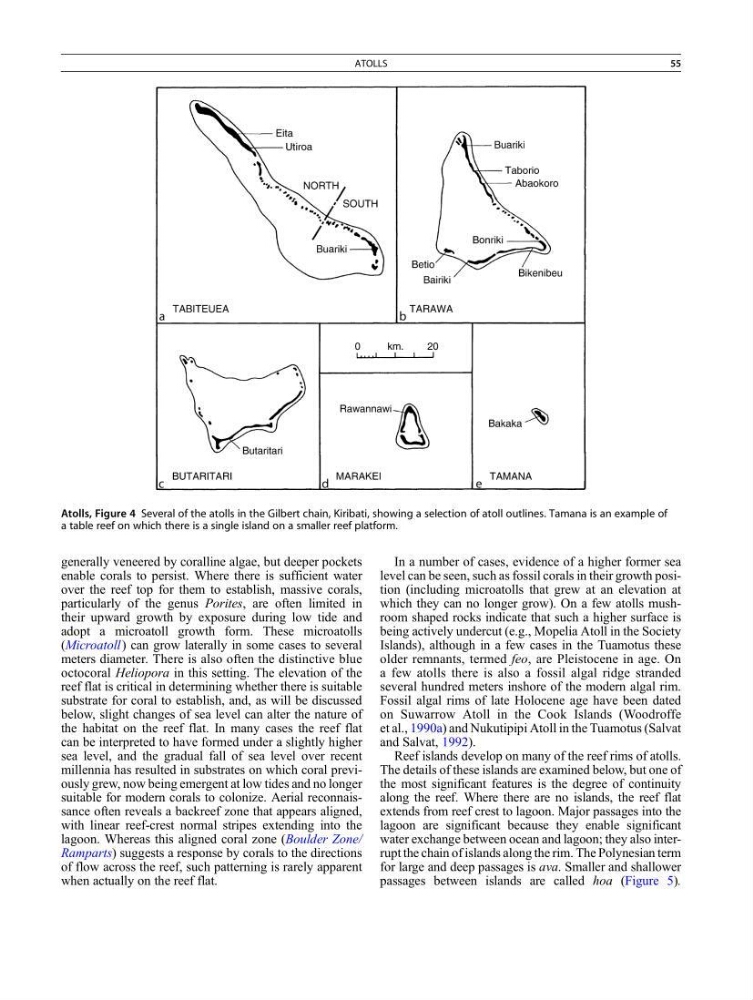
Atolls, Figure 4 Several of the atolls in the Gilbert chain, Kiribati, showing a selection of atoll outlines. Tamana is an example of
a table reef on which there is a single island on a smaller reef platform.
ATOLLS
55
enable corals to persist. Where there is sufficient water
over the reef top for them to establish, massive corals,
particularly of the genus Porites, are often limited in
their upward growth by exposure during low tide and
adopt a microatoll growth form. These microatolls
(Microatoll) can grow laterally in some cases to several
meters diameter. There is also often the distinctive blue
octocoral Heliopora in this setting. The elevation of the
reef flat is critical in determining whether there is suitable
substrate for coral to establish, and, as will be discussed
below, slight changes of sea level can alter the nature of
the habitat on the reef flat. In many cases the reef flat
can be interpreted to have formed under a slightly higher
sea level, and the gradual fall of sea level over recent
millennia has resulted in substrates on which coral previously grew, now being emergent at low tides and no longer
suitable for modern corals to colonize. Aerial reconnaissance often reveals a backreef zone that appears aligned,
with linear reef-crest normal stripes extending into the
lagoon. Whereas this aligned coral zone (Boulder Zone/
Ramparts) suggests a response by corals to the directions
of flow across the reef, such patterning is rarely apparent
when actually on the reef flat.
In a number of cases, evidence of a higher former sea
level can be seen, such as fossil corals in their growth position (including microatolls that grew at an elevation at
which they can no longer grow). On a few atolls mushroom shaped rocks indicate that such a higher surface is
being actively undercut (e.g., Mopelia Atoll in the Society
Islands), although in a few cases in the Tuamotus these
older remnants, termed feo, are Pleistocene in age. On
a few atolls there is also a fossil algal ridge stranded
several hundred meters inshore of the modern algal rim.
Fossil algal rims of late Holocene age have been dated
on Suwarrow Atoll in the Cook Islands (Woodroffe
et al., 1990a) and Nukutipipi Atoll in the Tuamotus (Salvat
and Salvat, 1992).
Reef islands develop on many of the reef rims of atolls.
The details of these islands are examined below, but one of
the most significant features is the degree of continuity
along the reef. Where there are no islands, the reef flat
extends from reef crest to lagoon. Major passages into the
lagoon are significant because they enable significant
water exchange between ocean and lagoon; they also interrupt the chain of islands along the rim. The Polynesian term
for large and deep passages is ava. Smaller and shallower
passages between islands are called hoa (Figure 5).
Atolls, Figure 4 Several of the atolls in the Gilbert chain, Kiribati, showing a selection of atoll outlines. Tamana is an example of
a table reef on which there is a single island on a smaller reef platform.
ATOLLS
55