

of the larger atolls, such as Tabiteuea and Tarawa have
a much better developed eastern windward margin (see
Figure 4).
The reef front is steep and rises abruptly from the ocean
floor, often from as deep as 4,000 m. Although there is a rain
of sediment sourced from the living reefs that cascades
down the forereef, many atolls margins are characterized
by a steep drop-off which exceeds the angle of repose, indicating that the reef has been built by vertical accretion. Much
of the forereef of Mururoa (Mururoa Atoll), below 10 m
water depth, is at an angle of 45
(Chevalier et al., 1969).
The reef front often has one or more distinct terraces;
for example at 15–20 m depth on the reef front of Marshall
Island atolls (Emery et al., 1954). The shallow reef front
commonly has a prominent spur and groove (Spurs and
Grooves) morphology (Munk and Sargent, 1954). This
consists of broad ridges, covered by coral or coralline
algae, which run at right angles to the reef margin, oriented
into the dominant wave direction. The ridges are
interpreted as constructional, interspersed with sand-filled
channels that may be erosional. Spur and groove are best
developed on high-energy reef fronts and merge into surge
channels at the reef crest (see Reef Front Wave Energy).
The reef crest is generally dominated on the windward
side of the atoll by a prominent crest, veneered by pink
algae (Porolithon or Lithothamnion) forming an algal
rim (Algal Rims) on higher-energy trade-wind dominated
windward reef crests. Waves break on all sides of an atoll,
if the reef reaches sea level, but the largest breakers are on
the margin that faces the swell direction.
Reef rim
The reef rim can be of variable width and contains islands
in some instances, or can be a broad reef flat in others.
Typically, the reef flat (Reef Flats) is between 100 and
1,000 m wide; many of the north Pacific atolls have an
average width of about 500 m (Wiens, 1962). The reef
flat is shallow, or commonly much of it may be exposed
during lowest tide. In other settings, distinct zones can
be discriminated across the upper surface. The algal rim,
over which coralline algae are dominant, often merges into
a backreef zone that has detrital material on its surface. In
the higher energy setting, this is a discontinuous scatter of
boulders of dead and detached corals, or fragments of reef
limestone. In less exposed sites, such as lower energy
atolls rims or the leeward margin of otherwise high-energy
atolls, the fragments are smaller and less frequent. Corals
thrive in pools of water that remain deep enough over
a tidal cycle, and the reef crest and immediate backreef
are some of the most productive settings. Turf algae can
be abundant and benthic foraminifera are epiphytic on
these algae or under loose boulders and within crevices
on the reef (Collen and Garton, 2004).
The reef flat that forms on Pacific and Indian Ocean
atolls is usually broad and flat. On some atolls a slightly
deeper channel may occur behind the boulder zone, usually with thickets of branching Acropora and Monitpora
corals, and this has been called the boat channel (Boat
Channel) as it is adopted as the preferred route to navigate
a small boat along the reef rim. If the reef flat is at an elevation that it is exposed during low tide, then the surface is
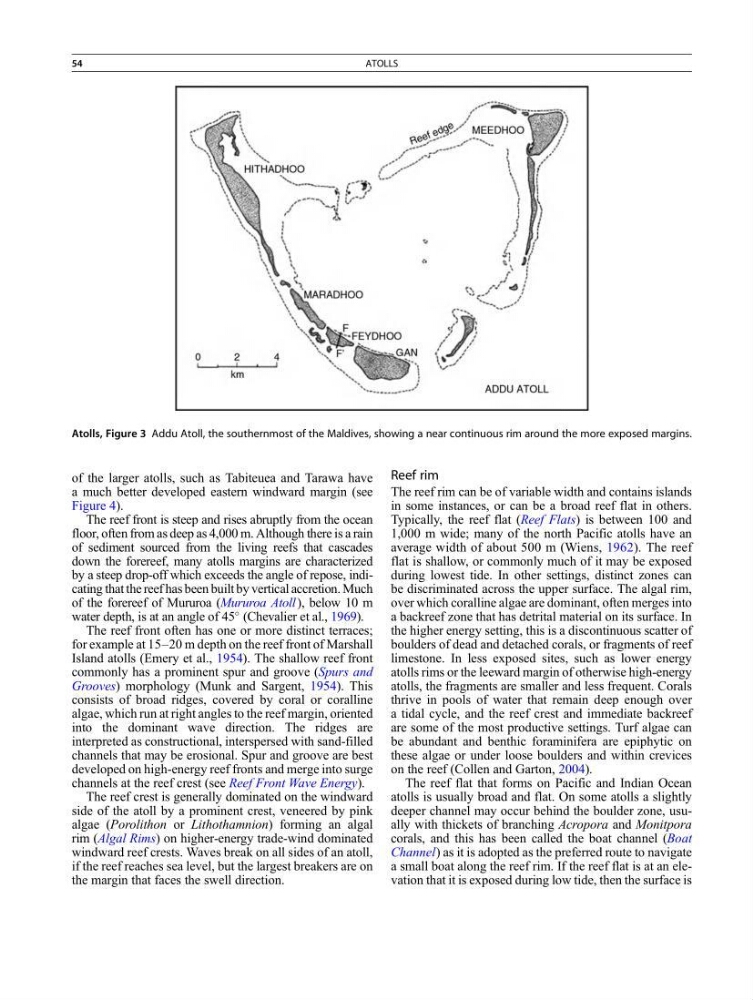
Atolls, Figure 3 Addu Atoll, the southernmost of the Maldives, showing a near continuous rim around the more exposed margins.
54
ATOLLS
a much better developed eastern windward margin (see
Figure 4).
The reef front is steep and rises abruptly from the ocean
floor, often from as deep as 4,000 m. Although there is a rain
of sediment sourced from the living reefs that cascades
down the forereef, many atolls margins are characterized
by a steep drop-off which exceeds the angle of repose, indicating that the reef has been built by vertical accretion. Much
of the forereef of Mururoa (Mururoa Atoll), below 10 m
water depth, is at an angle of 45
(Chevalier et al., 1969).
The reef front often has one or more distinct terraces;
for example at 15–20 m depth on the reef front of Marshall
Island atolls (Emery et al., 1954). The shallow reef front
commonly has a prominent spur and groove (Spurs and
Grooves) morphology (Munk and Sargent, 1954). This
consists of broad ridges, covered by coral or coralline
algae, which run at right angles to the reef margin, oriented
into the dominant wave direction. The ridges are
interpreted as constructional, interspersed with sand-filled
channels that may be erosional. Spur and groove are best
developed on high-energy reef fronts and merge into surge
channels at the reef crest (see Reef Front Wave Energy).
The reef crest is generally dominated on the windward
side of the atoll by a prominent crest, veneered by pink
algae (Porolithon or Lithothamnion) forming an algal
rim (Algal Rims) on higher-energy trade-wind dominated
windward reef crests. Waves break on all sides of an atoll,
if the reef reaches sea level, but the largest breakers are on
the margin that faces the swell direction.
Reef rim
The reef rim can be of variable width and contains islands
in some instances, or can be a broad reef flat in others.
Typically, the reef flat (Reef Flats) is between 100 and
1,000 m wide; many of the north Pacific atolls have an
average width of about 500 m (Wiens, 1962). The reef
flat is shallow, or commonly much of it may be exposed
during lowest tide. In other settings, distinct zones can
be discriminated across the upper surface. The algal rim,
over which coralline algae are dominant, often merges into
a backreef zone that has detrital material on its surface. In
the higher energy setting, this is a discontinuous scatter of
boulders of dead and detached corals, or fragments of reef
limestone. In less exposed sites, such as lower energy
atolls rims or the leeward margin of otherwise high-energy
atolls, the fragments are smaller and less frequent. Corals
thrive in pools of water that remain deep enough over
a tidal cycle, and the reef crest and immediate backreef
are some of the most productive settings. Turf algae can
be abundant and benthic foraminifera are epiphytic on
these algae or under loose boulders and within crevices
on the reef (Collen and Garton, 2004).
The reef flat that forms on Pacific and Indian Ocean
atolls is usually broad and flat. On some atolls a slightly
deeper channel may occur behind the boulder zone, usually with thickets of branching Acropora and Monitpora
corals, and this has been called the boat channel (Boat
Channel) as it is adopted as the preferred route to navigate
a small boat along the reef rim. If the reef flat is at an elevation that it is exposed during low tide, then the surface is
Atolls, Figure 3 Addu Atoll, the southernmost of the Maldives, showing a near continuous rim around the more exposed margins.
54
ATOLLS