

Although shelf atolls are also found elsewhere, such as off
the northern coast of Australia (e.g., Rowley Shoals and
Seringapatam Atoll on Timor Shelf, see Western
Australian Reefs), slope atolls have rarely been described.
A further variant of an atoll is a reef called an almost
atoll. This term has been used differently by different
authors; sometimes it has been used to refer to a rapidly
subsiding volcanic island that did not form an atoll. However, it is generally taken, in the sense used by Davis
(1928), to refer to a residual volcanic island that is
surrounded by an annular reef, and which will be an atoll
when the remaining volcanic rock has subsided below
the level of the sea. Chuuk (Truk) is a classic example,
but Aitutaki is an almost atoll in the southern Cook Islands,
which has been described in detail by Stoddart (1975).
There has also been recognition of a class of bank atolls,
sometimes referred to as submerged atolls, that includes
banks on which reef growth does not reach sea level. There
are examples in Palau and the Caroline Islands, and Saya de
Malha in the Indian Ocean. A further category comprises
atolls that are “raised” or emergent, in which older limestones are exposed. Reef limestones of last interglacial
age have been found to underlie the rim of atolls at depths
of 10–20 m (described below), and on several atolls these
outcrop at the surface, or as in the case of Aldabra and
Henderson Island, are the dominant subaerial limestone
(Braithwaite et al., 1973; Pandolfi, 2008). Elevated atolls
include Maré, Lifou and Ouvea in Vanuatu, Makatea in
French Polynesia, Nauru, and Niue. Older limestones
record successive periods of accretion, and many of these
limestones are dolomitized or contain phosphate deposits
that have often been mined. Mataiva in the Tuamotu
Archipelago also has exposures of Tertiary limestone.
Surface morphology
The general topography and geomorphology of atolls was
outlined in a book by Wiens, entitled Atoll Environment
and Ecology, based on detailed studies sponsored by
the Pacific Science Board and focused on the Marshall
Islands, as well as selected other Pacific atolls (Wiens,
1962). In this account, and in a major review by Stoddart
(1969), three features are distinguished: the outer reef,
the reef rim, and the lagoon. These are considered below.
Outer reef
The outer reef of an atoll is near continuous and is generally subject to ocean swell that breaks on all sides
(Figure 3). The windward rim of the atoll is generally
more continuous than the leeward; for example, the major
passages through the reef and into the lagoon are more
often on the leeward side of the atoll, as seen in the
Tuamotu Archipelago (Guilcher, 1988). In many cases,
reef islands are more abundant on the windward reef than
on the leeward. In the case of many of the atolls in Kiribati,
the leeward margin does not reach sea level, and many
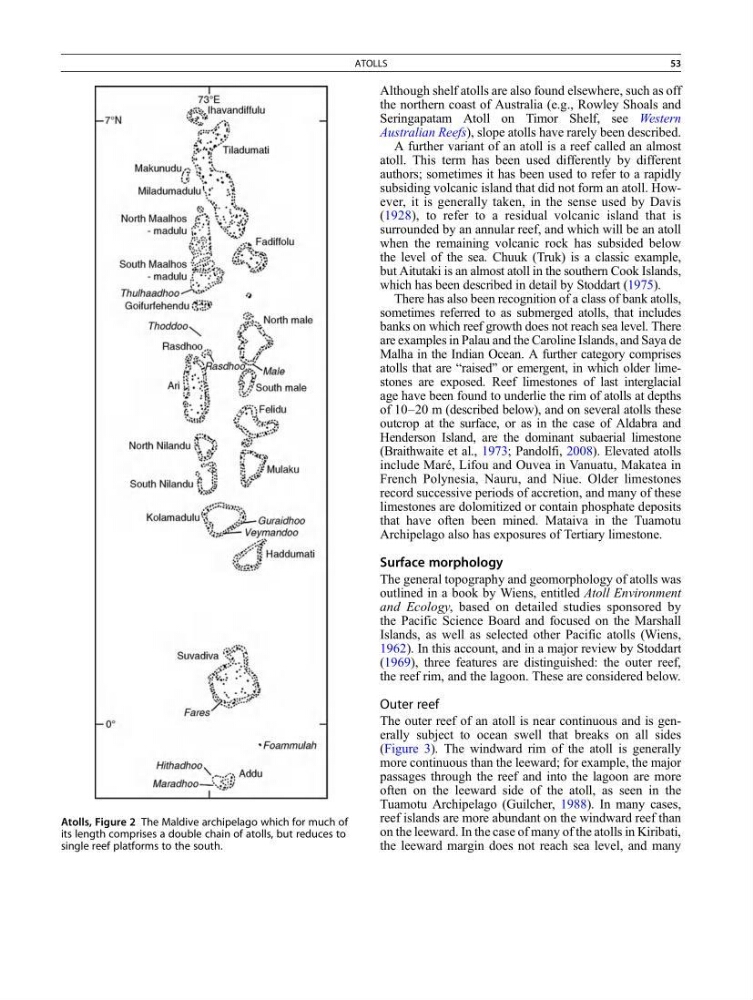
Atolls, Figure 2 The Maldive archipelago which for much of
its length comprises a double chain of atolls, but reduces to
single reef platforms to the south.
ATOLLS
53
the northern coast of Australia (e.g., Rowley Shoals and
Seringapatam Atoll on Timor Shelf, see Western
Australian Reefs), slope atolls have rarely been described.
A further variant of an atoll is a reef called an almost
atoll. This term has been used differently by different
authors; sometimes it has been used to refer to a rapidly
subsiding volcanic island that did not form an atoll. However, it is generally taken, in the sense used by Davis
(1928), to refer to a residual volcanic island that is
surrounded by an annular reef, and which will be an atoll
when the remaining volcanic rock has subsided below
the level of the sea. Chuuk (Truk) is a classic example,
but Aitutaki is an almost atoll in the southern Cook Islands,
which has been described in detail by Stoddart (1975).
There has also been recognition of a class of bank atolls,
sometimes referred to as submerged atolls, that includes
banks on which reef growth does not reach sea level. There
are examples in Palau and the Caroline Islands, and Saya de
Malha in the Indian Ocean. A further category comprises
atolls that are “raised” or emergent, in which older limestones are exposed. Reef limestones of last interglacial
age have been found to underlie the rim of atolls at depths
of 10–20 m (described below), and on several atolls these
outcrop at the surface, or as in the case of Aldabra and
Henderson Island, are the dominant subaerial limestone
(Braithwaite et al., 1973; Pandolfi, 2008). Elevated atolls
include Maré, Lifou and Ouvea in Vanuatu, Makatea in
French Polynesia, Nauru, and Niue. Older limestones
record successive periods of accretion, and many of these
limestones are dolomitized or contain phosphate deposits
that have often been mined. Mataiva in the Tuamotu
Archipelago also has exposures of Tertiary limestone.
Surface morphology
The general topography and geomorphology of atolls was
outlined in a book by Wiens, entitled Atoll Environment
and Ecology, based on detailed studies sponsored by
the Pacific Science Board and focused on the Marshall
Islands, as well as selected other Pacific atolls (Wiens,
1962). In this account, and in a major review by Stoddart
(1969), three features are distinguished: the outer reef,
the reef rim, and the lagoon. These are considered below.
Outer reef
The outer reef of an atoll is near continuous and is generally subject to ocean swell that breaks on all sides
(Figure 3). The windward rim of the atoll is generally
more continuous than the leeward; for example, the major
passages through the reef and into the lagoon are more
often on the leeward side of the atoll, as seen in the
Tuamotu Archipelago (Guilcher, 1988). In many cases,
reef islands are more abundant on the windward reef than
on the leeward. In the case of many of the atolls in Kiribati,
the leeward margin does not reach sea level, and many
Atolls, Figure 2 The Maldive archipelago which for much of
its length comprises a double chain of atolls, but reduces to
single reef platforms to the south.
ATOLLS
53