

Although most atolls have a lagoon, sheltered from
open ocean swell by the peripheral reef, there are also
numerous small platforms, which instead of a lagoon,
may be dominated by a single island in the middle of these
smaller platforms. These are generally called table reefs,
following Tayama (1952), and on those where an extensive reef-top island has formed there is often a swampy
central depression.
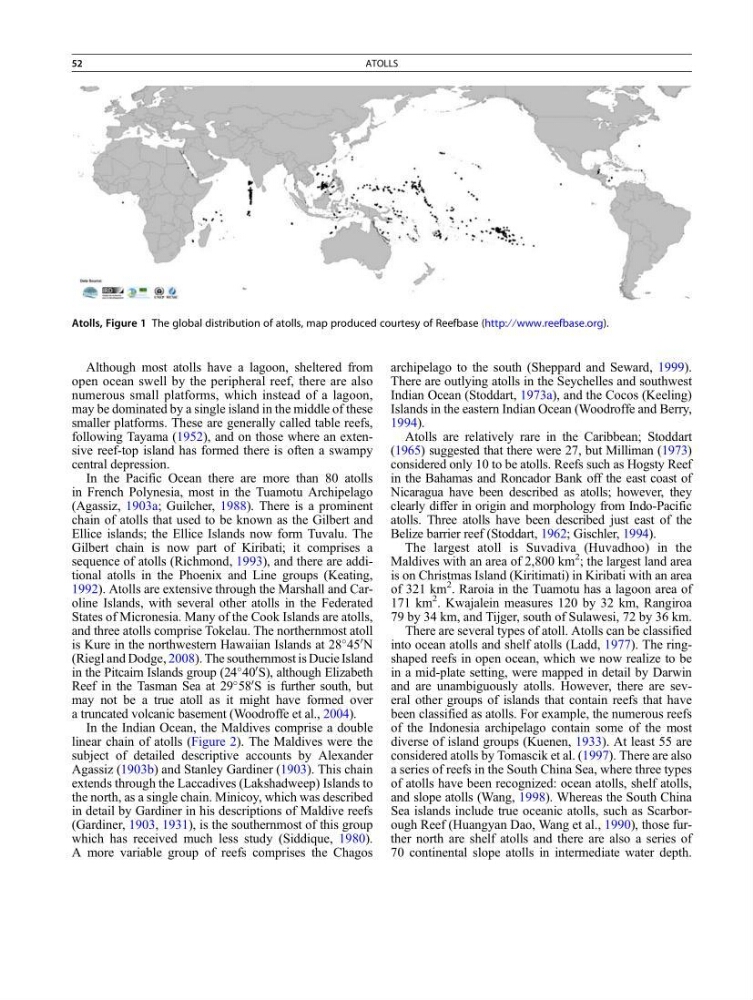
In the Pacific Ocean there are more than 80 atolls
in French Polynesia, most in the Tuamotu Archipelago
(Agassiz, 1903a; Guilcher, 1988). There is a prominent
chain of atolls that used to be known as the Gilbert and
Ellice islands; the Ellice Islands now form Tuvalu. The
Gilbert chain is now part of Kiribati; it comprises a
sequence of atolls (Richmond, 1993), and there are additional atolls in the Phoenix and Line groups (Keating,
1992). Atolls are extensive through the Marshall and Caroline Islands, with several other atolls in the Federated
States of Micronesia. Many of the Cook Islands are atolls,
and three atolls comprise Tokelau. The northernmost atoll
is Kure in the northwestern Hawaiian Islands at 28
45
0 N
(Riegl and Dodge, 2008). The southernmost is Ducie Island
in the Pitcairn Islands group (24
40
0 S), although Elizabeth
Reef in the Tasman Sea at 29
58
0 S is further south, but
may not be a true atoll as it might have formed over
a truncated volcanic basement (Woodroffe et al., 2004).
In the Indian Ocean, the Maldives comprise a double
linear chain of atolls (Figure 2). The Maldives were the
subject of detailed descriptive accounts by Alexander
Agassiz (1903b) and Stanley Gardiner (1903). This chain
extends through the Laccadives (Lakshadweep) Islands to
the north, as a single chain. Minicoy, which was described
in detail by Gardiner in his descriptions of Maldive reefs
(Gardiner, 1903, 1931), is the southernmost of this group
which has received much less study (Siddique, 1980).
A more variable group of reefs comprises the Chagos
archipelago to the south (Sheppard and Seward, 1999).
There are outlying atolls in the Seychelles and southwest
Indian Ocean (Stoddart, 1973a), and the Cocos (Keeling)
Islands in the eastern Indian Ocean (Woodroffe and Berry,
1994).
Atolls are relatively rare in the Caribbean; Stoddart
(1965) suggested that there were 27, but Milliman (1973)
considered only 10 to be atolls. Reefs such as Hogsty Reef
in the Bahamas and Roncador Bank off the east coast of
Nicaragua have been described as atolls; however, they
clearly differ in origin and morphology from Indo-Pacific
atolls. Three atolls have been described just east of the
Belize barrier reef (Stoddart, 1962; Gischler, 1994).
The largest atoll is Suvadiva (Huvadhoo) in the
Maldives with an area of 2,800 km
2
; the largest land area
is on Christmas Island (Kiritimati) in Kiribati with an area
of 321 km
2
. Raroia in the Tuamotu has a lagoon area of
171 km
2
. Kwajalein measures 120 by 32 km, Rangiroa
79 by 34 km, and Tijger, south of Sulawesi, 72 by 36 km.
There are several types of atoll. Atolls can be classified
into ocean atolls and shelf atolls (Ladd, 1977). The ringshaped reefs in open ocean, which we now realize to be
in a mid-plate setting, were mapped in detail by Darwin
and are unambiguously atolls. However, there are several other groups of islands that contain reefs that have
been classified as atolls. For example, the numerous reefs
of the Indonesia archipelago contain some of the most
diverse of island groups (Kuenen, 1933). At least 55 are
considered atolls by Tomascik et al. (1997). There are also
a series of reefs in the South China Sea, where three types
of atolls have been recognized: ocean atolls, shelf atolls,
and slope atolls (Wang, 1998). Whereas the South China
Sea islands include true oceanic atolls, such as Scarborough Reef (Huangyan Dao, Wang et al., 1990), those further north are shelf atolls and there are also a series of
70 continental slope atolls in intermediate water depth.
Atolls, Figure 1 The global distribution of atolls, map produced courtesy of Reefbase (http:⁄⁄www.reefbase.org).
52
ATOLLS
open ocean swell by the peripheral reef, there are also
numerous small platforms, which instead of a lagoon,
may be dominated by a single island in the middle of these
smaller platforms. These are generally called table reefs,
following Tayama (1952), and on those where an extensive reef-top island has formed there is often a swampy
central depression.
In the Pacific Ocean there are more than 80 atolls
in French Polynesia, most in the Tuamotu Archipelago
(Agassiz, 1903a; Guilcher, 1988). There is a prominent
chain of atolls that used to be known as the Gilbert and
Ellice islands; the Ellice Islands now form Tuvalu. The
Gilbert chain is now part of Kiribati; it comprises a
sequence of atolls (Richmond, 1993), and there are additional atolls in the Phoenix and Line groups (Keating,
1992). Atolls are extensive through the Marshall and Caroline Islands, with several other atolls in the Federated
States of Micronesia. Many of the Cook Islands are atolls,
and three atolls comprise Tokelau. The northernmost atoll
is Kure in the northwestern Hawaiian Islands at 28
45
0 N
(Riegl and Dodge, 2008). The southernmost is Ducie Island
in the Pitcairn Islands group (24
40
0 S), although Elizabeth
Reef in the Tasman Sea at 29
58
0 S is further south, but
may not be a true atoll as it might have formed over
a truncated volcanic basement (Woodroffe et al., 2004).
In the Indian Ocean, the Maldives comprise a double
linear chain of atolls (Figure 2). The Maldives were the
subject of detailed descriptive accounts by Alexander
Agassiz (1903b) and Stanley Gardiner (1903). This chain
extends through the Laccadives (Lakshadweep) Islands to
the north, as a single chain. Minicoy, which was described
in detail by Gardiner in his descriptions of Maldive reefs
(Gardiner, 1903, 1931), is the southernmost of this group
which has received much less study (Siddique, 1980).
A more variable group of reefs comprises the Chagos
archipelago to the south (Sheppard and Seward, 1999).
There are outlying atolls in the Seychelles and southwest
Indian Ocean (Stoddart, 1973a), and the Cocos (Keeling)
Islands in the eastern Indian Ocean (Woodroffe and Berry,
1994).
Atolls are relatively rare in the Caribbean; Stoddart
(1965) suggested that there were 27, but Milliman (1973)
considered only 10 to be atolls. Reefs such as Hogsty Reef
in the Bahamas and Roncador Bank off the east coast of
Nicaragua have been described as atolls; however, they
clearly differ in origin and morphology from Indo-Pacific
atolls. Three atolls have been described just east of the
Belize barrier reef (Stoddart, 1962; Gischler, 1994).
The largest atoll is Suvadiva (Huvadhoo) in the
Maldives with an area of 2,800 km
2
; the largest land area
is on Christmas Island (Kiritimati) in Kiribati with an area
of 321 km
2
. Raroia in the Tuamotu has a lagoon area of
171 km
2
. Kwajalein measures 120 by 32 km, Rangiroa
79 by 34 km, and Tijger, south of Sulawesi, 72 by 36 km.
There are several types of atoll. Atolls can be classified
into ocean atolls and shelf atolls (Ladd, 1977). The ringshaped reefs in open ocean, which we now realize to be
in a mid-plate setting, were mapped in detail by Darwin
and are unambiguously atolls. However, there are several other groups of islands that contain reefs that have
been classified as atolls. For example, the numerous reefs
of the Indonesia archipelago contain some of the most
diverse of island groups (Kuenen, 1933). At least 55 are
considered atolls by Tomascik et al. (1997). There are also
a series of reefs in the South China Sea, where three types
of atolls have been recognized: ocean atolls, shelf atolls,
and slope atolls (Wang, 1998). Whereas the South China
Sea islands include true oceanic atolls, such as Scarborough Reef (Huangyan Dao, Wang et al., 1990), those further north are shelf atolls and there are also a series of
70 continental slope atolls in intermediate water depth.
Atolls, Figure 1 The global distribution of atolls, map produced courtesy of Reefbase (http:⁄⁄www.reefbase.org).
52
ATOLLS