

The degree to which the lagoon of an atoll is enclosed, and
the nature of the passages is a key feature in relation to circulation in, and flushing of, the lagoon (see Lagoons and
Lagoon Circulation).
Those atolls with numerous or large ava are generally
effectively flushed by tidal circulation, whereas atolls that
have almost continuous reef rims around their perimeter
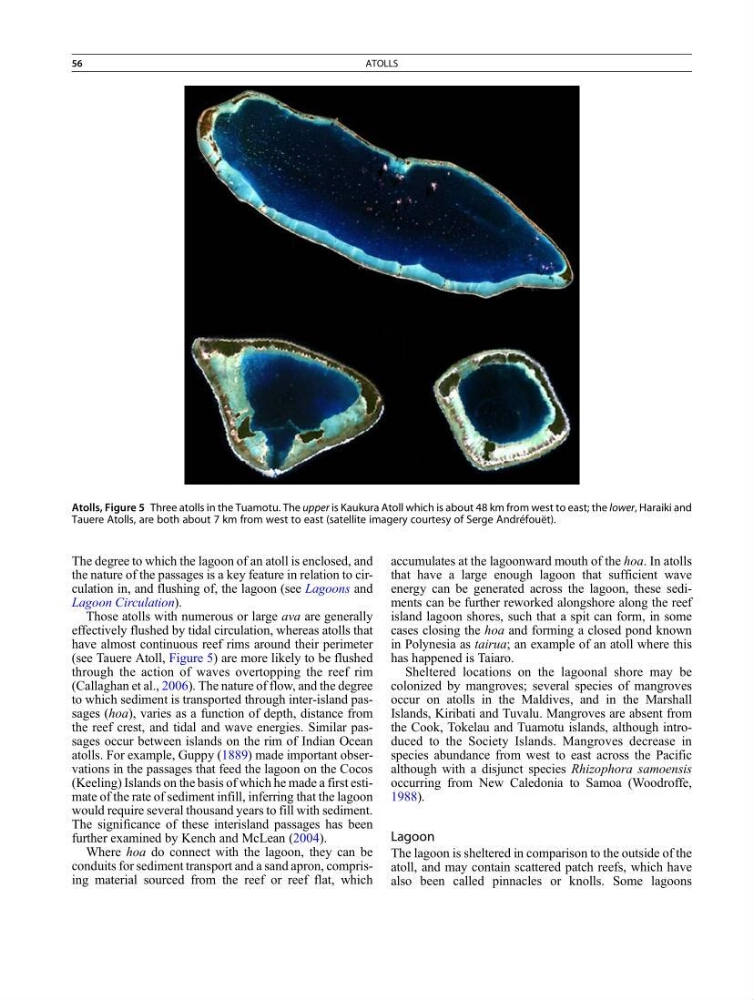
(see Tauere Atoll, Figure 5) are more likely to be flushed
through the action of waves overtopping the reef rim
(Callaghan et al., 2006). The nature of flow, and the degree
to which sediment is transported through inter-island passages (hoa), varies as a function of depth, distance from
the reef crest, and tidal and wave energies. Similar passages occur between islands on the rim of Indian Ocean
atolls. For example, Guppy (1889) made important observations in the passages that feed the lagoon on the Cocos
(Keeling) Islands on the basis of which he made a first estimate of the rate of sediment infill, inferring that the lagoon
would require several thousand years to fill with sediment.
The significance of these interisland passages has been
further examined by Kench and McLean (2004).
Where hoa do connect with the lagoon, they can be
conduits for sediment transport and a sand apron, comprising material sourced from the reef or reef flat, which
accumulates at the lagoonward mouth of the hoa. In atolls
that have a large enough lagoon that sufficient wave
energy can be generated across the lagoon, these sediments can be further reworked alongshore along the reef
island lagoon shores, such that a spit can form, in some
cases closing the hoa and forming a closed pond known
in Polynesia as tairua; an example of an atoll where this
has happened is Taiaro.
Sheltered locations on the lagoonal shore may be
colonized by mangroves; several species of mangroves
occur on atolls in the Maldives, and in the Marshall
Islands, Kiribati and Tuvalu. Mangroves are absent from
the Cook, Tokelau and Tuamotu islands, although introduced to the Society Islands. Mangroves decrease in
species abundance from west to east across the Pacific
although with a disjunct species Rhizophora samoensis
occurring from New Caledonia to Samoa (Woodroffe,
1988).
Lagoon
The lagoon is sheltered in comparison to the outside of the
atoll, and may contain scattered patch reefs, which have
also been called pinnacles or knolls. Some lagoons
Atolls, Figure 5 Three atolls in the Tuamotu. The upper is Kaukura Atoll which is about 48 km from west to east; the lower, Haraiki and
Tauere Atolls, are both about 7 km from west to east (satellite imagery courtesy of Serge Andre ´foue ¨t).
56
ATOLLS
the nature of the passages is a key feature in relation to circulation in, and flushing of, the lagoon (see Lagoons and
Lagoon Circulation).
Those atolls with numerous or large ava are generally
effectively flushed by tidal circulation, whereas atolls that
have almost continuous reef rims around their perimeter
(see Tauere Atoll, Figure 5) are more likely to be flushed
through the action of waves overtopping the reef rim
(Callaghan et al., 2006). The nature of flow, and the degree
to which sediment is transported through inter-island passages (hoa), varies as a function of depth, distance from
the reef crest, and tidal and wave energies. Similar passages occur between islands on the rim of Indian Ocean
atolls. For example, Guppy (1889) made important observations in the passages that feed the lagoon on the Cocos
(Keeling) Islands on the basis of which he made a first estimate of the rate of sediment infill, inferring that the lagoon
would require several thousand years to fill with sediment.
The significance of these interisland passages has been
further examined by Kench and McLean (2004).
Where hoa do connect with the lagoon, they can be
conduits for sediment transport and a sand apron, comprising material sourced from the reef or reef flat, which
accumulates at the lagoonward mouth of the hoa. In atolls
that have a large enough lagoon that sufficient wave
energy can be generated across the lagoon, these sediments can be further reworked alongshore along the reef
island lagoon shores, such that a spit can form, in some
cases closing the hoa and forming a closed pond known
in Polynesia as tairua; an example of an atoll where this
has happened is Taiaro.
Sheltered locations on the lagoonal shore may be
colonized by mangroves; several species of mangroves
occur on atolls in the Maldives, and in the Marshall
Islands, Kiribati and Tuvalu. Mangroves are absent from
the Cook, Tokelau and Tuamotu islands, although introduced to the Society Islands. Mangroves decrease in
species abundance from west to east across the Pacific
although with a disjunct species Rhizophora samoensis
occurring from New Caledonia to Samoa (Woodroffe,
1988).
Lagoon
The lagoon is sheltered in comparison to the outside of the
atoll, and may contain scattered patch reefs, which have
also been called pinnacles or knolls. Some lagoons
Atolls, Figure 5 Three atolls in the Tuamotu. The upper is Kaukura Atoll which is about 48 km from west to east; the lower, Haraiki and
Tauere Atolls, are both about 7 km from west to east (satellite imagery courtesy of Serge Andre ´foue ¨t).
56
ATOLLS