

Recovery of damaged reefs may be very limited, particularly when surfaces are reduced to mobile rubble which
inhibits successful coral colonization and growth.
Background
Coral mining has caused extensive degradation of reefs in
a number of countries, which include India, Maldives, Sri
Lanka, Tanzania, and the Philippines (Brown, 1997a). The
use of coral rock as a construction material in many countries in the central Indian Ocean has had a long history,
particularly in the building of mosques, temples, and
shrines. Early photographs taken by Agassiz in Malé in
the Maldives in 1903 show houses constructed of coconut
leaves and available timber, but by the mid-late tewntieth
century construction of houses, boundary walls, groynes,
and breakwaters with coral blocks was commonplace
(Brown, 1997b). At Mafia Island, in Tanzania two forms
of coral were extracted in the early to late twentieth century for both local and commercial construction (Dulvy
et al., 1995); these were fossilized limestone and living
reef coral. In Sri Lanka, corals are primarily used in the
construction industry for production of mortar and plaster
with subsidiary uses as lime in soil improvement and in
the ceramic and cement industry. In India, corals (coral
fragments or ‘challi’ rather than coral ‘stones’) are also
used for the production of lime with lime kilns in the
Tuticorin area of southern India, exporting lime all over
the country to meet the demands of paper and sugar industries, leather tanning and bleaching, mortar production,
and white wash paint. Coral ‘stones’ extracted from areas
such as the Gulf of Mannar, India, are used as building
blocks or in road construction and as source material for
house decorations. Similarly, in West Sumatra branching
and massive corals are extracted to sell as decorative materials for house walls. In the offshore islands, it is estimated
that over 10–24 tons of shells and corals are collected
from the reefs per year in an activity that involves ten people collecting once or twice a week (Tomascik et al.,
1997).
While the construction industry is a major user of corals
in the above-mentioned countries, it is clear that there
is wide variation in the exploitation of specific coral
products by different countries. These differences are
reflected in the total harvest of coral products and also
in the site and method of exploitation. In the mid1990s, in Sri Lanka the greatest proportion of coral rock
(42%) was derived from fossil reefs inshore, whereas live
coral collection represented 12% and coral rubble (collected from the beach and reef flats) 30% of the total harvest. In India, the collection of coral fragments greatly
exceeded the collection of coral ‘stones’ mainly because
of its ease of collection and the reduced demand for the
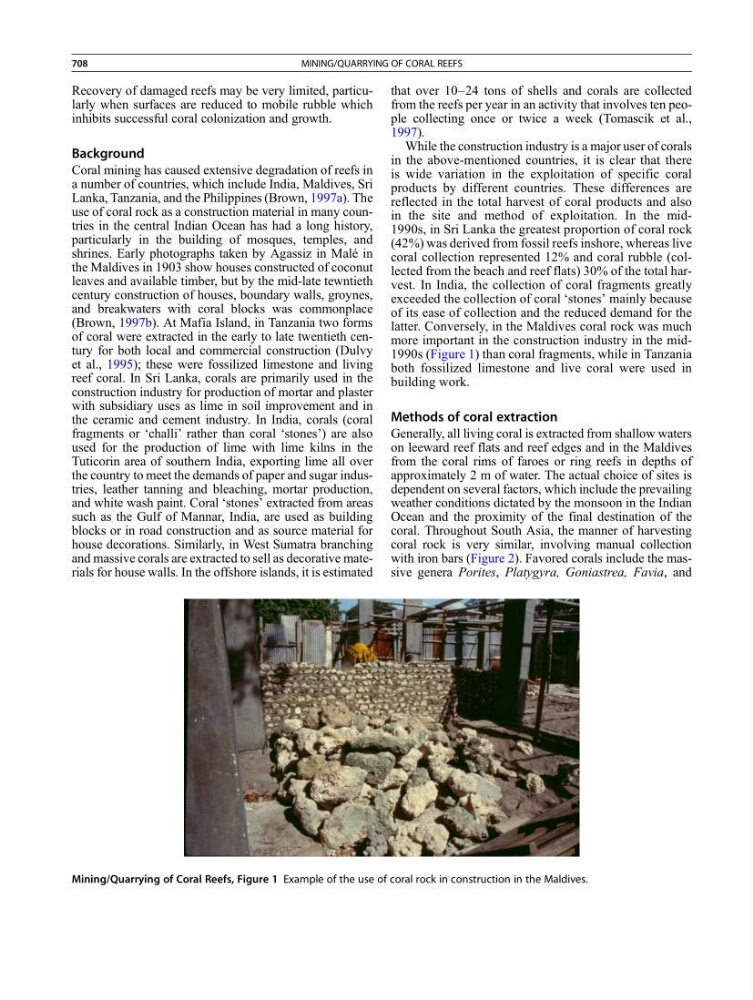
latter. Conversely, in the Maldives coral rock was much
more important in the construction industry in the mid1990s (Figure 1) than coral fragments, while in Tanzania
both fossilized limestone and live coral were used in
building work.
Methods of coral extraction
Generally, all living coral is extracted from shallow waters
on leeward reef flats and reef edges and in the Maldives
from the coral rims of faroes or ring reefs in depths of
approximately 2 m of water. The actual choice of sites is
dependent on several factors, which include the prevailing
weather conditions dictated by the monsoon in the Indian
Ocean and the proximity of the final destination of the
coral. Throughout South Asia, the manner of harvesting
coral rock is very similar, involving manual collection
with iron bars (Figure 2). Favored corals include the massive genera Porites, Platygyra, Goniastrea, Favia, and
Mining/Quarrying of Coral Reefs, Figure 1 Example of the use of coral rock in construction in the Maldives.
708
MINING/QUARRYING OF CORAL REEFS