

Favites as well as the branching genera Acropora and
Pocillopora (Brown and Dunne, 1988). In the Maldives,
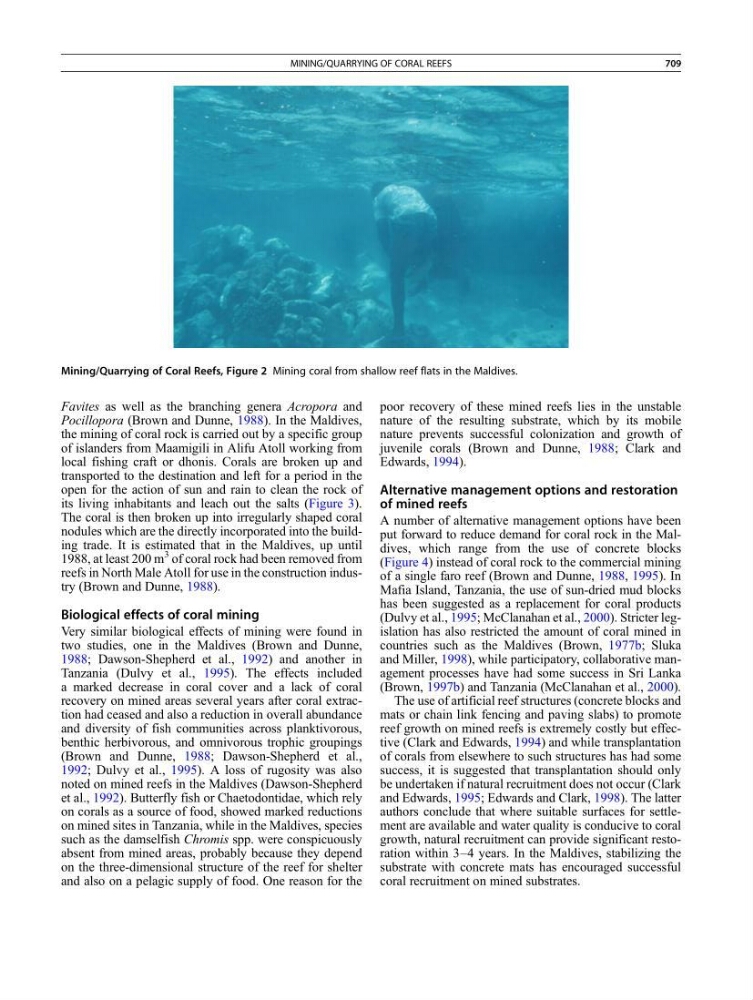
the mining of coral rock is carried out by a specific group
of islanders from Maamigili in Alifu Atoll working from
local fishing craft or dhonis. Corals are broken up and
transported to the destination and left for a period in the
open for the action of sun and rain to clean the rock of
its living inhabitants and leach out the salts (Figure 3).
The coral is then broken up into irregularly shaped coral
nodules which are the directly incorporated into the building trade. It is estimated that in the Maldives, up until
1988, at least 200 m
3 of coral rock had been removed from
reefs in North Male Atoll for use in the construction industry (Brown and Dunne, 1988).
Biological effects of coral mining
Very similar biological effects of mining were found in
two studies, one in the Maldives (Brown and Dunne,
1988; Dawson-Shepherd et al., 1992) and another in
Tanzania (Dulvy et al., 1995). The effects included
a marked decrease in coral cover and a lack of coral
recovery on mined areas several years after coral extraction had ceased and also a reduction in overall abundance
and diversity of fish communities across planktivorous,
benthic herbivorous, and omnivorous trophic groupings
(Brown and Dunne, 1988; Dawson-Shepherd et al.,
1992; Dulvy et al., 1995). A loss of rugosity was also
noted on mined reefs in the Maldives (Dawson-Shepherd
et al., 1992). Butterfly fish or Chaetodontidae, which rely
on corals as a source of food, showed marked reductions
on mined sites in Tanzania, while in the Maldives, species
such as the damselfish Chromis spp. were conspicuously
absent from mined areas, probably because they depend
on the three-dimensional structure of the reef for shelter
and also on a pelagic supply of food. One reason for the
poor recovery of these mined reefs lies in the unstable
nature of the resulting substrate, which by its mobile
nature prevents successful colonization and growth of
juvenile corals (Brown and Dunne, 1988; Clark and
Edwards, 1994).
Alternative management options and restoration
of mined reefs
A number of alternative management options have been
put forward to reduce demand for coral rock in the Maldives, which range from the use of concrete blocks
(Figure 4) instead of coral rock to the commercial mining
of a single faro reef (Brown and Dunne, 1988, 1995). In
Mafia Island, Tanzania, the use of sun-dried mud blocks
has been suggested as a replacement for coral products
(Dulvy et al., 1995; McClanahan et al., 2000). Stricter legislation has also restricted the amount of coral mined in
countries such as the Maldives (Brown, 1977b; Sluka
and Miller, 1998), while participatory, collaborative management processes have had some success in Sri Lanka
(Brown, 1997b) and Tanzania (McClanahan et al., 2000).
The use of artificial reef structures (concrete blocks and
mats or chain link fencing and paving slabs) to promote
reef growth on mined reefs is extremely costly but effective (Clark and Edwards, 1994) and while transplantation
of corals from elsewhere to such structures has had some
success, it is suggested that transplantation should only
be undertaken if natural recruitment does not occur (Clark
and Edwards, 1995; Edwards and Clark, 1998). The latter
authors conclude that where suitable surfaces for settlement are available and water quality is conducive to coral
growth, natural recruitment can provide significant restoration within 3–4 years. In the Maldives, stabilizing the
substrate with concrete mats has encouraged successful
coral recruitment on mined substrates.
Mining/Quarrying of Coral Reefs, Figure 2 Mining coral from shallow reef flats in the Maldives.
MINING/QUARRYING OF CORAL REEFS
709