

arrays of below-ground roots bearing distinctively vascular, air-breathing anatomy. Specialized above-ground
roots and buttresses further provide exposed air-breathing
surfaces and physical support, as well as significant habitat amongst their structure – a characteristic shared with
adjacent upland forests and reefal corals.
Ancestral mangrove plants are believed to have
reinvaded marine environments in multiple episodes from
diverse angiosperm lineages culminating in today’s mangrove flora (also Saenger, 2002). Their appearance and
evolution appears constrained by key functional attributes
essential to their survival in saline, inundated settings
where isotonic extremes, desiccation, and hydrologic
exposure combine as uniquely harsh constraints on organisms living in the tidal zone, and estuaries. The land–sea
interface is a dynamic environment, where subtle changes
in climate, sea level, sediment, and nutrient inputs have
dramatic consequences for the distribution and health of
mangroves. Adding to these, direct human disturbance
of mangroves include: eutrophication, dredging/filling,
overfishing, and sedimentation. The combined pressures,
coupled with global climate change and sea level rise, have
led to many healthy mangrove areas becoming endangered
communities (Duke et al., 2007). Various rehabilitation projects have shown further that it is extremely difficult to
achieve effective, large-scale restoration. Urgent protective
measures need to be implemented to avoid further mangroves losses and further degradation of coastal ecosystems.
Rich and diverse
Mangroves are a diverse group of predominantly tropical
trees and shrubs growing in the upper half of the intertidal
zone of coastal areas worldwide (Duke, 1992). They are
often mistakenly thought of as a single entity. But, like
coral reefs, healthy mangroves are functionally diverse
and complex. They also provide essential structure and
habitat for a host of marine and intertidal species
(Figure 5), comprised of both: residents amongst their
dense forest of stems and complex roots, and as visitors
with each flooding tide. Mangroves are analogous to tropical rainforests also, where they have foliage canopy habitat for birds, mammals, insects, and other invertebrates.
Shared ancestral links underlie many similarities between
these plant-structured habitats.
Mangroves are not a genetic entity, but an ecological
one (Duke et al., 1998). Mangrove vegetation includes
a range of functional forms, including trees, shrubs,
a palm, and ground fern. The only plant families comprised exclusively of mangrove taxa are Avicenniaceae
and Sonneratiaceae, although this continues to be debated.
In Table 1, 77 species of mangrove plants are listed for the
world. This number however, is not fixed, and varies with
different authors since there are a number of subjective
and influential factors, including: doubts surrounding the
definition of mangroves; whether to include saltmarsh
plants; whether to include mangrove associates; and
inconclusive taxonomic description of all taxa.
Amongst the 21 flowering plant genera found in mangroves, there is a relatively high degree of specialization
for the tidal wetland habitat. Twelve angiosperm genera
are exclusively mangrove while ten others include nonmangrove species. This latter group includes: Aglaia,
Barringtonia, Cynometra, Diospyros, Dolichandrone,
Excoecaria, Heritiera, Mora, Pemphis, Tabebuia, and
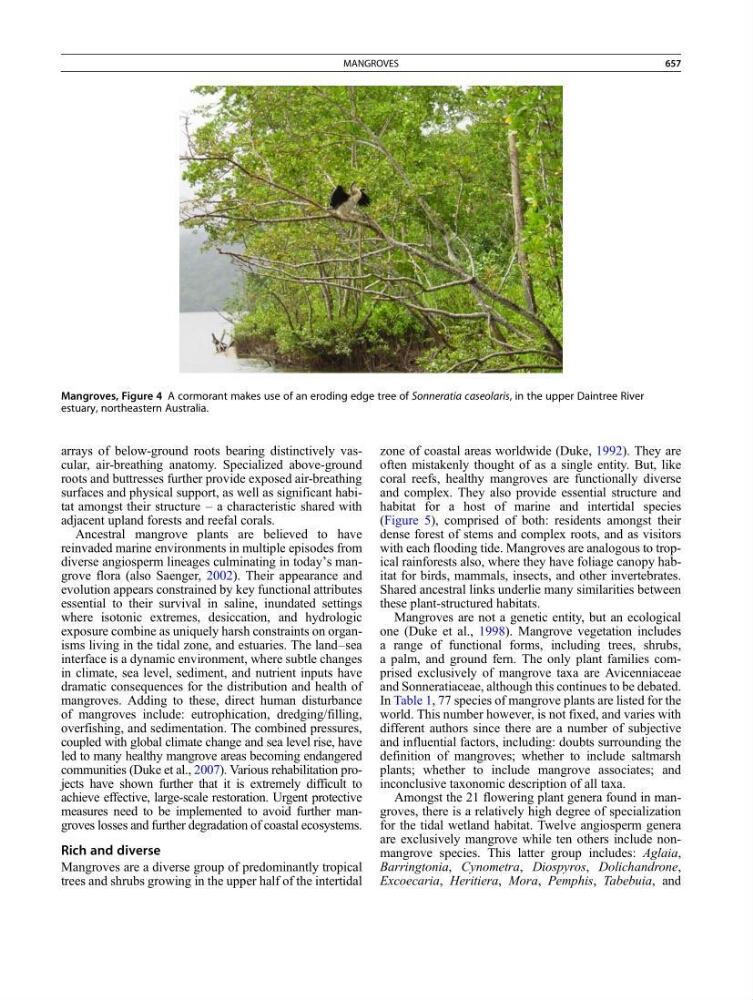
Mangroves, Figure 4 A cormorant makes use of an eroding edge tree of Sonneratia caseolaris, in the upper Daintree River
estuary, northeastern Australia.
MANGROVES
657