

Xylocarpus. For Pemphis, this genus has only one upland
species located inland as an isolated population on the
island of Madacascar. Others show different degrees and
types of variation. For instance, distinct hybrids are
reported in four genera including Bruguiera, Lumnitzera
(Figure 6), Sonneratia, and Rhizophora (in Table 1, see
species prefixed with “X”). Overall, the diversity of species in these genera is often relatively low, being one or
two. These relatively low measures of diversity are
believed to be the result of harsh growth conditions present in intertidal habitats. Local and regional environmental factors are believed to play a key role in defining the
ecological entity that is mangrove habitat. Rhizophora
species, the most diverse and dominant genus, often occur
at the front of mangroves, fronting the sea or channel, and
associated with moderate salinities but not extremes.
Avicennia species, having a wider salinity tolerance, are
notably variable occurring in both frontal and upland
stands in the Indo-West Pacific.
Structural diversity
Mangrove plants characteristically range from trees (like
species of Avicennia (Figure 7), Rhizophora (Figure 2)),
to shrubs (species of Aegiceras, Aegialitis, Pemphis, and
Conocarpus), to the trunkless palm (Nypa fruticans
(Figure 8)), and ground fern (Acrostichum). Trees and
shrubs vary further where they might be columnar and
erect (Pelliciera rhizophorae (Figure 9), Bruguiera
parviflora), to spreading, sprawling (Acanthus spp.,
Scyphiphora hydrophylacea), and multiple-stemmed
(Ceriops decandra). Growth form might also vary within
the same species (Lumnitzera littorea and Rhizophora),
having both an erect tree form, and low tangled thicket
forms. In general, edge plants (both waterfront and landward) have more lower limbs and foliage, and their
stems are laterally sprawling and sinuous, rather than
erect and straight. Some species typically form combined
closed canopies (Avicennia marina, Rhizophora
apiculata, Bruguiera parviflora, Bruguiera gymnorhiza,
Camptostemon schultzii, Xylocarpus spp.), while others
are commonly found as undercanopy plants beneath the
closed canopy (like species of Aegiceras, Cynometra,
Acanthus, Acrostichum, and Ceriops decandra).
Mangroves have notable above-ground breathing roots
and shallow below-ground anchoring roots, because their
soils are usually saturated and airless. The trees have
broad support structures, such as buttresses and sturdy
prop roots, because soils are often soft and unconsolidated. Root structures above ground include four types:
(1) pneumatophores – pencil-like (Avicennia (Figure 7)),
erect conical (Xylocarpus moluccensis), thinly conical
(Sonneratia alba), and elongate conical (Sonneratia
caseolaris (Figure 4) and Sonneratia lanceolata);
(2) knee roots – thick and knobbly (Bruguiera) and
thin and wiry (Lumnitzera littorea); (3) stilt roots
(Rhizophora (Figure 2)); and (4) buttresses – sinuous
planks (Xylocarpus granatum, Heritiera littoralis, and
Ceriops spp., Pelliciera rhizophorae), and erect “fins”
(Bruguiera X rhynchopetala, Xylocarpus moluccensis).
Roots are used by various fauna, but most notably by
burrowing shipworms, mollusks, termites, and crabs.
Factors influencing mangrove distributions
Mangroves have evolved and flourished in their dynamic
setting. While mangroves collectively have specialized
morphologies and physiologies, these attributes have
limits that vary with individual species. The distributional
range of each mangrove species reflects its response to the
dominant influencing factors at global, regional, and local
scales (Duke et al., 1998).
Where mangroves inhabit tropical and subtropical
regions of the world, their presence in higher latitudes is
generally constrained by the 20
C winter isotherm in the
respective hemispheres (Figure 10). Exceptions to this
pattern mostly correspond to the paths of oceanic circulation currents where mangrove distributions are broader on
eastern continental margins and more constrained on the
west. Present day distribution patterns depend on specialized, water-buoyant propagules of mangroves. Their dispersal is constrained by wide bodies of water and
continental land masses. Four major barriers restrict dispersal of warm coastal marine organisms (including mangroves) around the world today, namely: the continents of
(1) Africa and Euro-Asia; plus (2) North and South American continents; and the oceans of (3) the North and South
Atlantic; plus (4) the eastern Pacific. The relative effectiveness of each of these barriers differ, depending on its
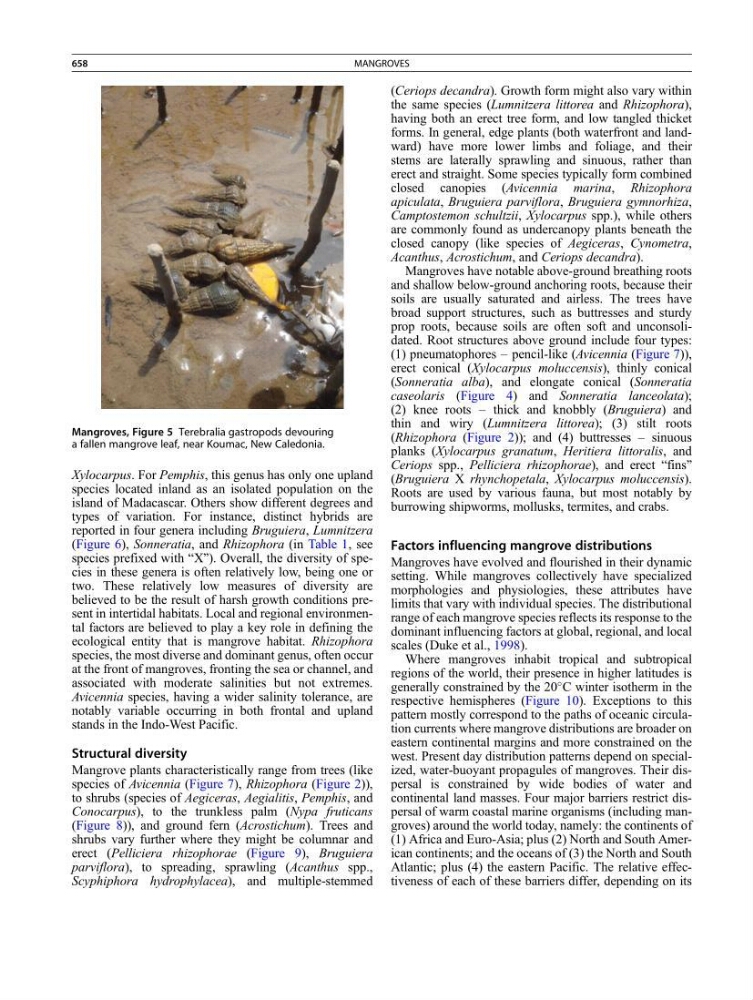
Mangroves, Figure 5 Terebralia gastropods devouring
a fallen mangrove leaf, near Koumac, New Caledonia.
658
MANGROVES