

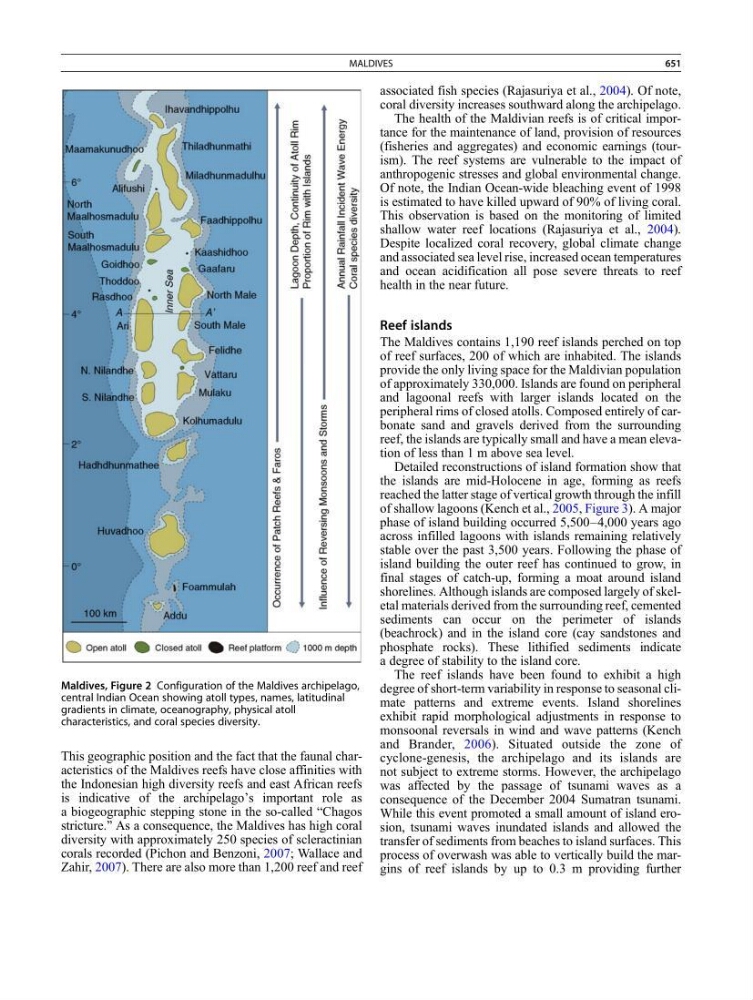
This geographic position and the fact that the faunal characteristics of the Maldives reefs have close affinities with
the Indonesian high diversity reefs and east African reefs
is indicative of the archipelago’s important role as
a biogeographic stepping stone in the so-called “Chagos
stricture.” As a consequence, the Maldives has high coral
diversity with approximately 250 species of scleractinian
corals recorded (Pichon and Benzoni, 2007; Wallace and
Zahir, 2007). There are also more than 1,200 reef and reef
associated fish species (Rajasuriya et al., 2004). Of note,
coral diversity increases southward along the archipelago.
The health of the Maldivian reefs is of critical importance for the maintenance of land, provision of resources
(fisheries and aggregates) and economic earnings (tourism). The reef systems are vulnerable to the impact of
anthropogenic stresses and global environmental change.
Of note, the Indian Ocean-wide bleaching event of 1998
is estimated to have killed upward of 90% of living coral.
This observation is based on the monitoring of limited
shallow water reef locations (Rajasuriya et al., 2004).
Despite localized coral recovery, global climate change
and associated sea level rise, increased ocean temperatures
and ocean acidification all pose severe threats to reef
health in the near future.
Reef islands
The Maldives contains 1,190 reef islands perched on top
of reef surfaces, 200 of which are inhabited. The islands
provide the only living space for the Maldivian population
of approximately 330,000. Islands are found on peripheral
and lagoonal reefs with larger islands located on the
peripheral rims of closed atolls. Composed entirely of carbonate sand and gravels derived from the surrounding
reef, the islands are typically small and have a mean elevation of less than 1 m above sea level.
Detailed reconstructions of island formation show that
the islands are mid-Holocene in age, forming as reefs
reached the latter stage of vertical growth through the infill
of shallow lagoons (Kench et al., 2005, Figure 3). A major
phase of island building occurred 5,500–4,000 years ago
across infilled lagoons with islands remaining relatively
stable over the past 3,500 years. Following the phase of
island building the outer reef has continued to grow, in
final stages of catch-up, forming a moat around island
shorelines. Although islands are composed largely of skeletal materials derived from the surrounding reef, cemented
sediments can occur on the perimeter of islands
(beachrock) and in the island core (cay sandstones and
phosphate rocks). These lithified sediments indicate
a degree of stability to the island core.
The reef islands have been found to exhibit a high
degree of short-term variability in response to seasonal climate patterns and extreme events. Island shorelines
exhibit rapid morphological adjustments in response to
monsoonal reversals in wind and wave patterns (Kench
and Brander, 2006). Situated outside the zone of
cyclone-genesis, the archipelago and its islands are
not subject to extreme storms. However, the archipelago
was affected by the passage of tsunami waves as a
consequence of the December 2004 Sumatran tsunami.
While this event promoted a small amount of island erosion, tsunami waves inundated islands and allowed the
transfer of sediments from beaches to island surfaces. This
process of overwash was able to vertically build the margins of reef islands by up to 0.3 m providing further
Maldives, Figure 2 Configuration of the Maldives archipelago,
central Indian Ocean showing atoll types, names, latitudinal
gradients in climate, oceanography, physical atoll
characteristics, and coral species diversity.
MALDIVES
651