

evidence that the reef islands are morphologically
dynamic features on reef surfaces (Kench et al., 2006).
Summary
Located in the central Indian Ocean the Maldives is one of
the largest and most geologically complex mid-ocean atoll
chains in the world. The archipelago possesses high biological diversity, a unique geological history, and contains
a diverse range of reef structures and atoll types. The reefs
are also host to a large number of vegetated reef islands.
However, despite the aerial extent and unique aspects
of reef and island diversity, structure and evolution, the
Maldives remain one of the least studied reef systems in
the world.
Bibliography
Agassiz, A., 1903. The coral reefs of the Maldives. Memoirs
of the Museum of Comparative Zoology, Harvard College, 29,
1–68.
Aubert, O., and Droxler, A., 1992. General Cenozoic evolution of
the Maldives carbonate system (equatorial Indian Ocean). Bulletin des Centres de Recherches Exploration-Production Elf
Aquitane, 16, 113–136.
Belopolsky, A., and Droxler, A., 2003. Imaging Tertiary carbonate
system – the Maldives, Indian Ocean: insights into carbonate
sequence interpretation. The Leading Edge, 22, 646–652.
Darwin, C., 1842. The Structure and Distribution of Coral Reefs.
London: Smith Elder.
Duncan, R. A., and Hargreaves, R. B., 1990. 40Ar/39Ar geochronology of basement rocks from the Mascarene plateau, the
Chagos Bank, and the Maldives Ridge. Proceedings Ocean Drilling Programme, Scientific Results, 115, 43–51.
Duncan, R. A., and Pyle, D. G., 1988. Rapid eruption of the Deccan
flood basalts at the Cretaceous/Tertiary boundary. Nature, 333,
841–843.
Gardiner, J. S., 1903. The Fauna and Geography of the Maldive and
Laccadive Archipelagoes. Cambridge: Cambridge University
Press.
Gischler, E., Hudson, J. H., and Pisera, A., 2008. Late Quaternary
reef growth and sea level in the Maldives, Indian Ocean. Marine
Geology, 250, 104–113.
Hass, H., 1965. Expedition into the Unknown: a Report on the Expedition of the Research Ship Xarifa to the Maldives and Nicobar
Islands. London: Hutchison and Co.
Kench, P. S., and Brander, R. W., 2006. Response of reef island
shorelines to seasonal climate oscillations: South Maalhosmadulu
atoll, Maldives. Journal of Geophysical Research, 111, F01001,
doi:10.1029/2005JF000323.
Kench, P. S., McLean, R. F., Brander, R. W., Nichol, S. L., Smithers,
S. G., Ford, M. R., Parnell, K. E., and Aslam, M., 2006.
Geological effects of tsunami on mid-ocean atoll islands: the
Maldives before and after the Sumatran tsunami. Geology, 34,
177–180.
Kench, P. S., McLean, R. F., and Nichol, S. L., 2005. New model of
reef-island evolution: Maldives, Indian Ocean. Geology, 33,
145–148.
Kench, P. S., Smithers, S. G., McLean, R. F., and Nichol, S. L.,
2009. Holocene reef growth in the Maldives: evidence of
a mid-Holocene sea-level highstand in the central Indian Ocean.
Geology, 37, 455–458.
Naseer, A., and Hatcher, B. G., 2004. Inventory of the Maldives
coral reefs using morphometrics generated from Landsat ETMþ
imagery. Coral Reefs, 23, 161–168.
Pichon, M., and Benzoni, F., 2007. Taxonomic re-appraisal of
zooxanthellate Scleractinian Corals in the Maldive Archipelago.
Zootaxa, 1441, 21–33.
Purdy, E. G., and Bertram, G. T., 1993. Carbonate concepts from the
Maldives, Indian Ocean. American Association of Petroleum
Geologists Studies in Geology, 34, 56 p.
Rajasuriya, A., Zahir, H., Venkataraman, K., Zahirul Islam, Z.,
and Tamelander, J., 2004. Status of coral reefs in South Asia:
Bangladesh, Chagos, India, Maldives and Sri Lanka.
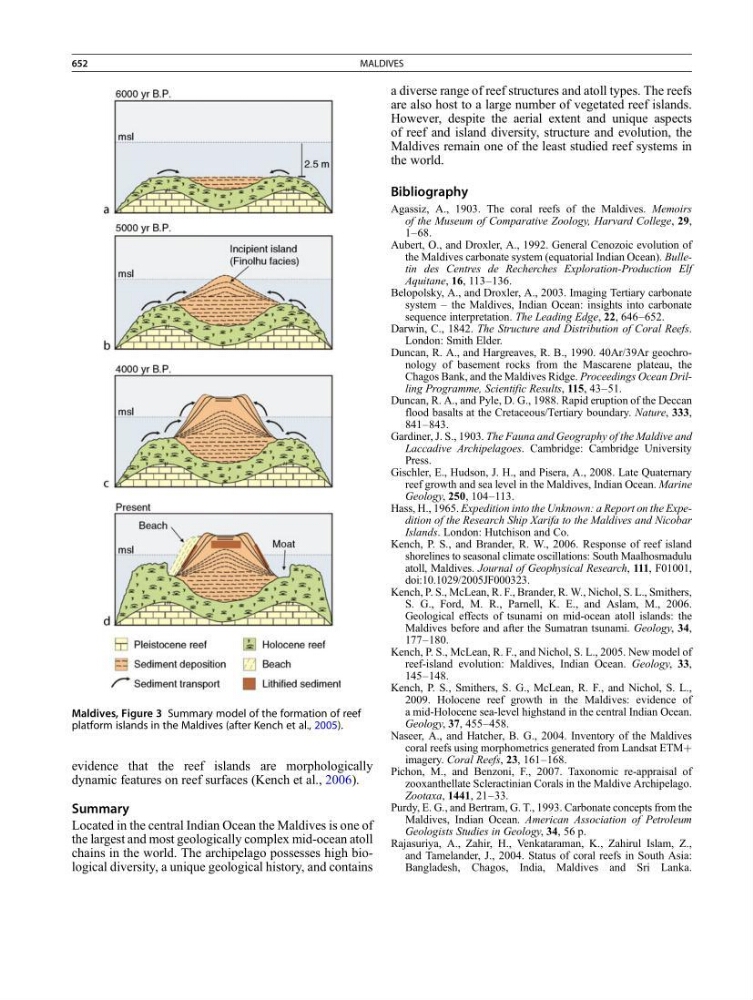
Maldives, Figure 3 Summary model of the formation of reef
platform islands in the Maldives (after Kench et al., 2005).
652
MALDIVES