

vertical reef accretion to a mid-Holocene highstand of
approximately 0.5 m above present 2,500 years ago
(Kench et al., 2009), where elsewhere the lack of higher
sea level evidence suggests reef accretion may have
lagged other sites (Gischler et al., 2008).
Reef structure
The Maldivian archipelago consists of 2,041 individual
reefs with a total reef area of 4,513 km
2 (Naseer and
Hatcher, 2004). This complex network of reefs is organized into a number of distinct atoll and reef types. There
are 21 atolls and 4 oceanic reef platforms.
Atolls can be divided into two types based on their
broad physiographic characteristics. Open atolls are the
dominant atoll type (16 in total) and are characterized
by heavily dissected atoll rims, which in planform appear
as a sequence of individual reef platforms enclosing
a central lagoon. Passages provide free connection
between the lagoon and waters of the surrounding ocean
and inner sea. Open atolls are large structures ranging
from 290 to 3,790 km
2 in area, that contain numerous
lagoonal reefs and collectively account for 99.5% of all
Maldivian reefs. A striking feature of the open atolls is
the presence of faros, ring-shaped coral reefs located
within broader atoll lagoons. Globally faros are scarce,
yet they are abundant in the Maldives where their formation has yet to be resolved. Closed atolls have a nearcontinuous reef rim that enclose their lagoons, and have
limited number of passages connecting the lagoon and surrounding oceanic water. There are only five closed atolls
in the archipelago, which are much smaller in area than
open atolls, ranging from 47 to 143 km
2
.
Four oceanic reef platforms also occur in the archipelago. These reef platforms are individual reefs that emerge
from the inner sea or ocean basin and have no structural
connection with
neighboring atolls. Oceanic reef
platforms are small in area ranging from 4.4 to 10.2 km 2
and have no lagoon that connects to the open ocean. Vegetated islands occupy a large proportion (16–50%) of the
reef platforms.
Latitudinal gradients in atoll characteristics and
processes
The physical characteristics of atolls in the Maldives show
marked spatial variations along the north-south gradient
(Figure 2). Northern atolls are characterized by a heavily
dissected atoll reef rim, numerous lagoonal patch reefs
and faros, and moderate lagoon depths (40–50 m). Reef
islands are located on the peripheral and lagoonal patch
reefs. Toward the south, atolls are characterized by more
continuous atoll reef rims, a higher proportion of peripheral reef rim containing islands, deeper lagoons
(70–80 m), and fewer lagoonal patch reefs.
Latitudinal variations in atoll morphology have been
attributed to broad north-south gradients in climate and
oceanographic conditions. Annual rainfall reduces from
south to north along the archipelago (Figure 2). Over the
longer-term this rainfall gradient has influenced solutional
lowering of lagoons during Quaternary glacial periods.
The archipelago is subject to monsoon conditions that
switch from the west to northeast in a predictable fashion
and influence wave and current patterns. The intensity of
oscillating monsoon conditions increases to the north. In
contrast, incident wave energy reduces in magnitude in
the northerly direction. This energy gradient influences
contemporary coral reef growth and island building
processes.
Reef ecology and biodiversity
The central Indian Ocean location of the Maldives places
the archipelago close to the mid-point between the reef
faunas of the east and west margins of the ocean basin.
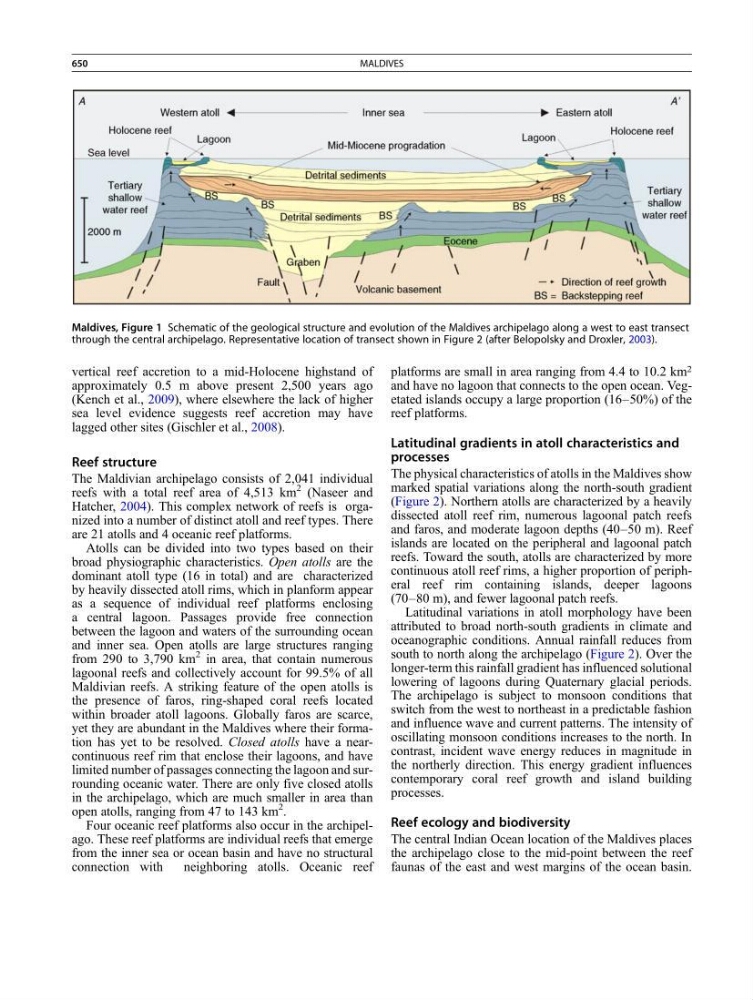
Maldives, Figure 1 Schematic of the geological structure and evolution of the Maldives archipelago along a west to east transect
through the central archipelago. Representative location of transect shown in Figure 2 (after Belopolsky and Droxler, 2003).
650
MALDIVES