

Heterocyst-forming species bind nitrogen gas into ammonia (NH 3 ), nitrite (NO 2
À
), or nitrate (NO 3
À
) that can be
absorbed by all plants. This role is crucial for tropical reef
systems and especially nutrient-depauperate atoll reefs,
which are extremely low in “fixed” nitrogen. Some of
these organisms contribute significantly to global ecology
and the oxygen cycle. For example, the marine cyanobacterium Prochlorococcus (0.5–0.8-µm diameter spheres)
accounts for >50% of the total photosynthetic production
of the open ocean and 20% of the planet’s atmospheric
oxygen (Partensky et al., 1999). Cyanobacteria are the
only group of organisms that are able to reduce nitrogen
and carbon in aerobic conditions, a feature that may be
responsible for their evolutionary and ecological success.
Blue-green algae are abundant worldwide and ubiquitous on coral reefs, where they often occur under extreme
environmental conditions. The universally present black
band in the splash zones that make rocks or boat ramps
slippery is a layer of microscopic blue-green algae. Such
blue-greens can withstand exposure to severe drying,
extreme salinity, rain water, bright sun, and high heat
and still flourish. Cyanobacteria are the oldest known life
forms on earth. Stromatolites containing fossilized oxygenproducing Cyanobacteria date to 1.5 billion years ago
(Zhang and Golubic, 1987). The ability of Cyanobacteria
to perform oxygenic photosynthesis is thought to have
converted the early reducing atmosphere of Earth into an
oxidizing one. Chloroplasts – the organelles responsible
for photosynthesis in all higher plants and eukaryotic
algae – evolved from Cyanobacteria via endosymbiosis.
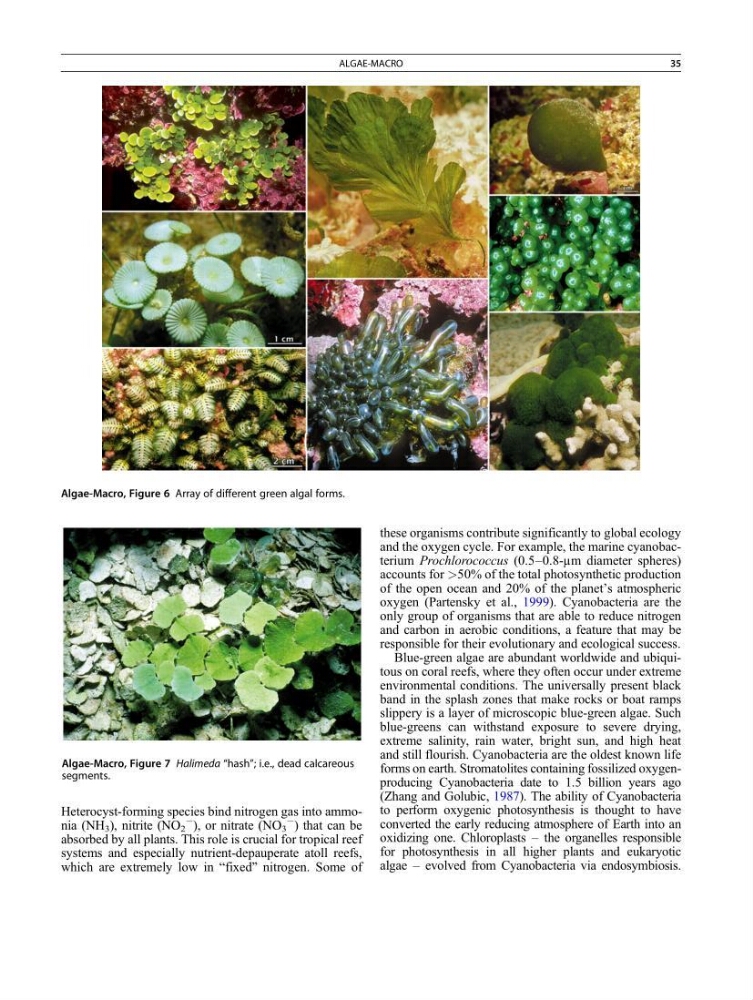
Algae-Macro, Figure 6 Array of different green algal forms.
Algae-Macro, Figure 7 Halimeda “hash”; i.e., dead calcareous
segments.
ALGAE-MACRO
35
À
), or nitrate (NO 3
À
) that can be
absorbed by all plants. This role is crucial for tropical reef
systems and especially nutrient-depauperate atoll reefs,
which are extremely low in “fixed” nitrogen. Some of
these organisms contribute significantly to global ecology
and the oxygen cycle. For example, the marine cyanobacterium Prochlorococcus (0.5–0.8-µm diameter spheres)
accounts for >50% of the total photosynthetic production
of the open ocean and 20% of the planet’s atmospheric
oxygen (Partensky et al., 1999). Cyanobacteria are the
only group of organisms that are able to reduce nitrogen
and carbon in aerobic conditions, a feature that may be
responsible for their evolutionary and ecological success.
Blue-green algae are abundant worldwide and ubiquitous on coral reefs, where they often occur under extreme
environmental conditions. The universally present black
band in the splash zones that make rocks or boat ramps
slippery is a layer of microscopic blue-green algae. Such
blue-greens can withstand exposure to severe drying,
extreme salinity, rain water, bright sun, and high heat
and still flourish. Cyanobacteria are the oldest known life
forms on earth. Stromatolites containing fossilized oxygenproducing Cyanobacteria date to 1.5 billion years ago
(Zhang and Golubic, 1987). The ability of Cyanobacteria
to perform oxygenic photosynthesis is thought to have
converted the early reducing atmosphere of Earth into an
oxidizing one. Chloroplasts – the organelles responsible
for photosynthesis in all higher plants and eukaryotic
algae – evolved from Cyanobacteria via endosymbiosis.
Algae-Macro, Figure 6 Array of different green algal forms.
Algae-Macro, Figure 7 Halimeda “hash”; i.e., dead calcareous
segments.
ALGAE-MACRO
35