

This evolutionary step dramatically changed the composition of life forms on Earth, triggering an explosion of biodiversity and leading to the near-extinction of oxygenintolerant organisms.
Summary
Marine macroalgae are among the oldest and most significant inhabitants of coral reefs. Because of the rapid degradation of tropical reefs worldwide, it is imperative that the
role and diversity of macroalgae be studied in a timely,
efficient, and scientifically verifiable manner. It is of paramount importance to characterize the world’s coral-reef
environments and to understand the responses of these
foundation species. The fleshy macroalgal forms are the
food of herbivores, and only become abundant when their
rate of production exceeds the capacity of herbivores to
consume them. On healthy oligotrophic coral reefs, even
very low nutrient increases may shift relative dominance
from corals to macroalgae by both stimulating macroalgal
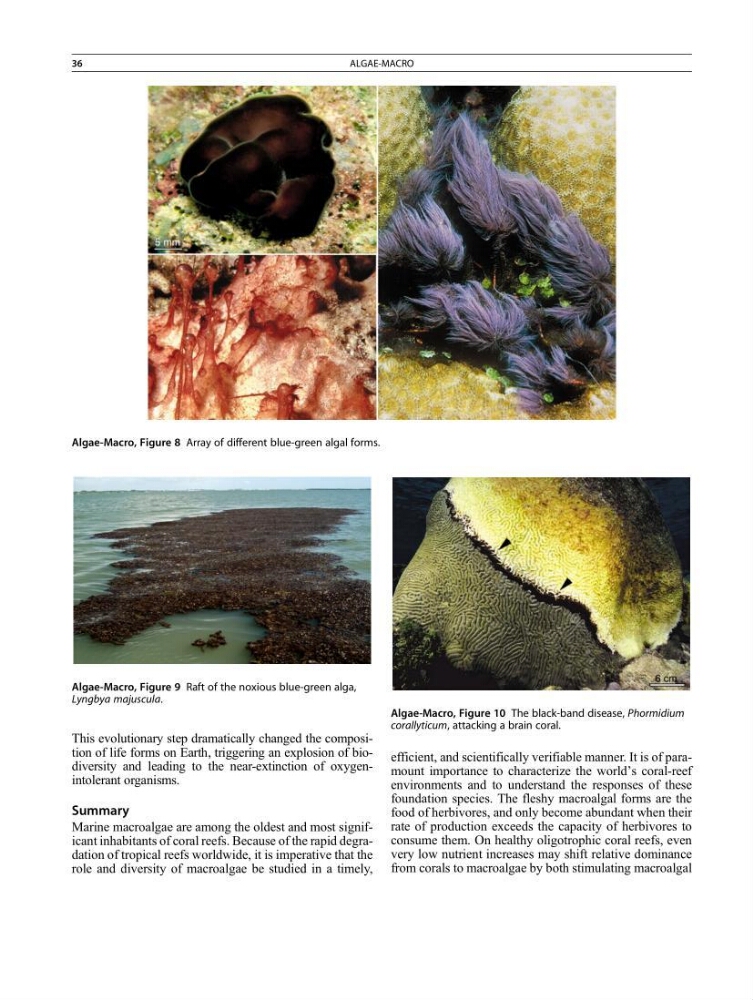
Algae-Macro, Figure 8 Array of different blue-green algal forms.
Algae-Macro, Figure 9 Raft of the noxious blue-green alga,
Lyngbya majuscula.
Algae-Macro, Figure 10 The black-band disease, Phormidium
corallyticum, attacking a brain coral.
36
ALGAE-MACRO
Summary
Marine macroalgae are among the oldest and most significant inhabitants of coral reefs. Because of the rapid degradation of tropical reefs worldwide, it is imperative that the
role and diversity of macroalgae be studied in a timely,
efficient, and scientifically verifiable manner. It is of paramount importance to characterize the world’s coral-reef
environments and to understand the responses of these
foundation species. The fleshy macroalgal forms are the
food of herbivores, and only become abundant when their
rate of production exceeds the capacity of herbivores to
consume them. On healthy oligotrophic coral reefs, even
very low nutrient increases may shift relative dominance
from corals to macroalgae by both stimulating macroalgal
Algae-Macro, Figure 8 Array of different blue-green algal forms.
Algae-Macro, Figure 9 Raft of the noxious blue-green alga,
Lyngbya majuscula.
Algae-Macro, Figure 10 The black-band disease, Phormidium
corallyticum, attacking a brain coral.
36
ALGAE-MACRO