

Green algae are always present on tropical coral reefs
and lagoon floors, often intermixed among seagrass
shoots. These are the siphonaceaous (giant-celled) forms
of Bryopsidales, such as Halimeda, Avrainvillea, Udotea,
and Caulerpa that employ a unique cytoplasmic streaming/blade abandonment mechanism to eliminate epiphytes
(Littler and Littler, 1999). Most Bryopsidales have
a rhizophytic “rooted” growth form and readily take-up
pore water nutrients by cytoplasmic streaming (Williams,
1984). The deepest occurring fleshy upright alga
(Rhipiliopsis profunda) is a member of this group and
was found by submersible attached to bedrock at a depth
of 210 m (Littler and Littler, 1994). Some genera of filamentous or sheet-like green algae are extremely tolerant
of stressful conditions and can be indicators of fresh-water
seeps, recently disturbed areas (as early colonizers of
newly exposed substrates), habitats of low herbivory (high
herbivory eliminates palatable greens), and especially
areas with an overabundance of nutrients (e.g., bird
roosting islands, polluted areas).
Calcified green algae are major contributors to the production of marine sediments. Some genera, such as Udotea
and Penicillus, produce enormous amounts of fine silt and
other sediments due to continual sloughing and following
disintegration. In many tropical locales, the sparkling white
sand beaches are mostly bleached and eroded calciumcarbonate (aragonite) skeletons of Halimeda. “Halimeda
hash” (i.e., the coarse oatmeal-like accumulations of
Halimeda segments, Figure 7) has been used in powergenerating plants and other fossil-fueled industries as
smoke-stack scrubbers/neutralizers to precipitate sulfurous acid and other precursors to acid rain.
Cyanobacteria (blue-green “algae”)
This ancient, highly controversial, and difficult group is
a “prokaryote,” not a true plant. The Cyanobacteria were
the first group to evolve photosynthesis, the process
that powers the biological world. On tropical reefs,
they comprise masses of microscopic organisms that are
strung together into large filamentous clumps or colonies
(Figure 8). In life, most of these large aggregations have
distinctive colors, shapes, or growth forms that provide
distinctive recognition features. However, these are lost
in preserved specimens, and thus went unappreciated
by earlier museum/herbarium-bound taxonomists. Most
commonly, the color of blue-green algae is some peculiar
shade of pink to purple to black – a combination of red
from the pigment phycoerythrin, blue from phycocyanin,
and green from chlorophyll.
Colonies may form filamentous tufts, sheets, or globular spheres (Figure 8). Some filamentous colonies show
the ability to differentiate into several specialized cell
types: vegetative cells (the normal, photosynthetic cells
that are formed under favorable growing conditions),
akinetes (the stress-resistant long-lived spores that form
when environmental conditions become harsh), and thickwalled heterocysts, which contain the enzyme nitrogenase
for nitrogen fixation (see below; Herrero and Flores,
2008). Heterocysts also form under specific environmental
conditions (anoxia, hypoxia) or where nitrogen is limiting.
Many Cyanobacteria also form motile reproductive filaments called hormogonia that glide free from the parent colony at special weaker cells (necridia) and disperse to form
new colonies.
Like the other groups of seaweeds, excessive standing
biomass of Cyanobacteria is usually considered detrimental to the health of coral-reef systems and people. They
produce chemical compounds that can be toxic to fish,
plankton, and invertebrates. For example, swimmers’ itch,
a skin irritation that beach goers commonly experience, is
caused by blooms of the blue-green alga Lyngbya majuscula
(Figure 9). Black-band disease of corals (Figure 10), found
throughout all tropical oceans, is caused by blue-green algae
and associated microorganisms (Ruetzler et al., 1983).
Certain Cyanobacteria produce neurotoxins, hepatotoxins,
cytotoxins, and endotoxins that can be dangerous to animals
and humans (Paul et al., 2007). Several cases of human- and
many cases of livestock-poisoning have been documented.
The nitrogen fixing capacity of some blue-green algae
is extremely important, although often overlooked.
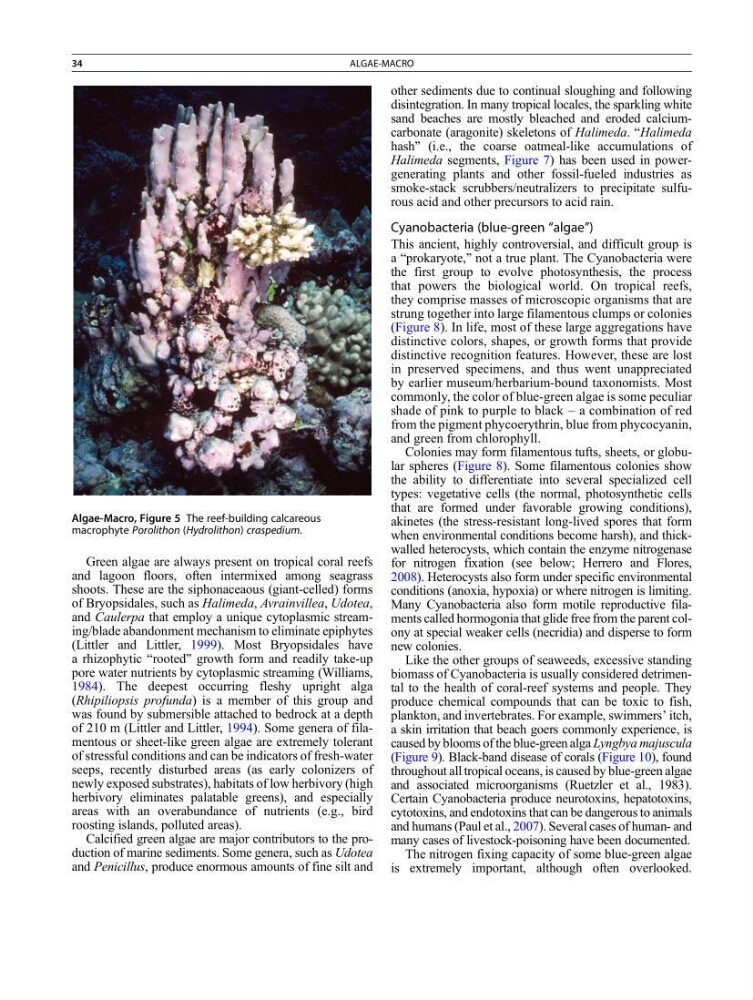
Algae-Macro, Figure 5 The reef-building calcareous
macrophyte Porolithon (Hydrolithon) craspedium.
34
ALGAE-MACRO
and lagoon floors, often intermixed among seagrass
shoots. These are the siphonaceaous (giant-celled) forms
of Bryopsidales, such as Halimeda, Avrainvillea, Udotea,
and Caulerpa that employ a unique cytoplasmic streaming/blade abandonment mechanism to eliminate epiphytes
(Littler and Littler, 1999). Most Bryopsidales have
a rhizophytic “rooted” growth form and readily take-up
pore water nutrients by cytoplasmic streaming (Williams,
1984). The deepest occurring fleshy upright alga
(Rhipiliopsis profunda) is a member of this group and
was found by submersible attached to bedrock at a depth
of 210 m (Littler and Littler, 1994). Some genera of filamentous or sheet-like green algae are extremely tolerant
of stressful conditions and can be indicators of fresh-water
seeps, recently disturbed areas (as early colonizers of
newly exposed substrates), habitats of low herbivory (high
herbivory eliminates palatable greens), and especially
areas with an overabundance of nutrients (e.g., bird
roosting islands, polluted areas).
Calcified green algae are major contributors to the production of marine sediments. Some genera, such as Udotea
and Penicillus, produce enormous amounts of fine silt and
other sediments due to continual sloughing and following
disintegration. In many tropical locales, the sparkling white
sand beaches are mostly bleached and eroded calciumcarbonate (aragonite) skeletons of Halimeda. “Halimeda
hash” (i.e., the coarse oatmeal-like accumulations of
Halimeda segments, Figure 7) has been used in powergenerating plants and other fossil-fueled industries as
smoke-stack scrubbers/neutralizers to precipitate sulfurous acid and other precursors to acid rain.
Cyanobacteria (blue-green “algae”)
This ancient, highly controversial, and difficult group is
a “prokaryote,” not a true plant. The Cyanobacteria were
the first group to evolve photosynthesis, the process
that powers the biological world. On tropical reefs,
they comprise masses of microscopic organisms that are
strung together into large filamentous clumps or colonies
(Figure 8). In life, most of these large aggregations have
distinctive colors, shapes, or growth forms that provide
distinctive recognition features. However, these are lost
in preserved specimens, and thus went unappreciated
by earlier museum/herbarium-bound taxonomists. Most
commonly, the color of blue-green algae is some peculiar
shade of pink to purple to black – a combination of red
from the pigment phycoerythrin, blue from phycocyanin,
and green from chlorophyll.
Colonies may form filamentous tufts, sheets, or globular spheres (Figure 8). Some filamentous colonies show
the ability to differentiate into several specialized cell
types: vegetative cells (the normal, photosynthetic cells
that are formed under favorable growing conditions),
akinetes (the stress-resistant long-lived spores that form
when environmental conditions become harsh), and thickwalled heterocysts, which contain the enzyme nitrogenase
for nitrogen fixation (see below; Herrero and Flores,
2008). Heterocysts also form under specific environmental
conditions (anoxia, hypoxia) or where nitrogen is limiting.
Many Cyanobacteria also form motile reproductive filaments called hormogonia that glide free from the parent colony at special weaker cells (necridia) and disperse to form
new colonies.
Like the other groups of seaweeds, excessive standing
biomass of Cyanobacteria is usually considered detrimental to the health of coral-reef systems and people. They
produce chemical compounds that can be toxic to fish,
plankton, and invertebrates. For example, swimmers’ itch,
a skin irritation that beach goers commonly experience, is
caused by blooms of the blue-green alga Lyngbya majuscula
(Figure 9). Black-band disease of corals (Figure 10), found
throughout all tropical oceans, is caused by blue-green algae
and associated microorganisms (Ruetzler et al., 1983).
Certain Cyanobacteria produce neurotoxins, hepatotoxins,
cytotoxins, and endotoxins that can be dangerous to animals
and humans (Paul et al., 2007). Several cases of human- and
many cases of livestock-poisoning have been documented.
The nitrogen fixing capacity of some blue-green algae
is extremely important, although often overlooked.
Algae-Macro, Figure 5 The reef-building calcareous
macrophyte Porolithon (Hydrolithon) craspedium.
34
ALGAE-MACRO