

Untreated sewage and agricultural fertilisers from
nearby mainland contain high concentrations of nitrogen
and phosphorous and these nutrients impose stress upon
corals; encourage competition from marine grasses, algae
and filter feeders such as sponges; ultimately they weaken
the coral leading to its destruction (Bell, 1991; Kinsey,
1991; Rasmussen et al., 1993). Wave-induced groundwater flow from the ocean through atoll islands can transport
liquid wastes, originally discharged from dwellings into
the island sediments, into the atoll lagoon, resulting in pollution of lagoonal waters (Nielsen, 1999).
Hence, sewage needs to be treated to a high standard of
purity before it can be released into atoll lagoons or ocean
waters in the vicinity of coral reefs and islands. General
waste, particularly on small reef islands, may have to be
removed from the islands for disposal elsewhere.
Electric power usually is generated by local diesel
power units since solar and wind power do not operate
well with large bird populations. On small islands, or in
confined areas, diesel generators can create unacceptable
noise problems.
Construction of causeways linking atoll islands may
result in higher ocean water levels on the seaward side of
these islands and stronger currents in the residual channels
between them, causing overtopping, erosion and destruction of both islands and causeways. Causeways also block
exchange between ocean and lagoon waters, reduce the
flushing of a lagoon and hence cause deterioration of
water quality in lagoons (Coleman, 1991, Maragos, 1993).
The shoreline alignments of coral cays change with
changing wind and wave conditions with the most vulnerable part of the cay being the apparently sheltered lee side.
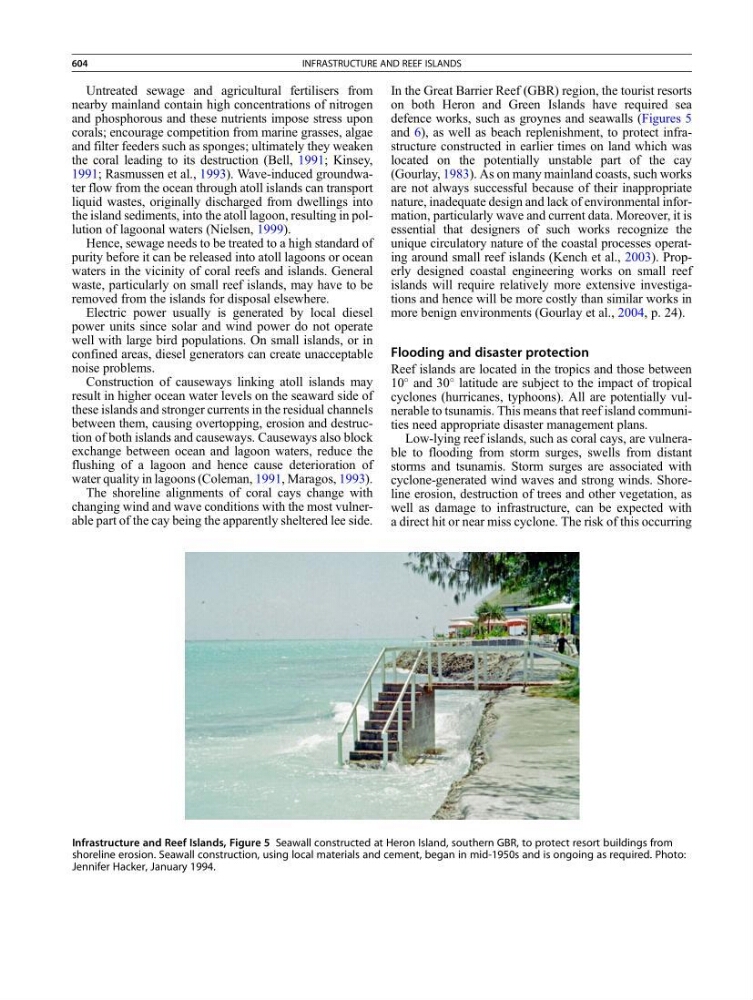
In the Great Barrier Reef (GBR) region, the tourist resorts
on both Heron and Green Islands have required sea
defence works, such as groynes and seawalls (Figures 5
and 6), as well as beach replenishment, to protect infrastructure constructed in earlier times on land which was
located on the potentially unstable part of the cay
(Gourlay, 1983). As on many mainland coasts, such works
are not always successful because of their inappropriate
nature, inadequate design and lack of environmental information, particularly wave and current data. Moreover, it is
essential that designers of such works recognize the
unique circulatory nature of the coastal processes operating around small reef islands (Kench et al., 2003). Properly designed coastal engineering works on small reef
islands will require relatively more extensive investigations and hence will be more costly than similar works in
more benign environments (Gourlay et al., 2004, p. 24).
Flooding and disaster protection
Reef islands are located in the tropics and those between
10
and 30
latitude are subject to the impact of tropical
cyclones (hurricanes, typhoons). All are potentially vulnerable to tsunamis. This means that reef island communities need appropriate disaster management plans.
Low-lying reef islands, such as coral cays, are vulnerable to flooding from storm surges, swells from distant
storms and tsunamis. Storm surges are associated with
cyclone-generated wind waves and strong winds. Shoreline erosion, destruction of trees and other vegetation, as
well as damage to infrastructure, can be expected with
a direct hit or near miss cyclone. The risk of this occurring
Infrastructure and Reef Islands, Figure 5 Seawall constructed at Heron Island, southern GBR, to protect resort buildings from
shoreline erosion. Seawall construction, using local materials and cement, began in mid-1950s and is ongoing as required. Photo:
Jennifer Hacker, January 1994.
604
INFRASTRUCTURE AND REEF ISLANDS