

a coral cay inevitably also is the location of the largest trees
which are the favored nesting sites for some bird species.
Fresh water may have to be imported, collected from
rainfall, pumped from underlying fresh water lenses, or
obtained by desalination of sea water. In some situations
where fresh water is scarce, salt water can be used for
some purposes, e.g., flushing toilets and firefighting. In
other cases, appropriately treated sewage effluent can be
used to water gardens and lawns.
Waste disposal creates problems. For example, at Green
Island, the most visited cay on the GBR, sewage used to be
discharged onto the reef flat. During a period of more than
30 years of sewage discharge, the area of seagrass on the
reef flat expanded from 900 to 130,000 m
2 (Hopley,
1982). These seagrass beds trapped sand eroded from
the cay’s beaches, preventing its return to the cay and
thus contributing to the latter’s continuing loss of sand
(BPAQ, 1989).
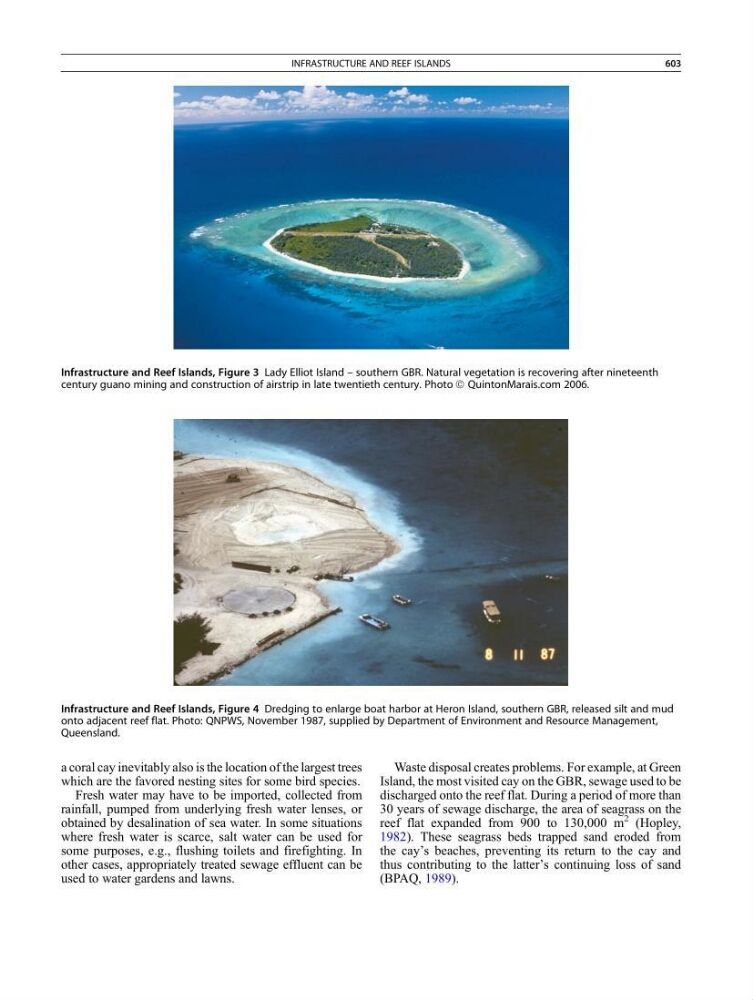
Infrastructure and Reef Islands, Figure 3 Lady Elliot Island – southern GBR. Natural vegetation is recovering after nineteenth
century guano mining and construction of airstrip in late twentieth century. Photo ã QuintonMarais.com 2006.
Infrastructure and Reef Islands, Figure 4 Dredging to enlarge boat harbor at Heron Island, southern GBR, released silt and mud
onto adjacent reef flat. Photo: QNPWS, November 1987, supplied by Department of Environment and Resource Management,
Queensland.
INFRASTRUCTURE AND REEF ISLANDS
603