

places, e.g., the Maldives, sea planes provide a major form
of interisland transport and their operation may require the
removal of patch reefs and other obstructions from landing
areas in lagoons.
Construction of airfields and roads on reef islands and
surrounding reefs or in adjoining lagoons requires supplies of suitable filling material. In some cases, this will
have to be coraline sand and gravel dredged from adjoining lagoons and in other cases terrigenous material quarried from an adjoining continental island. While coraline
sand and gravel filling material does not meet all the usually required technical specifications – it lacks fine sands
– it can be used effectively for such reclamations (Bullen,
1991). All such dredging and reclamation projects pose
the risk of undesirable environmental impacts.
Location of buildings on reef islands usually requires
removal of vegetation and thereby interference with
nesting sites for birds and turtles. Moreover, buildings
need to be located away from the unstable portions of the
island’s shoreline. The most stable central portion of
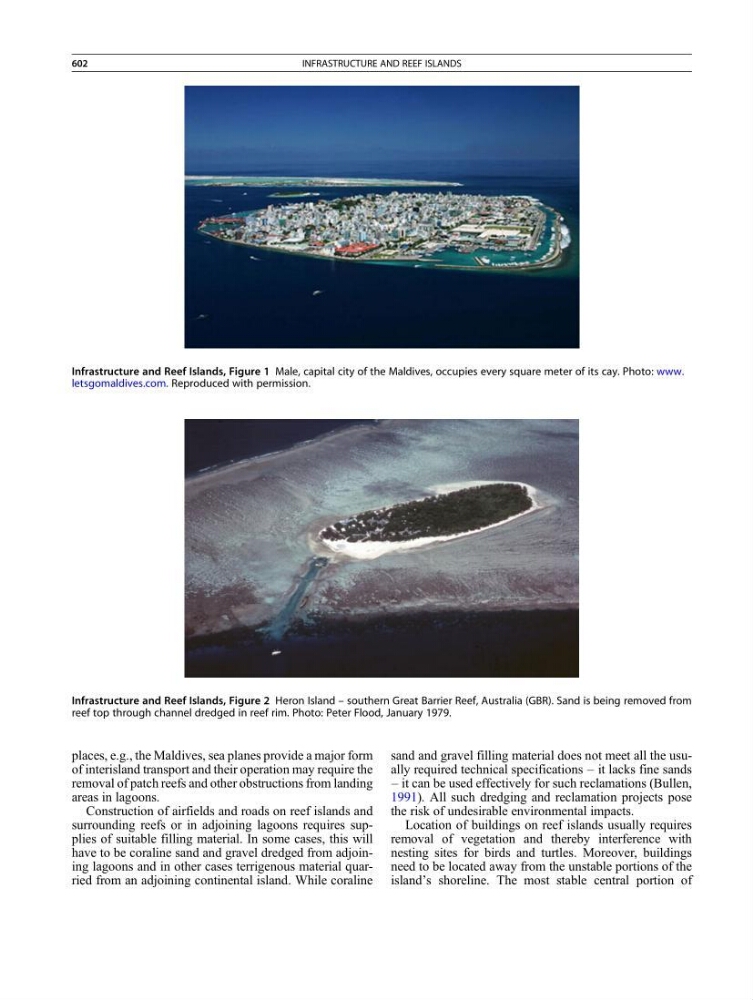
Infrastructure and Reef Islands, Figure 1 Male, capital city of the Maldives, occupies every square meter of its cay. Photo: www.
letsgomaldives.com. Reproduced with permission.
Infrastructure and Reef Islands, Figure 2 Heron Island – southern Great Barrier Reef, Australia (GBR). Sand is being removed from
reef top through channel dredged in reef rim. Photo: Peter Flood, January 1979.
602
INFRASTRUCTURE AND REEF ISLANDS