

necessarily require or indicate detrimentally abundant
dissolved nutrients.
Fleshy macroalgae can outcompete corals (Birkeland,
1977; Bellwood et al., 2006), many of which are inhibited
under elevated nutrient levels (reviewed in Marubini and
Davies, 1996). Fast-growing macroalgae are opportunists
that benefit from disturbances that release space resources
from established longer-lived organisms. They can also
take over space from living corals (Birkeland, 1977) when
provided with sufficient nutrients. As a result, frondose
macroalgae (those that form carpets of horizontal thalli)
are generally recognized as harmful to coral reefs due to
the linkage between excessive blooms and coastal eutrophication (ECOHAB, 1997). The competitive dominance
of fast-growing macroalgae is inferred from their overshadowing canopy heights, as well as from inverse correlations in abundances between algae and other benthic
producers (Lewis, 1986), particularly under elevated nutrient concentrations (e.g., Littler et al., 1993; Lapointe et al.,
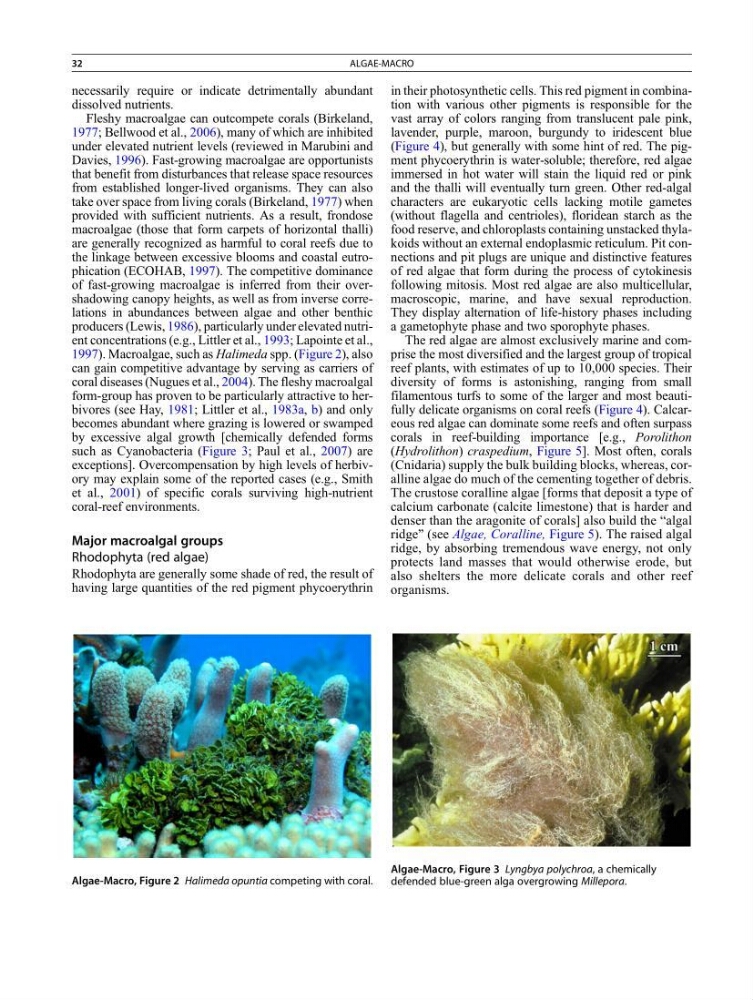
1997). Macroalgae, such as Halimeda spp. (Figure 2), also
can gain competitive advantage by serving as carriers of
coral diseases (Nugues et al., 2004). The fleshy macroalgal
form-group has proven to be particularly attractive to herbivores (see Hay, 1981; Littler et al., 1983a, b) and only
becomes abundant where grazing is lowered or swamped
by excessive algal growth [chemically defended forms
such as Cyanobacteria (Figure 3; Paul et al., 2007) are
exceptions]. Overcompensation by high levels of herbivory may explain some of the reported cases (e.g., Smith
et al., 2001) of specific corals surviving high-nutrient
coral-reef environments.
Major macroalgal groups
Rhodophyta (red algae)
Rhodophyta are generally some shade of red, the result of
having large quantities of the red pigment phycoerythrin
in their photosynthetic cells. This red pigment in combination with various other pigments is responsible for the
vast array of colors ranging from translucent pale pink,
lavender, purple, maroon, burgundy to iridescent blue
(Figure 4), but generally with some hint of red. The pigment phycoerythrin is water-soluble; therefore, red algae
immersed in hot water will stain the liquid red or pink
and the thalli will eventually turn green. Other red-algal
characters are eukaryotic cells lacking motile gametes
(without flagella and centrioles), floridean starch as the
food reserve, and chloroplasts containing unstacked thylakoids without an external endoplasmic reticulum. Pit connections and pit plugs are unique and distinctive features
of red algae that form during the process of cytokinesis
following mitosis. Most red algae are also multicellular,
macroscopic, marine, and have sexual reproduction.
They display alternation of life-history phases including
a gametophyte phase and two sporophyte phases.
The red algae are almost exclusively marine and comprise the most diversified and the largest group of tropical
reef plants, with estimates of up to 10,000 species. Their
diversity of forms is astonishing, ranging from small
filamentous turfs to some of the larger and most beautifully delicate organisms on coral reefs (Figure 4). Calcareous red algae can dominate some reefs and often surpass
corals in reef-building importance [e.g., Porolithon
(Hydrolithon) craspedium, Figure 5]. Most often, corals
(Cnidaria) supply the bulk building blocks, whereas, coralline algae do much of the cementing together of debris.
The crustose coralline algae [forms that deposit a type of
calcium carbonate (calcite limestone) that is harder and
denser than the aragonite of corals] also build the “algal
ridge” (see Algae, Coralline, Figure 5). The raised algal
ridge, by absorbing tremendous wave energy, not only
protects land masses that would otherwise erode, but
also shelters the more delicate corals and other reef
organisms.
Algae-Macro, Figure 2 Halimeda opuntia competing with coral.
Algae-Macro, Figure 3 Lyngbya polychroa, a chemically
defended blue-green alga overgrowing Millepora.
32
ALGAE-MACRO
dissolved nutrients.
Fleshy macroalgae can outcompete corals (Birkeland,
1977; Bellwood et al., 2006), many of which are inhibited
under elevated nutrient levels (reviewed in Marubini and
Davies, 1996). Fast-growing macroalgae are opportunists
that benefit from disturbances that release space resources
from established longer-lived organisms. They can also
take over space from living corals (Birkeland, 1977) when
provided with sufficient nutrients. As a result, frondose
macroalgae (those that form carpets of horizontal thalli)
are generally recognized as harmful to coral reefs due to
the linkage between excessive blooms and coastal eutrophication (ECOHAB, 1997). The competitive dominance
of fast-growing macroalgae is inferred from their overshadowing canopy heights, as well as from inverse correlations in abundances between algae and other benthic
producers (Lewis, 1986), particularly under elevated nutrient concentrations (e.g., Littler et al., 1993; Lapointe et al.,
1997). Macroalgae, such as Halimeda spp. (Figure 2), also
can gain competitive advantage by serving as carriers of
coral diseases (Nugues et al., 2004). The fleshy macroalgal
form-group has proven to be particularly attractive to herbivores (see Hay, 1981; Littler et al., 1983a, b) and only
becomes abundant where grazing is lowered or swamped
by excessive algal growth [chemically defended forms
such as Cyanobacteria (Figure 3; Paul et al., 2007) are
exceptions]. Overcompensation by high levels of herbivory may explain some of the reported cases (e.g., Smith
et al., 2001) of specific corals surviving high-nutrient
coral-reef environments.
Major macroalgal groups
Rhodophyta (red algae)
Rhodophyta are generally some shade of red, the result of
having large quantities of the red pigment phycoerythrin
in their photosynthetic cells. This red pigment in combination with various other pigments is responsible for the
vast array of colors ranging from translucent pale pink,
lavender, purple, maroon, burgundy to iridescent blue
(Figure 4), but generally with some hint of red. The pigment phycoerythrin is water-soluble; therefore, red algae
immersed in hot water will stain the liquid red or pink
and the thalli will eventually turn green. Other red-algal
characters are eukaryotic cells lacking motile gametes
(without flagella and centrioles), floridean starch as the
food reserve, and chloroplasts containing unstacked thylakoids without an external endoplasmic reticulum. Pit connections and pit plugs are unique and distinctive features
of red algae that form during the process of cytokinesis
following mitosis. Most red algae are also multicellular,
macroscopic, marine, and have sexual reproduction.
They display alternation of life-history phases including
a gametophyte phase and two sporophyte phases.
The red algae are almost exclusively marine and comprise the most diversified and the largest group of tropical
reef plants, with estimates of up to 10,000 species. Their
diversity of forms is astonishing, ranging from small
filamentous turfs to some of the larger and most beautifully delicate organisms on coral reefs (Figure 4). Calcareous red algae can dominate some reefs and often surpass
corals in reef-building importance [e.g., Porolithon
(Hydrolithon) craspedium, Figure 5]. Most often, corals
(Cnidaria) supply the bulk building blocks, whereas, coralline algae do much of the cementing together of debris.
The crustose coralline algae [forms that deposit a type of
calcium carbonate (calcite limestone) that is harder and
denser than the aragonite of corals] also build the “algal
ridge” (see Algae, Coralline, Figure 5). The raised algal
ridge, by absorbing tremendous wave energy, not only
protects land masses that would otherwise erode, but
also shelters the more delicate corals and other reef
organisms.
Algae-Macro, Figure 2 Halimeda opuntia competing with coral.
Algae-Macro, Figure 3 Lyngbya polychroa, a chemically
defended blue-green alga overgrowing Millepora.
32
ALGAE-MACRO