

sedimentary facies including (1) coral-mollusk facies of
the outer barrier reef, (2) coral-red algal facies of the reef
flat, (3) mollusk-coral and (4) mollusk-Halimeda facies
of the lagoon, and (5) mollusk-foram facies of the deep
lagoonal plains. Guilcher (1971) compared the Mayotte
barrier reef with south Pacific (Polynesian) barrier reefs
and noted that a major difference is the lack of a distinct
algal ridge and larger cays (motu).
Maldives
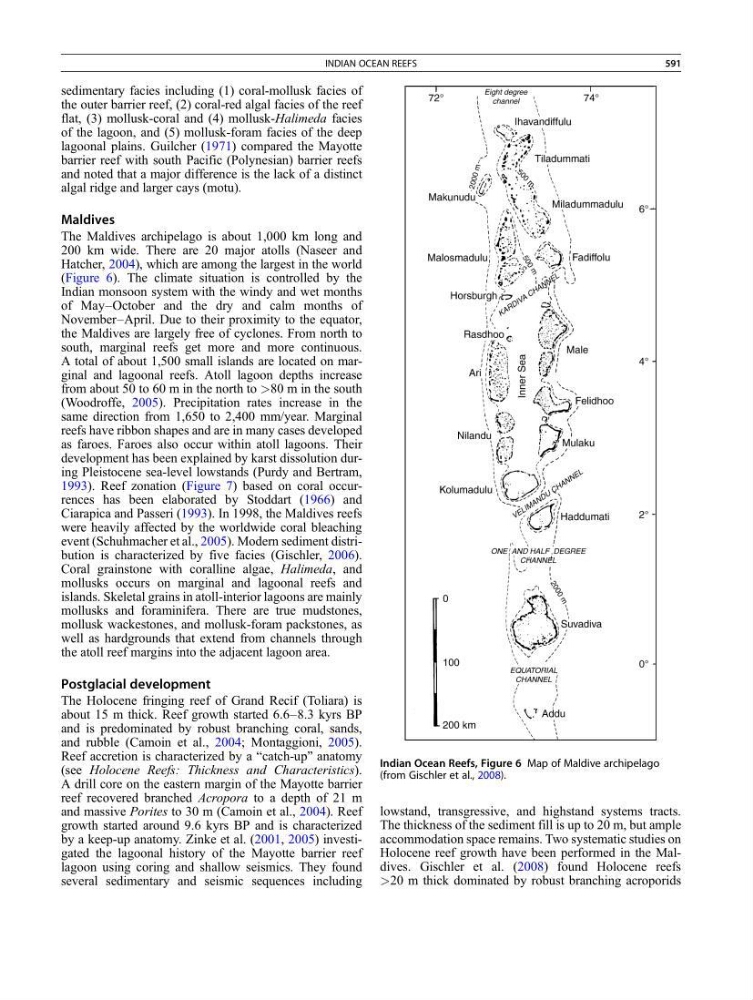
The Maldives archipelago is about 1,000 km long and
200 km wide. There are 20 major atolls (Naseer and
Hatcher, 2004), which are among the largest in the world
(Figure 6). The climate situation is controlled by the
Indian monsoon system with the windy and wet months
of May–October and the dry and calm months of
November–April. Due to their proximity to the equator,
the Maldives are largely free of cyclones. From north to
south, marginal reefs get more and more continuous.
A total of about 1,500 small islands are located on marginal and lagoonal reefs. Atoll lagoon depths increase
from about 50 to 60 m in the north to >80 m in the south
(Woodroffe, 2005). Precipitation rates increase in the
same direction from 1,650 to 2,400 mm/year. Marginal
reefs have ribbon shapes and are in many cases developed
as faroes. Faroes also occur within atoll lagoons. Their
development has been explained by karst dissolution during Pleistocene sea-level lowstands (Purdy and Bertram,
1993). Reef zonation (Figure 7) based on coral occurrences has been elaborated by Stoddart (1966) and
Ciarapica and Passeri (1993). In 1998, the Maldives reefs
were heavily affected by the worldwide coral bleaching
event (Schuhmacher et al., 2005). Modern sediment distribution is characterized by five facies (Gischler, 2006).
Coral grainstone with coralline algae, Halimeda, and
mollusks occurs on marginal and lagoonal reefs and
islands. Skeletal grains in atoll-interior lagoons are mainly
mollusks and foraminifera. There are true mudstones,
mollusk wackestones, and mollusk-foram packstones, as
well as hardgrounds that extend from channels through
the atoll reef margins into the adjacent lagoon area.
Postglacial development
The Holocene fringing reef of Grand Recif (Toliara) is
about 15 m thick. Reef growth started 6.6–8.3 kyrs BP
and is predominated by robust branching coral, sands,
and rubble (Camoin et al., 2004; Montaggioni, 2005).
Reef accretion is characterized by a “catch-up” anatomy
(see Holocene Reefs: Thickness and Characteristics).
A drill core on the eastern margin of the Mayotte barrier
reef recovered branched Acropora to a depth of 21 m
and massive Porites to 30 m (Camoin et al., 2004). Reef
growth started around 9.6 kyrs BP and is characterized
by a keep-up anatomy. Zinke et al. (2001, 2005) investigated the lagoonal history of the Mayotte barrier reef
lagoon using coring and shallow seismics. They found
several sedimentary and seismic sequences including
lowstand, transgressive, and highstand systems tracts.
The thickness of the sediment fill is up to 20 m, but ample
accommodation space remains. Two systematic studies on
Holocene reef growth have been performed in the Maldives. Gischler et al. (2008) found Holocene reefs
>20 m thick dominated by robust branching acroporids
Indian Ocean Reefs, Figure 6 Map of Maldive archipelago
(from Gischler et al., 2008).
INDIAN OCEAN REEFS
591