

in marginal sites and massive corals (Porites) and sand
and rubble facies in lagoonal reef sites. Reef growth
started no later than 8.5 kyrs BP. Marginal reefs belong
to the keep-up and lagoonal reefs to the catch-up types.
Late Pleistocene reef limestone from marine isotope stage
5e (135 kyears BP) underlies the Holocene reefs. Kench
et al. (2009) found comparable reef thicknesses and timings of reef growth; however, their cores were dominated
by massive corals, possibly due to the more protected drill
sites as compared to the ones of Gischler et al. (2008). In
addition, Kench et al. (2009) concluded that late Holocene
sea level exceeded the modern one by 0.5 m from 4 kyrs
BP, based on microatoll data (Figure 8). Holocene sea
level in the Indian Ocean in general is controversial, in that
both transgressive and transgressive–regressive curves
have been proposed (Camoin et al., 2004; Woodroffe,
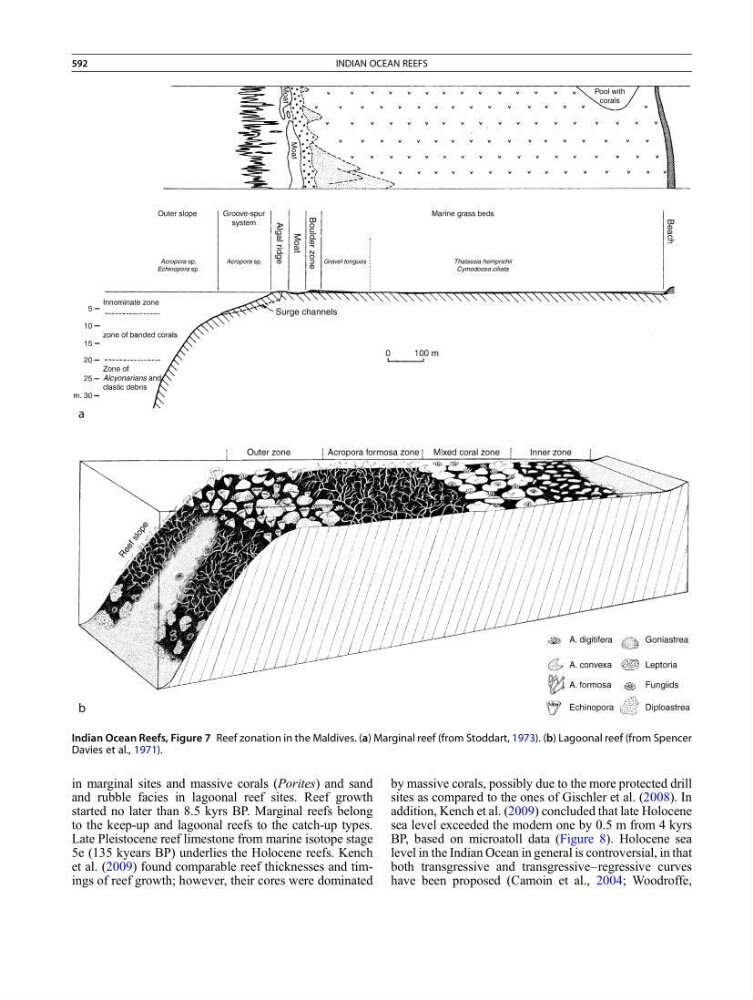
Indian Ocean Reefs, Figure 7 Reef zonation in the Maldives. (a) Marginal reef (from Stoddart, 1973). (b) Lagoonal reef (from Spencer
Davies et al., 1971).
592
INDIAN OCEAN REEFS