

slope spurs and grooves, (2) outer flat with spurs and
grooves, (3) boulder zone, (4) loose-surface flat, (5) seagrass, and (6) inner slope zones (Figure 3). More than
200 species of Scleractinian corals have been described
from Grand Récif. Some authors refer to Grand Récif as
a fringing reef (Pichon, 1964, 1971) and others as
a barrier reef (Guilcher, 1988, p. 107). Similar problems
of terminology exist for Ningaloo Reef on the western
Australian coast. Both have sections that are “typical” narrow fringing reefs close to the shore, as well as offshore
sections that are much larger, more complex, and separated from the shore by navigable channels up to several
kilometers in width.
Mayotte
The volcanic island of Mayotte in the western Indian
Ocean covers an area of 375 km
2 and is 660 m high
(Figure 4). There is a surrounding barrier reef that is up
to 2 km wide and interrupted by deep (60–80 m) channels.
Four small sand cays occur on the barrier reef. In the NW,
the barrier reef has a wide gap. Interestingly, some areas of
the barrier reef form ribbons and faroes comparable to
marginal reefs in the Maldives (see below). The lagoon
inside the barrier reef covers some 1,500 km
2
, is up to
15 km wide, and reaches a depth of 80 m (Guilcher,
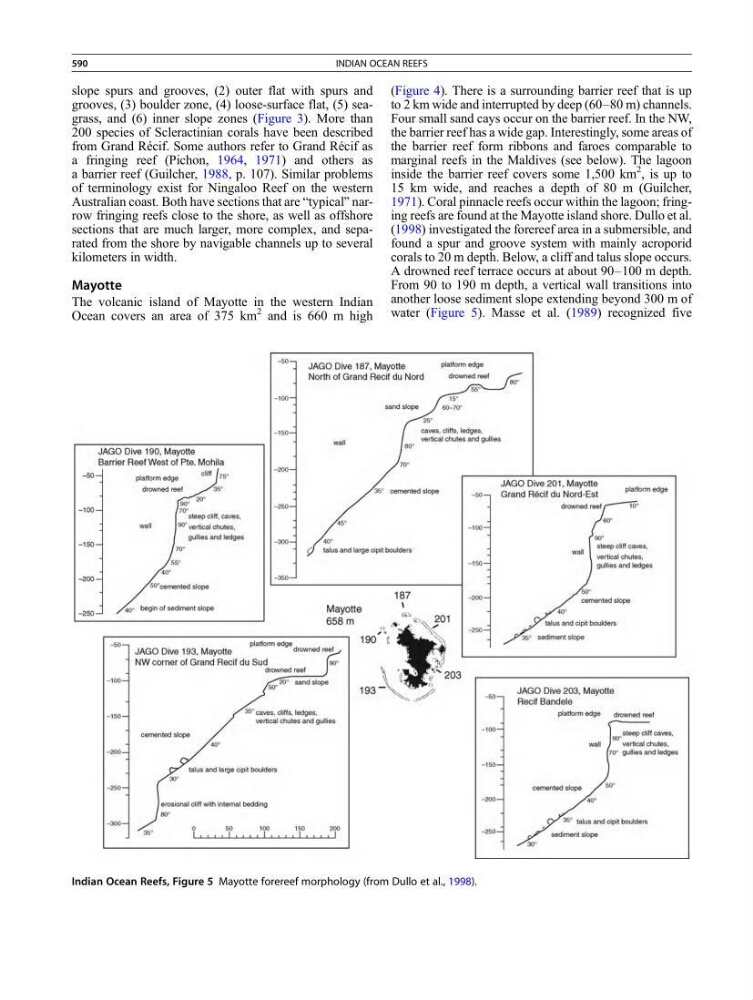
1971). Coral pinnacle reefs occur within the lagoon; fringing reefs are found at the Mayotte island shore. Dullo et al.
(1998) investigated the forereef area in a submersible, and
found a spur and groove system with mainly acroporid
corals to 20 m depth. Below, a cliff and talus slope occurs.
A drowned reef terrace occurs at about 90–100 m depth.
From 90 to 190 m depth, a vertical wall transitions into
another loose sediment slope extending beyond 300 m of
water (Figure 5). Masse et al. (1989) recognized five
Indian Ocean Reefs, Figure 5 Mayotte forereef morphology (from Dullo et al., 1998).
590
INDIAN OCEAN REEFS