

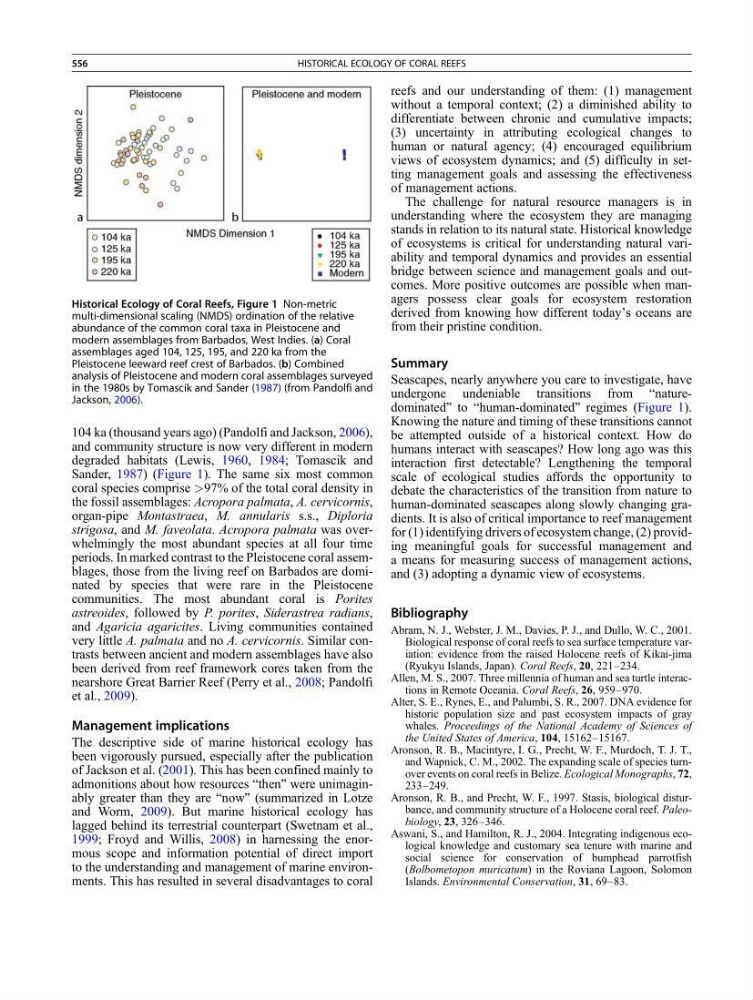
104 ka (thousand years ago) (Pandolfi and Jackson, 2006),
and community structure is now very different in modern
degraded habitats (Lewis, 1960, 1984; Tomascik and
Sander, 1987) (Figure 1). The same six most common
coral species comprise >97% of the total coral density in
the fossil assemblages: Acropora palmata, A. cervicornis,
organ-pipe Montastraea, M. annularis s.s., Diploria
strigosa, and M. faveolata. Acropora palmata was overwhelmingly the most abundant species at all four time
periods. In marked contrast to the Pleistocene coral assemblages, those from the living reef on Barbados are dominated by species that were rare in the Pleistocene
communities. The most abundant coral is Porites
astreoides, followed by P. porites, Siderastrea radians,
and Agaricia agaricites. Living communities contained
very little A. palmata and no A. cervicornis. Similar contrasts between ancient and modern assemblages have also
been derived from reef framework cores taken from the
nearshore Great Barrier Reef (Perry et al., 2008; Pandolfi
et al., 2009).
Management implications
The descriptive side of marine historical ecology has
been vigorously pursued, especially after the publication
of Jackson et al. (2001). This has been confined mainly to
admonitions about how resources “then” were unimaginably greater than they are “now” (summarized in Lotze
and Worm, 2009). But marine historical ecology has
lagged behind its terrestrial counterpart (Swetnam et al.,
1999; Froyd and Willis, 2008) in harnessing the enormous scope and information potential of direct import
to the understanding and management of marine environments. This has resulted in several disadvantages to coral
reefs and our understanding of them: (1) management
without a temporal context; (2) a diminished ability to
differentiate between chronic and cumulative impacts;
(3) uncertainty in attributing ecological changes to
human or natural agency; (4) encouraged equilibrium
views of ecosystem dynamics; and (5) difficulty in setting management goals and assessing the effectiveness
of management actions.
The challenge for natural resource managers is in
understanding where the ecosystem they are managing
stands in relation to its natural state. Historical knowledge
of ecosystems is critical for understanding natural variability and temporal dynamics and provides an essential
bridge between science and management goals and outcomes. More positive outcomes are possible when managers possess clear goals for ecosystem restoration
derived from knowing how different today’s oceans are
from their pristine condition.
Summary
Seascapes, nearly anywhere you care to investigate, have
undergone undeniable transitions from “naturedominated” to “human-dominated” regimes (Figure 1).
Knowing the nature and timing of these transitions cannot
be attempted outside of a historical context. How do
humans interact with seascapes? How long ago was this
interaction first detectable? Lengthening the temporal
scale of ecological studies affords the opportunity to
debate the characteristics of the transition from nature to
human-dominated seascapes along slowly changing gradients. It is also of critical importance to reef management
for (1) identifying drivers of ecosystem change, (2) providing meaningful goals for successful management and
a means for measuring success of management actions,
and (3) adopting a dynamic view of ecosystems.
Bibliography
Abram, N. J., Webster, J. M., Davies, P. J., and Dullo, W. C., 2001.
Biological response of coral reefs to sea surface temperature variation: evidence from the raised Holocene reefs of Kikai-jima
(Ryukyu Islands, Japan). Coral Reefs, 20, 221–234.
Allen, M. S., 2007. Three millennia of human and sea turtle interactions in Remote Oceania. Coral Reefs, 26, 959–970.
Alter, S. E., Rynes, E., and Palumbi, S. R., 2007. DNA evidence for
historic population size and past ecosystem impacts of gray
whales. Proceedings of the National Academy of Sciences of
the United States of America, 104, 15162–15167.
Aronson, R. B., Macintyre, I. G., Precht, W. F., Murdoch, T. J. T.,
and Wapnick, C. M., 2002. The expanding scale of species turnover events on coral reefs in Belize. Ecological Monographs, 72,
233–249.
Aronson, R. B., and Precht, W. F., 1997. Stasis, biological disturbance, and community structure of a Holocene coral reef. Paleobiology, 23, 326–346.
Aswani, S., and Hamilton, R. J., 2004. Integrating indigenous ecological knowledge and customary sea tenure with marine and
social science for conservation of bumphead parrotfish
(Bolbometopon muricatum) in the Roviana Lagoon, Solomon
Islands. Environmental Conservation, 31, 69–83.
Historical Ecology of Coral Reefs, Figure 1 Non-metric
multi-dimensional scaling (NMDS) ordination of the relative
abundance of the common coral taxa in Pleistocene and
modern assemblages from Barbados, West Indies. (a) Coral
assemblages aged 104, 125, 195, and 220 ka from the
Pleistocene leeward reef crest of Barbados. (b) Combined
analysis of Pleistocene and modern coral assemblages surveyed
in the 1980s by Tomascik and Sander (1987) (from Pandolfi and
Jackson, 2006).
556
HISTORICAL ECOLOGY OF CORAL REEFS