

eutrophication in areas of confined circulation, particularly in shallow water bays and on reef flats, and widespread over-fishing of reef fish on practically all offshore
reefs. There is an urgent need to strengthen the enforcement of fish and game regulations by the State of Hawaii.
The State should also actively increase the number of
Marine Protected Areas (MPA’s) in the main islands
where today only about 1% of the coastline is protected.
In contrast, the NWHI have been almost completely
protected under a recent (2006) Executive Order that
reclassified the entire area (except Midway Island) as
a Marine Monument.
Outlook
Looking ahead toward the present century, particularly with
regard to global climate change (GCC), coral reefs in the
Hawaiian Archipelago may be relatively well situated.
The four most important factors associated with GCC that
may affect coral reefs are sea-level rise, increases in sea surface temperature, increases in ocean acidification, and
increased storminess. Rising sea level may pose
a flooding problem for the lowest isles in the northwest
but it will also raise the “lid” providing more accommodation space for coral reef growth to take place on most island
shelves throughout the chain. Given the northern latitude of
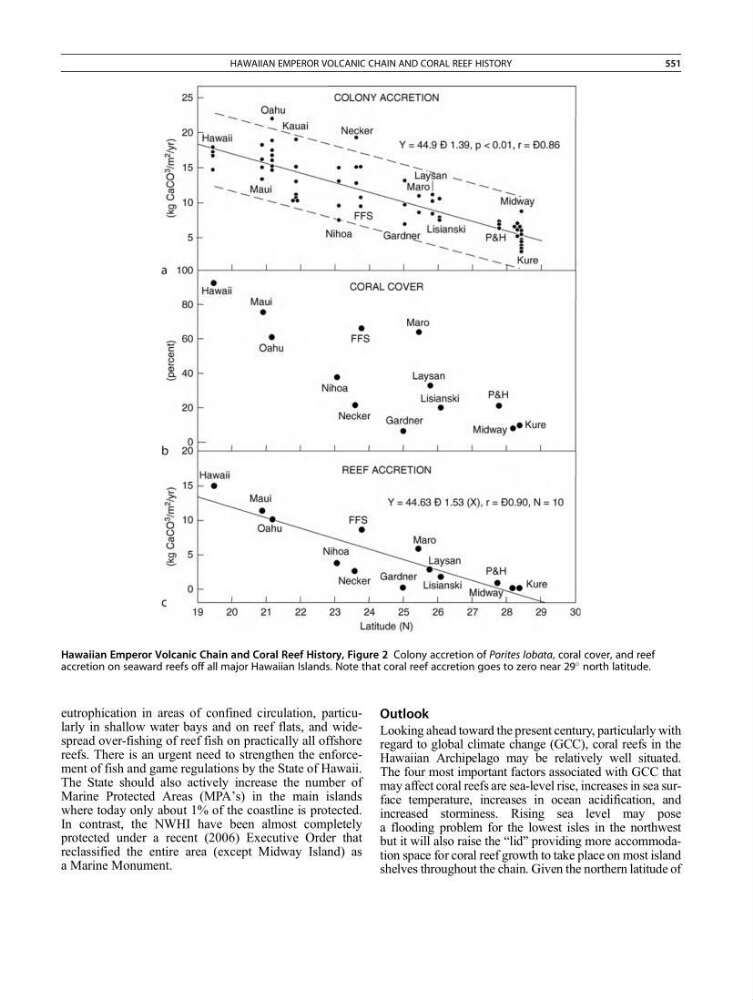
Hawaiian Emperor Volcanic Chain and Coral Reef History, Figure 2 Colony accretion of Porites lobata, coral cover, and reef
accretion on seaward reefs off all major Hawaiian Islands. Note that coral reef accretion goes to zero near 29
north latitude.
HAWAIIAN EMPEROR VOLCANIC CHAIN AND CORAL REEF HISTORY
551