

the Archipelago, rising sea surface temperature may not be
as great a problem as it could be for more tropical reefs.
Although effects due to increasing ocean acidification are
not well understood, large carbonate deposits that exist
throughout the Archipelago may buffer the potential
impacts of slightly lower pH. Increased storminess is also
hard to predict depending on frequency, magnitude, and
location, but if larger wave events are produced, then intermediate disturbance may become more limiting to coral
development and abundance. Overall, while it may be premature to predict dire consequences for the health of coral
reefs globally, the coming century clearly contains as many
challenges as it does uncertainties.
Bibliography
Dollar, S. J., 1982. Wave stress and coral community structure in
Hawaii. Coral Reefs, 1, 71–81.
Darwin, C., 1842. Coral Reefs. London: Smith Elder.
Fletcher, C. H., Bochicchio, C., Conger, C. L., Engels, M. S.,
Feirstein, E. J., Frazer, N., Glenn, C. R., Grossman, E. E.,
Harney, J. N., Isoun, E., Murray-Wallace, C. V., Rooney, J. J.,
Rubin, K. H., Sherman, C. E., and Vitousek, S., 2008. Geology
of Hawaiian reefs. In Riegl, B. M., and Dodge, R. E. (eds.),
Coral Reefs of the USA. Springer, Vol. 11, pp. 435–487.
Grigg, R. W., 1982. Darwin Point: A threshold for atoll formation.
Coral Reefs, 1, 29–34.
Grigg, R. W., 1988. Paleoceanography of coral reefs in the Hawaiian-Emperor Chain. Science, 240, 1737–1743.
Grigg, R. W., 1997. Paleoceanography of the Hawaiian-Emperor
Archipelago – revisited. Coral Reefs, 16, 145–153.
Grigg, R. W., 2008. The Darwin Point: a conceptual and historical
review. Proceedings 11
th International Coral Reef Symposium.
Fort Lauderdale, Florida, Mini-Symposium, 3, 1–5.
Jackson, E. D., Koizumi, I., Dalrymple, G. B., Clague, D. A.,
Kirkpatrick, J. R., and Greene, H. G., 1980. Introduction and
summary of the results of the DSDP Leg 55, the HawaiianEmperor experiment. Initial Reports Deep Sea Drilling Project,
55, 5–31.
Kennett, J. P., 1982. Marine Geology. Englewood Cliffs, NJ:
Prentice-Hall.
Morgan, W. J., 1972. Deep mantle convection plumes and plate
motions. American Association Petroleum Geologists Bulletin,
56, 203–213.
Maragos, J. E., Potts, D. C., Aeby, G., Gulko, D., Kenyon, J.,
Sciliano, D., and VanRavenswaay, D., 2004. Rapid ecological
assessment of corals (Anthozoa) on shallow reefs of the North
West Hawaiian Islands. Part I. Species and distributions. Pacific
Science, 58, 211–230.
Rooney, J. J., Wessel, P., Hoeke, R., Weiss, J., Baker, J., Parrish, F.,
Fletcher, C. H., Chojnacki, J., Garcia, M., Brainard, R., and
Vroom, P., 2008. Geology and Geomorphology of Coral Reefs
in the Northwestern Hawaiian Islands. In Riegl, B. M., and
Dodge, R. E. (eds.), Coral Reefs of the USA. Springer, Vol. 13,
pp. 519–571.
Scott, A. J., and Rotondo, G. M., 1983. A model to explain the differences between Pacific plate island-atoll types. Coral Reefs, 1,
139–149.
Veron, J. E. N., 2000. Corals of the World. Townsville, Australia:
Australian Institute Marine Science.
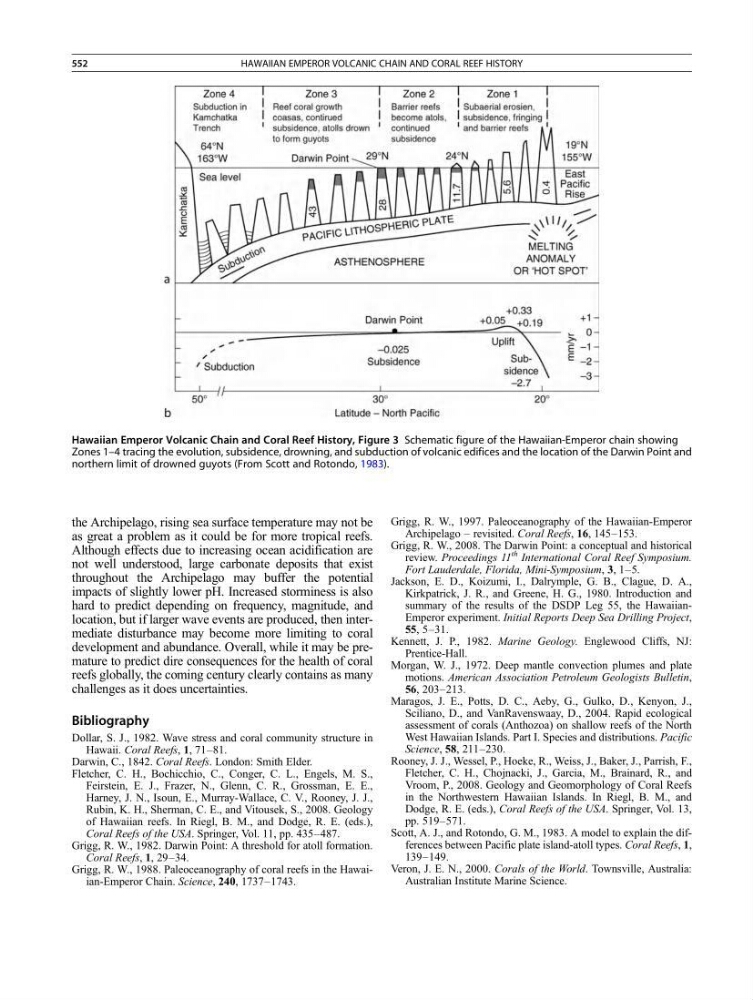
Hawaiian Emperor Volcanic Chain and Coral Reef History, Figure 3 Schematic figure of the Hawaiian-Emperor chain showing
Zones 1–4 tracing the evolution, subsidence, drowning, and subduction of volcanic edifices and the location of the Darwin Point and
northern limit of drowned guyots (From Scott and Rotondo, 1983).
552
HAWAIIAN EMPEROR VOLCANIC CHAIN AND CORAL REEF HISTORY