

strengthened and both are sources of transport of IWP
coral larvae into the northern Pacific Ocean. Hence,
the sudden appearance of reef corals in the Hawaiian
Archipelago and their continual presence throughout the
Neogene to the present day might best be attributed to
ocean circulation. Even today, the coral fauna of Hawaii
is highly attenuated and consists of less than 10% of the
coral species now present in the IWP.
Although the fossil record shows that reef corals have
been in the Hawaiian Archipelago since Mid-Oligocene
time, a moderate degree of taxonomic turnover has
occurred. Extinction and re-colonization events are particularly evident in the Midway core from the present all the
way back to early Miocene time (Wells, 1982). This is not
surprising, nor unexpected, given the northerly position of
the Hawaiian Islands near the latitudinal limits of reef
building corals as well as their relative isolation from
island stepping stones to the south and west.
Today, approximately 59 species of reef building corals
have been recognized in the main Hawaiian Islands while
57 are reported in the Northwestern Hawaiian Islands
(NWHI), (Maragos et al., 2004). These totals, while
significant, are still relatively depauperate compared to
the IWP where about 700 species are reported to exist
(Veron, 2000). The low species diversity of modern
Hawaiian reef building corals underlines the significance
of the isolation of the Hawaiian Archipelago, as well as,
its northerly latitude. The effect of latitude is particularly
important when applied to the growth rate of individual
corals.
Using Porites lobata as a proxy for all other common
reef corals in the Hawaiian Archipelago, Grigg (1982,
1997, 2008) showed that growth rates at the southeastern
end of the chain are typical of tropical coral growth rates
in general, while moving northwest in the chain, they
decline in a linear fashion almost as a direct function of
latitude (Figures 2 and 3). At the very end of the Archipelago, at a latitude of $29
north at Kure Atoll, the
net growth rate was found to be virtually zero if losses
due to bio-erosion, mechanical erosion, and the subsidence rate of the island were all taken into account.
If this fact is considered over geological time in combination with the northwesterly movement of the Pacific Plate,
then subsequent drift of the atoll to the northwest would
cause it to gradually drown, setting the northern limit
(threshold) of atoll formation (Grigg, 1982). In recognition of Darwin’s original theory of atoll formation
(Darwin, 1842), Grigg labeled this threshold “The Darwin
Point”.
Looking at coral reefs today in the Hawaiian Archipelago, they span about 10
of latitude stretching from optimal environments in the southeast to those in the
northwest at the extreme limits of coral reef growth. Considering the natural constraints associated with this geography, most Hawaiian reefs today are exceptionally
healthy. The most common natural disturbance events
are large episodic waves that abrade and scour the reefs
(Dollar, 1982). Within the major high Hawaiian Islands
from Hawaii to Kauai, the most significant anthropogenic
impacts include sedimentation events from land runoff,
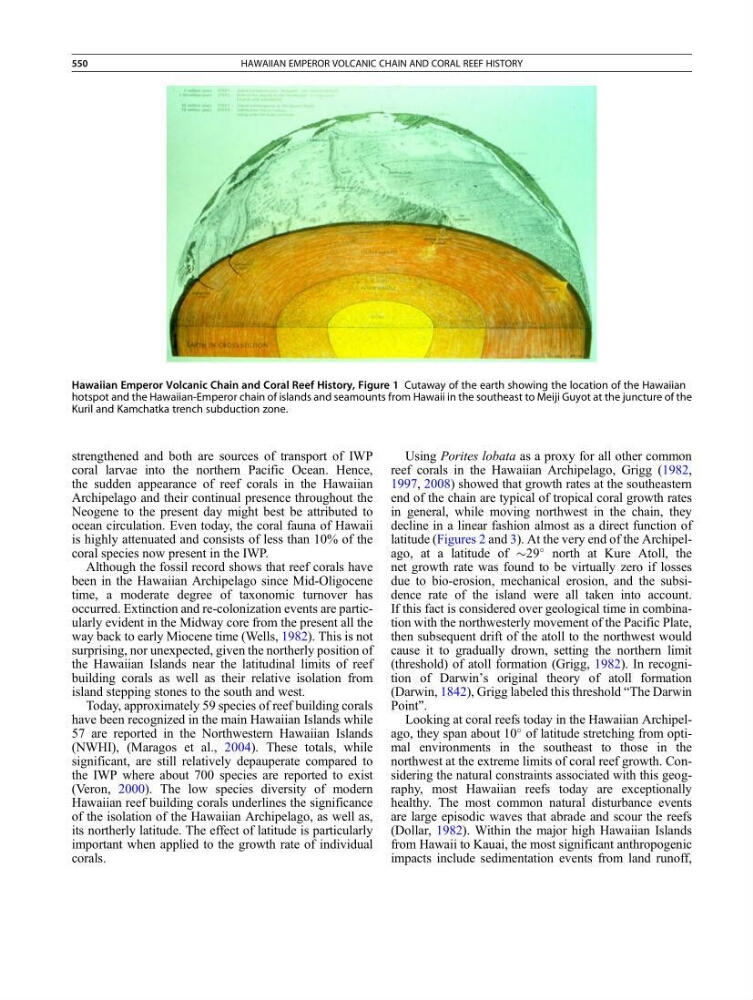
Hawaiian Emperor Volcanic Chain and Coral Reef History, Figure 1 Cutaway of the earth showing the location of the Hawaiian
hotspot and the Hawaiian-Emperor chain of islands and seamounts from Hawaii in the southeast to Meiji Guyot at the juncture of the
Kuril and Kamchatka trench subduction zone.
550
HAWAIIAN EMPEROR VOLCANIC CHAIN AND CORAL REEF HISTORY