

totally consuming host corallines that are left in its wake.
All species of articulated and crustose species tested to
date are easily infected by CLOD and it has now spread
to become circumtropical throughout all coral-reef habitats. In recent years, a white version of CLOD-like pathogen has become even more abundant worldwide, in
addition to the recently recorded dispersion of a virulent
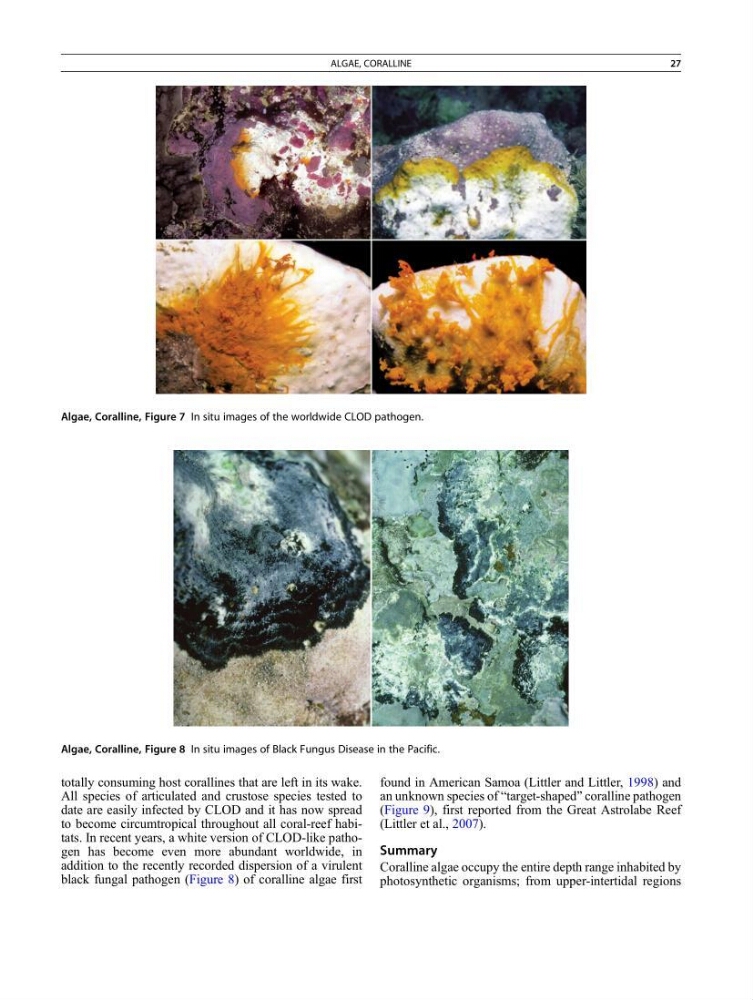
black fungal pathogen (Figure 8) of coralline algae first
found in American Samoa (Littler and Littler, 1998) and
an unknown species of “target-shaped” coralline pathogen
(Figure 9), first reported from the Great Astrolabe Reef
(Littler et al., 2007).
Summary
Coralline algae occupy the entire depth range inhabited by
photosynthetic organisms; from upper-intertidal regions
Algae, Coralline, Figure 7 In situ images of the worldwide CLOD pathogen.
Algae, Coralline, Figure 8 In situ images of Black Fungus Disease in the Pacific.
ALGAE, CORALLINE
27
All species of articulated and crustose species tested to
date are easily infected by CLOD and it has now spread
to become circumtropical throughout all coral-reef habitats. In recent years, a white version of CLOD-like pathogen has become even more abundant worldwide, in
addition to the recently recorded dispersion of a virulent
black fungal pathogen (Figure 8) of coralline algae first
found in American Samoa (Littler and Littler, 1998) and
an unknown species of “target-shaped” coralline pathogen
(Figure 9), first reported from the Great Astrolabe Reef
(Littler et al., 2007).
Summary
Coralline algae occupy the entire depth range inhabited by
photosynthetic organisms; from upper-intertidal regions
Algae, Coralline, Figure 7 In situ images of the worldwide CLOD pathogen.
Algae, Coralline, Figure 8 In situ images of Black Fungus Disease in the Pacific.
ALGAE, CORALLINE
27