

corallines (mainly species of Hydrolithon/Porolithon) are
crucial in constructing the framework, characterizes surfpounded windward coral reefs of tropical Indo-Pacific
and, to a lesser extent, Atlantic regions. The Pacific
algal-ridge builder, Hydrolithon (Porolithon) onkodes,
fixes a remarkable 3.2 mg of organic carbon per square
meter per hour and 1.9 mg Ca per square meter per hour
during an average daylight day (Littler, 1973). The algal
ridge by extending above the waterline absorbs tremendous wave energy, not only protecting coastal shorelines
that would otherwise erode, but also sheltering the more
delicate corals and other reef organisms. Algal ridges
develop intertidally and, therefore, require intense and
persistent wave action to form, so are best developed on
windward areas where there are consistent trade wind
conditions.
Some of the coralline algae that develop into shelf-like,
thick knobby, or upright branched crusts provide microhabitats for countless vulnerable invertebrates that would
otherwise suffer increased mortality due to fish predation
(Figure 3). Coralline algae also constitute a food source
in the energy webs of coral reefs. Sea urchins, parrotfishes,
surgeonfishes, limpets, and chitons all readily feed on coralline algae, which are usually not destroyed due to
sunken intercalary meristems that replenish the upper
damaged areas. Crustose corallines accelerate colonization by chemically attracting/facilitating the survival of
coral larvae (Harrington et al., 2004), as well as the larvae
of certain grazing invertebrates. This is adaptive for the
corallines because the herbivores then remove epiphytes
that might preempt available light or otherwise smother
the crusts. Because of their stony texture, indigestible
acid-neutralizing CaCO 3 , and covered intercalary meristematic layer, corallines are uniquely resistant to considerable levels of grazing. As examples, the most common
Indo-Pacific crustose coralline, Hydrolithon (Porolithon)
onkodes, often forms an intimate interrelationship with
the chiton Cryptoplax larvaeformis (Littler and Littler,
1999), as does the Atlantic coralline H. pachydermum
and the chiton Choneplax lata (Littler et al., 1995). The
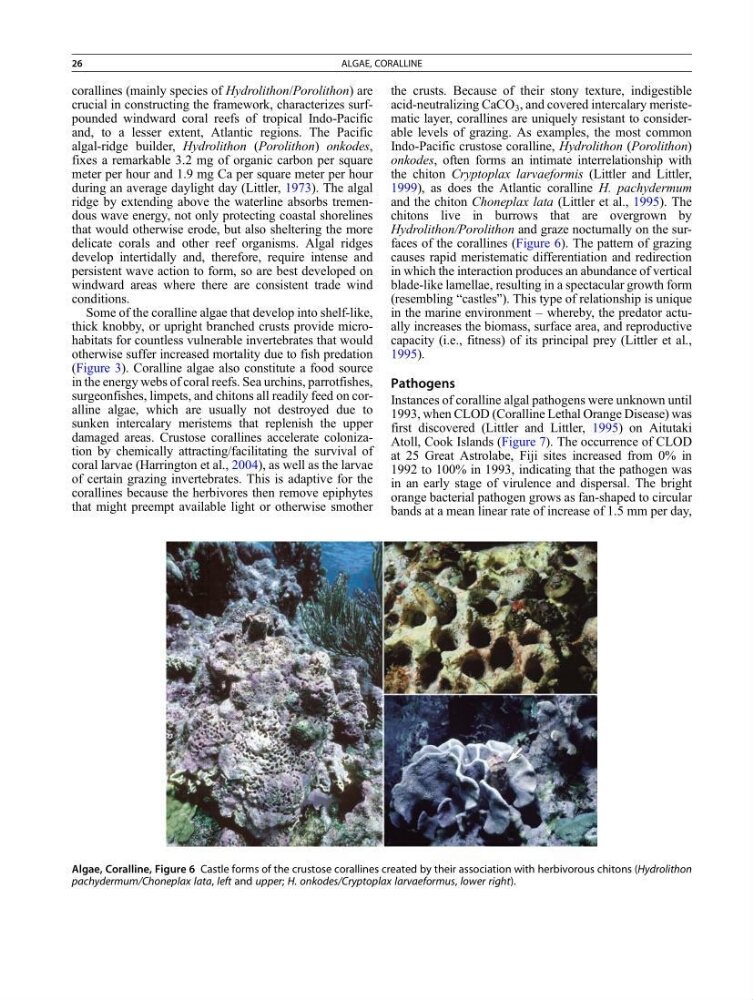
chitons live in burrows that are overgrown by
Hydrolithon/Porolithon and graze nocturnally on the surfaces of the corallines (Figure 6). The pattern of grazing
causes rapid meristematic differentiation and redirection
in which the interaction produces an abundance of vertical
blade-like lamellae, resulting in a spectacular growth form
(resembling “castles”). This type of relationship is unique
in the marine environment – whereby, the predator actually increases the biomass, surface area, and reproductive
capacity (i.e., fitness) of its principal prey (Littler et al.,
1995).
Pathogens
Instances of coralline algal pathogens were unknown until
1993, when CLOD (Coralline Lethal Orange Disease) was
first discovered (Littler and Littler, 1995) on Aitutaki
Atoll, Cook Islands (Figure 7). The occurrence of CLOD
at 25 Great Astrolabe, Fiji sites increased from 0% in
1992 to 100% in 1993, indicating that the pathogen was
in an early stage of virulence and dispersal. The bright
orange bacterial pathogen grows as fan-shaped to circular
bands at a mean linear rate of increase of 1.5 mm per day,
Algae, Coralline, Figure 6 Castle forms of the crustose corallines created by their association with herbivorous chitons (Hydrolithon
pachydermum/Choneplax lata, left and upper; H. onkodes/Cryptoplax larvaeformus, lower right).
26
ALGAE, CORALLINE
crucial in constructing the framework, characterizes surfpounded windward coral reefs of tropical Indo-Pacific
and, to a lesser extent, Atlantic regions. The Pacific
algal-ridge builder, Hydrolithon (Porolithon) onkodes,
fixes a remarkable 3.2 mg of organic carbon per square
meter per hour and 1.9 mg Ca per square meter per hour
during an average daylight day (Littler, 1973). The algal
ridge by extending above the waterline absorbs tremendous wave energy, not only protecting coastal shorelines
that would otherwise erode, but also sheltering the more
delicate corals and other reef organisms. Algal ridges
develop intertidally and, therefore, require intense and
persistent wave action to form, so are best developed on
windward areas where there are consistent trade wind
conditions.
Some of the coralline algae that develop into shelf-like,
thick knobby, or upright branched crusts provide microhabitats for countless vulnerable invertebrates that would
otherwise suffer increased mortality due to fish predation
(Figure 3). Coralline algae also constitute a food source
in the energy webs of coral reefs. Sea urchins, parrotfishes,
surgeonfishes, limpets, and chitons all readily feed on coralline algae, which are usually not destroyed due to
sunken intercalary meristems that replenish the upper
damaged areas. Crustose corallines accelerate colonization by chemically attracting/facilitating the survival of
coral larvae (Harrington et al., 2004), as well as the larvae
of certain grazing invertebrates. This is adaptive for the
corallines because the herbivores then remove epiphytes
that might preempt available light or otherwise smother
the crusts. Because of their stony texture, indigestible
acid-neutralizing CaCO 3 , and covered intercalary meristematic layer, corallines are uniquely resistant to considerable levels of grazing. As examples, the most common
Indo-Pacific crustose coralline, Hydrolithon (Porolithon)
onkodes, often forms an intimate interrelationship with
the chiton Cryptoplax larvaeformis (Littler and Littler,
1999), as does the Atlantic coralline H. pachydermum
and the chiton Choneplax lata (Littler et al., 1995). The
chitons live in burrows that are overgrown by
Hydrolithon/Porolithon and graze nocturnally on the surfaces of the corallines (Figure 6). The pattern of grazing
causes rapid meristematic differentiation and redirection
in which the interaction produces an abundance of vertical
blade-like lamellae, resulting in a spectacular growth form
(resembling “castles”). This type of relationship is unique
in the marine environment – whereby, the predator actually increases the biomass, surface area, and reproductive
capacity (i.e., fitness) of its principal prey (Littler et al.,
1995).
Pathogens
Instances of coralline algal pathogens were unknown until
1993, when CLOD (Coralline Lethal Orange Disease) was
first discovered (Littler and Littler, 1995) on Aitutaki
Atoll, Cook Islands (Figure 7). The occurrence of CLOD
at 25 Great Astrolabe, Fiji sites increased from 0% in
1992 to 100% in 1993, indicating that the pathogen was
in an early stage of virulence and dispersal. The bright
orange bacterial pathogen grows as fan-shaped to circular
bands at a mean linear rate of increase of 1.5 mm per day,
Algae, Coralline, Figure 6 Castle forms of the crustose corallines created by their association with herbivorous chitons (Hydrolithon
pachydermum/Choneplax lata, left and upper; H. onkodes/Cryptoplax larvaeformus, lower right).
26
ALGAE, CORALLINE