

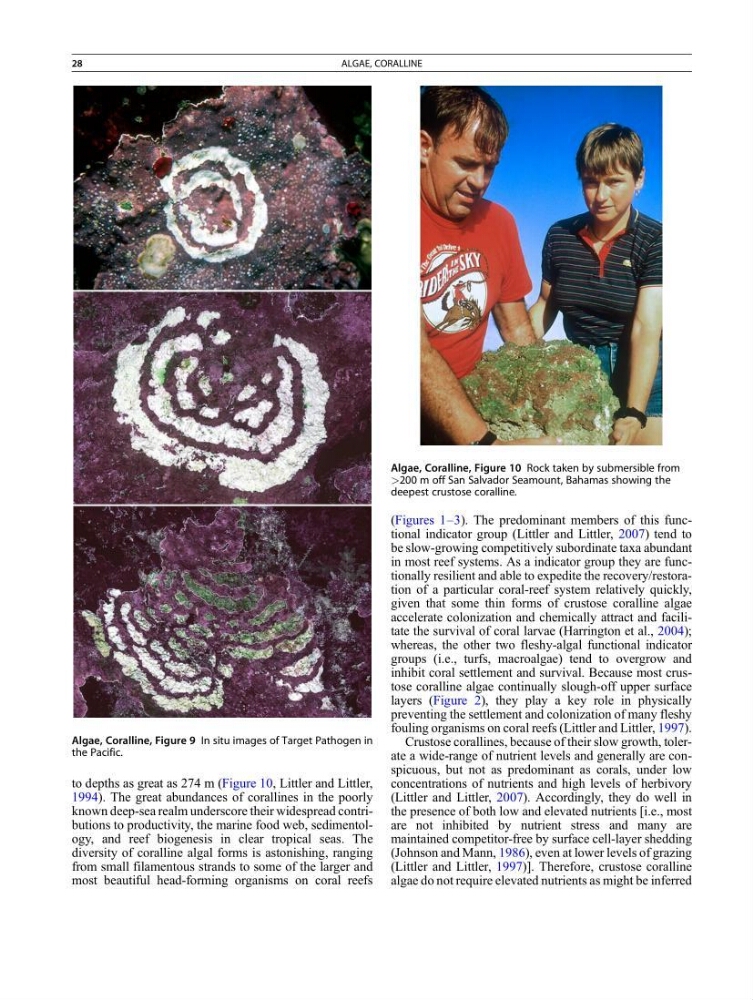
to depths as great as 274 m (Figure 10, Littler and Littler,
1994). The great abundances of corallines in the poorly
known deep-sea realm underscore their widespread contributions to productivity, the marine food web, sedimentology, and reef biogenesis in clear tropical seas. The
diversity of coralline algal forms is astonishing, ranging
from small filamentous strands to some of the larger and
most beautiful head-forming organisms on coral reefs
(Figures 1–3). The predominant members of this functional indicator group (Littler and Littler, 2007) tend to
be slow-growing competitively subordinate taxa abundant
in most reef systems. As a indicator group they are functionally resilient and able to expedite the recovery/restoration of a particular coral-reef system relatively quickly,
given that some thin forms of crustose coralline algae
accelerate colonization and chemically attract and facilitate the survival of coral larvae (Harrington et al., 2004);
whereas, the other two fleshy-algal functional indicator
groups (i.e., turfs, macroalgae) tend to overgrow and
inhibit coral settlement and survival. Because most crustose coralline algae continually slough-off upper surface
layers (Figure 2), they play a key role in physically
preventing the settlement and colonization of many fleshy
fouling organisms on coral reefs (Littler and Littler, 1997).
Crustose corallines, because of their slow growth, tolerate a wide-range of nutrient levels and generally are conspicuous, but not as predominant as corals, under low
concentrations of nutrients and high levels of herbivory
(Littler and Littler, 2007). Accordingly, they do well in
the presence of both low and elevated nutrients [i.e., most
are not inhibited by nutrient stress and many are
maintained competitor-free by surface cell-layer shedding
(Johnson and Mann, 1986), even at lower levels of grazing
(Littler and Littler, 1997)]. Therefore, crustose coralline
algae do not require elevated nutrients as might be inferred
Algae, Coralline, Figure 9 In situ images of Target Pathogen in
the Pacific.
Algae, Coralline, Figure 10 Rock taken by submersible from
>200 m off San Salvador Seamount, Bahamas showing the
deepest crustose coralline.
28
ALGAE, CORALLINE
1994). The great abundances of corallines in the poorly
known deep-sea realm underscore their widespread contributions to productivity, the marine food web, sedimentology, and reef biogenesis in clear tropical seas. The
diversity of coralline algal forms is astonishing, ranging
from small filamentous strands to some of the larger and
most beautiful head-forming organisms on coral reefs
(Figures 1–3). The predominant members of this functional indicator group (Littler and Littler, 2007) tend to
be slow-growing competitively subordinate taxa abundant
in most reef systems. As a indicator group they are functionally resilient and able to expedite the recovery/restoration of a particular coral-reef system relatively quickly,
given that some thin forms of crustose coralline algae
accelerate colonization and chemically attract and facilitate the survival of coral larvae (Harrington et al., 2004);
whereas, the other two fleshy-algal functional indicator
groups (i.e., turfs, macroalgae) tend to overgrow and
inhibit coral settlement and survival. Because most crustose coralline algae continually slough-off upper surface
layers (Figure 2), they play a key role in physically
preventing the settlement and colonization of many fleshy
fouling organisms on coral reefs (Littler and Littler, 1997).
Crustose corallines, because of their slow growth, tolerate a wide-range of nutrient levels and generally are conspicuous, but not as predominant as corals, under low
concentrations of nutrients and high levels of herbivory
(Littler and Littler, 2007). Accordingly, they do well in
the presence of both low and elevated nutrients [i.e., most
are not inhibited by nutrient stress and many are
maintained competitor-free by surface cell-layer shedding
(Johnson and Mann, 1986), even at lower levels of grazing
(Littler and Littler, 1997)]. Therefore, crustose coralline
algae do not require elevated nutrients as might be inferred
Algae, Coralline, Figure 9 In situ images of Target Pathogen in
the Pacific.
Algae, Coralline, Figure 10 Rock taken by submersible from
>200 m off San Salvador Seamount, Bahamas showing the
deepest crustose coralline.
28
ALGAE, CORALLINE