

(possible?) relation to the more recently coined biological
term, Meadows. For these reasons, it is proposed to very
briefly clarify as follows:
First, Halimeda are green calcareous precipitating algae
from the phylum Chlorophyta in the order Bryopsidales
and in two families – Halimedaceae and Udoteaceae.
The taxonomy is described by Hillis-Colinvaux (1980)
and in the Great Barrier Reef in various papers by Drew
and Abel (see references in Drew and Abel, 1988a, b).
There is no confusion over the term Halimeda, only sometimes over the identification of species.
Secondly, Bioherm is a geological term coined by
Cummings (1932) to describe both bedded and nonbedded
lens-like or mound-like accumulations, comprised of the
often in situ accumulation of invertebrate organisms. The
original definition had reefs in mind, invoking topographic relief above the sea floor, an in situ framework
and rapid accumulation. In a modern sense, the bioherms
described in this entry are not reefal, yet they are moundlike, often with significant relief above the surrounding
sea floor and with internal characters, which are bedded
or nonbedded and composed of in situ and derived
biologic accumulations that have accreted rapidly. In
a geological sense, mound-like structures sometimes show
substantial mud and few framework organisms (many Carboniferous mounds) and are still legitimately termed
bioherms. In the original definition, Cummings (op cit)
distinguished bioherms from related structures termed
Biostromes (see review by Kershaw, 1994), defined as
nonreefal flat bedded structures often but not necessarily
comprised of organic accumulations. It is noted here
because Orme (1985) and Orme et al. (1978) rightly
pointed out that in the northern Great Barrier Reef, large
areas of the mid shelf behind the Ribbon Reefs (termed
“back-reef” by Orme op cit) appear to be comprised of
crudely bedded laterally extensive nonmounded
“biostromal sediments” and are associated with Halimeda
Bioherms (called “banks” by Orme et al., 1978). Later,
Drew and Abel (1988a) described the surface characters
of such areas as “Meadows” and Hillis-Colinvaux
(1988), in a reef lagoonal environment, postulated that
Meadows might evolve into Bioherms.
In the present contribution, Halimeda Bioherms are
used to denote mounds showing relief above the surrounding sea floor and built by the in situ accumulation of
Halimeda together with other infauna. They are sometimes called Banks (Orme and Salama, 1988) although
Banks should rightly be reserved for much larger structures, for example, Bahama Banks. In the Great Barrier
Reef and elsewhere, Halimeda Bioherms are associated
with often larger areas having an extensive sheet-like form
and called Biostromal areas (Orme and Salama, 1988,
p. 136), the surface of such areas are called Halimeda
Meadows by Drew and Abel (1988b). Thus, the origin
of biostromes (a 3-D geologic term) might be elucidated
by studying their surface “Meadows” (a 2-D biological
term). Further, the origin of the Bioherms might be determined through studies of the spatially related Meadows/
Biostromes. This entry follows this treatment. First however, the biology of Halimeda Bioherms and their related
meadows are briefly reviewed.
The biology of Halimeda bioherms and adjacent
meadows (biostromes)
Halimeda are a green alga that belongs to the phyllum
Chlorophyta in the order Bryopsidales. Halimeda are
described by Hillis-Colinvaux (1980, 1988) as being
either Rhipsalian and possessing a holdfast or nonRhipsalian and possessing none or a limited holdfast. In
the modern environment, Halimeda occur as an accessory
component of reefs, or as principal components of
bioherms and meadows.
Halimeda Bioherms generally occur above a base line
of 50 m water depth while meadows generally occur
below this depth. The most extensive publications on their
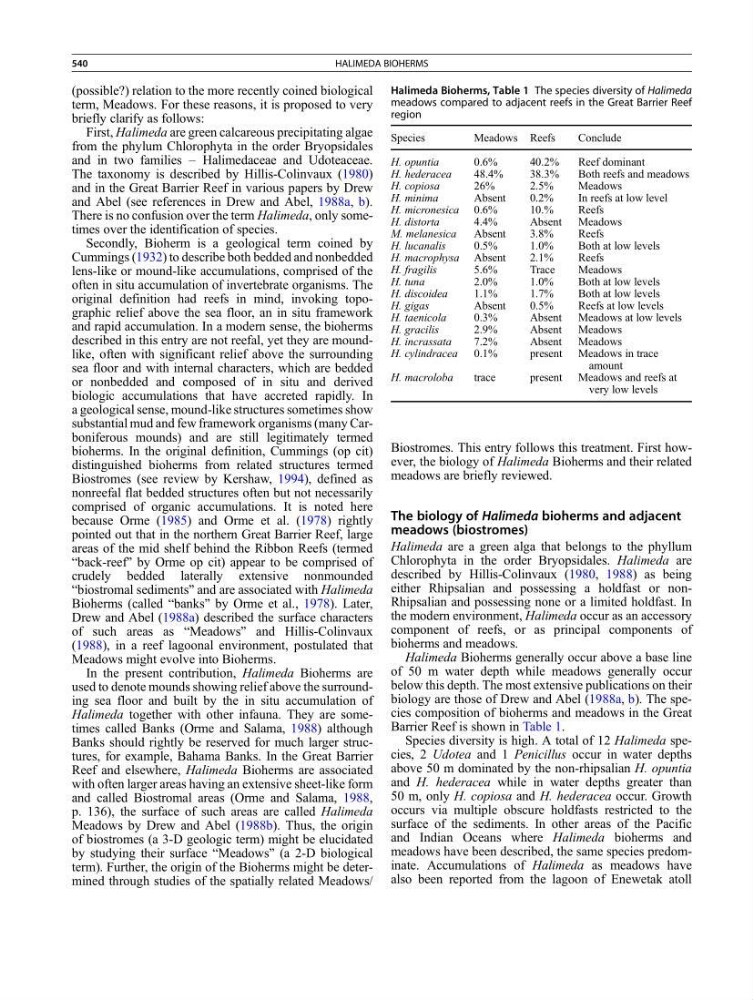
biology are those of Drew and Abel (1988a, b). The species composition of bioherms and meadows in the Great
Barrier Reef is shown in Table 1.
Species diversity is high. A total of 12 Halimeda species, 2 Udotea and 1 Penicillus occur in water depths
above 50 m dominated by the non-rhipsalian H. opuntia
and H. hederacea while in water depths greater than
50 m, only H. copiosa and H. hederacea occur. Growth
occurs via multiple obscure holdfasts restricted to the
surface of the sediments. In other areas of the Pacific
and Indian Oceans where Halimeda bioherms and
meadows have been described, the same species predominate. Accumulations of Halimeda as meadows have
also been reported from the lagoon of Enewetak atoll
Halimeda Bioherms, Table 1 The species diversity of Halimeda
meadows compared to adjacent reefs in the Great Barrier Reef
region
Species
Meadows Reefs
Conclude
H. opuntia
0.6%
40.2%
Reef dominant
H. hederacea
48.4%
38.3%
Both reefs and meadows
H. copiosa
26%
2.5%
Meadows
H. minima
Absent
0.2%
In reefs at low level
H. micronesica 0.6%
10.%
Reefs
H. distorta
4.4%
Absent Meadows
M. melanesica
Absent
3.8%
Reefs
H. lucanalis
0.5%
1.0%
Both at low levels
H. macrophysa Absent
2.1%
Reefs
H. fragilis
5.6%
Trace
Meadows
H. tuna
2.0%
1.0%
Both at low levels
H. discoidea
1.1%
1.7%
Both at low levels
H. gigas
Absent
0.5%
Reefs at low levels
H. taenicola
0.3%
Absent Meadows at low levels
H. gracilis
2.9%
Absent Meadows
H. incrassata
7.2%
Absent Meadows
H. cylindracea 0.1%
present Meadows in trace
amount
H. macroloba
trace
present Meadows and reefs at
very low levels
540
HALIMEDA BIOHERMS