

(Hillis-Colinvaux, 1988) where the dominant species are
the rhipsalian H. incrussata and H. cylindrica.
The global distribution of Halimeda bioherms
The Great Barrier Reef
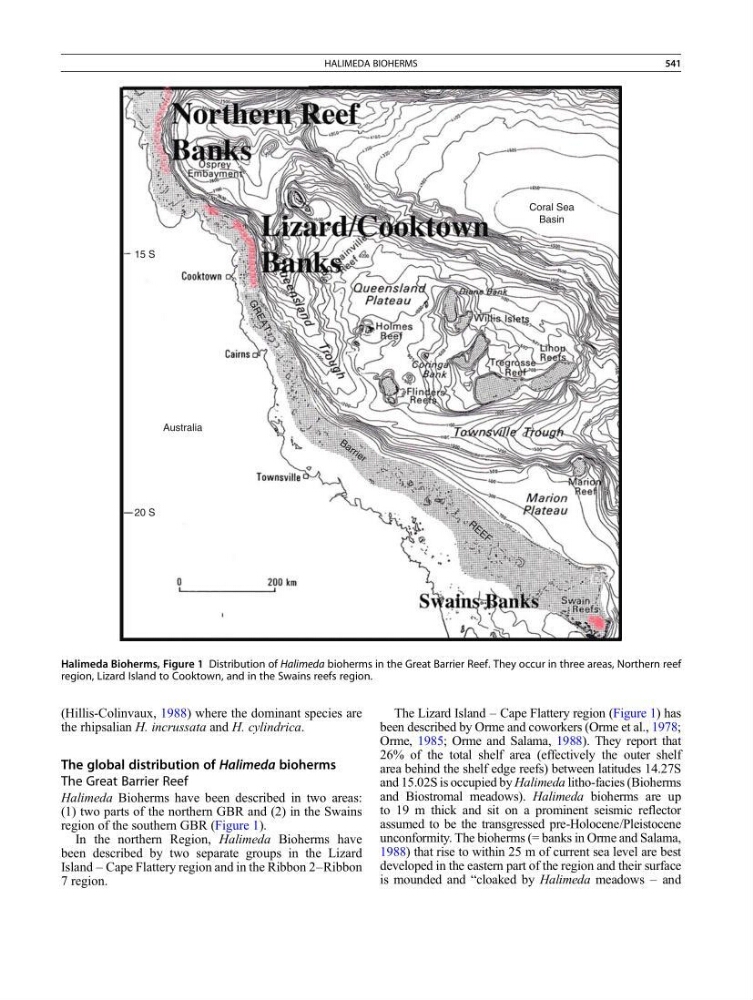
Halimeda Bioherms have been described in two areas:
(1) two parts of the northern GBR and (2) in the Swains
region of the southern GBR (Figure 1).
In the northern Region, Halimeda Bioherms have
been described by two separate groups in the Lizard
Island – Cape Flattery region and in the Ribbon 2–Ribbon
7 region.
The Lizard Island – Cape Flattery region (Figure 1) has
been described by Orme and coworkers (Orme et al., 1978;
Orme, 1985; Orme and Salama, 1988). They report that
26% of the total shelf area (effectively the outer shelf
area behind the shelf edge reefs) between latitudes 14.27S
and 15.02S is occupied by Halimeda litho-facies (Bioherms
and Biostromal meadows). Halimeda bioherms are up
to 19 m thick and sit on a prominent seismic reflector
assumed to be the transgressed pre-Holocene/Pleistocene
unconformity. The bioherms (= banks in Orme and Salama,
1988) that rise to within 25 m of current sea level are best
developed in the eastern part of the region and their surface
is mounded and “cloaked by Halimeda meadows – and
15 S
20 S
Australia
Coral Sea
Basin
G
R
E
A
T
R E E F
B a r r i e r
Halimeda Bioherms, Figure 1 Distribution of Halimeda bioherms in the Great Barrier Reef. They occur in three areas, Northern reef
region, Lizard Island to Cooktown, and in the Swains reefs region.
HALIMEDA BIOHERMS
541