

Chapter “Corals – environmental controls on growth”). Of
these constraints, all but temperature applies equally to
corals and reefs on regional scales.
Temperature is more limiting for reefs than corals
because of an ecological constraint: most corals can tolerate temperatures as low as 14
C for extended periods, but
consolidated reefs will not accrete under 18
C because at
that temperature corals cease to be competitive with
macro-algae in most parts of the world (Veron and
Minchin, 1992). Along subtropical continental coastlines
where at least some zooxanthellate corals occur, reefs
extend to a latitudinal limit defined by temperature which,
in turn, is controlled by the strength of poleward currents
(for example, Figure 3). In open oceans remote from continents, the same constraint applies where suitable substrates exist, but as poleward currents are weaker, the
latitudinal extent of reef development is less.
One further aspect of the role of temperature in controlling the latitudinal range of reefs is that reefs can develop
episodically, surviving as geological structures during
intervals of emergence and cold (such as were created by
the glacial cycles of the Pleistocene) and growing during
interglacial warm intervals.
Surface currents and dispersal
There is a wealth of information from experiments, genetics, taxonomy, and biogeography that coral larvae are able
to make very long ocean journeys, some enduring weeks,
even months, on the sea surface before settling (Richmond, 1987). Species endurance therefore depends on
the speed and direction of currents as well as the existence
of suitable substrates.
Survival during these voyages depends on time, therefore on the distance traveled, and speed.
Corals are dispersed along continental coastlines of
eastern and western Australia by the East Australian Current and Leeuwin Current (respectively) in the Southern
Hemisphere and along the islands of Japan in the
north by the Kuroshio. In each case, there is an orderly
“drop-out” sequence where species numbers progressively
attenuate (Veron, 1995). Each of these boundary currents
varies in position and strength, each variation potentially
causing changes in the number and variety of propagules
reaching high-latitude reefs. Importantly, as each current
flows poleward, propagules entrapped in them are on nonreturn journeys. As a result, these currents overwhelmingly
dominate the nature and diversity of coral communities
found today (Figures 3, 4a, b; Harriott and Banks, 2002).
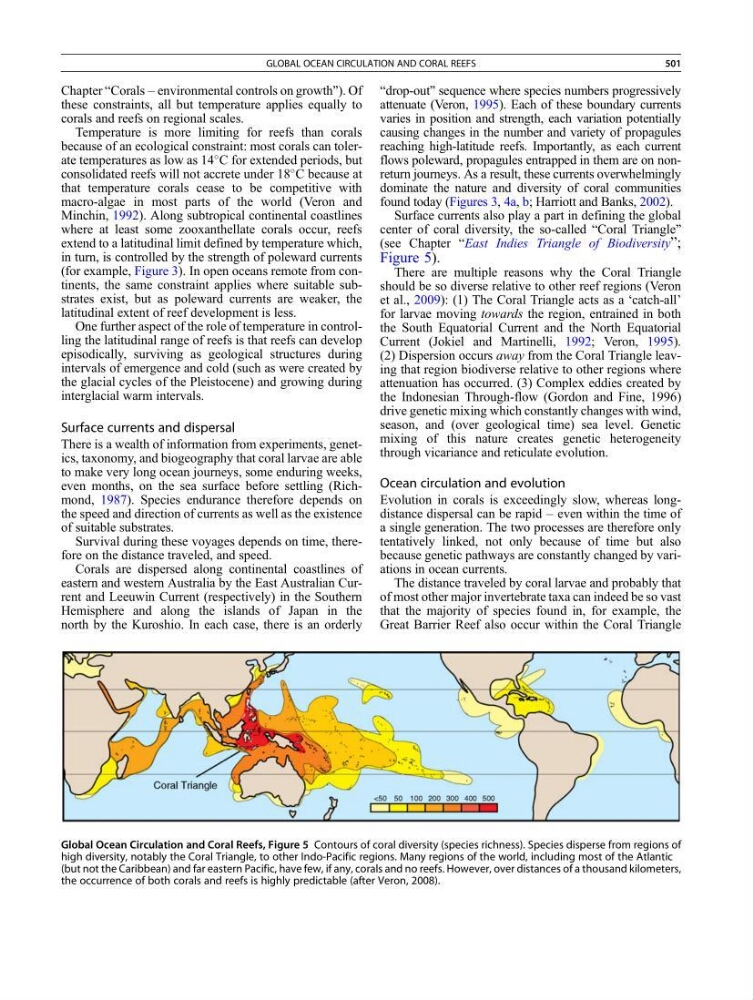
Surface currents also play a part in defining the global
center of coral diversity, the so-called “Coral Triangle”
(see Chapter “East Indies Triangle of Biodiversity”;
Figure 5).
There are multiple reasons why the Coral Triangle
should be so diverse relative to other reef regions (Veron
et al., 2009): (1) The Coral Triangle acts as a ‘catch-all’
for larvae moving towards the region, entrained in both
the South Equatorial Current and the North Equatorial
Current (Jokiel and Martinelli, 1992; Veron, 1995).
(2) Dispersion occurs away from the Coral Triangle leaving that region biodiverse relative to other regions where
attenuation has occurred. (3) Complex eddies created by
the Indonesian Through-flow (Gordon and Fine, 1996)
drive genetic mixing which constantly changes with wind,
season, and (over geological time) sea level. Genetic
mixing of this nature creates genetic heterogeneity
through vicariance and reticulate evolution.
Ocean circulation and evolution
Evolution in corals is exceedingly slow, whereas longdistance dispersal can be rapid – even within the time of
a single generation. The two processes are therefore only
tentatively linked, not only because of time but also
because genetic pathways are constantly changed by variations in ocean currents.
The distance traveled by coral larvae and probably that
of most other major invertebrate taxa can indeed be so vast
that the majority of species found in, for example, the
Great Barrier Reef also occur within the Coral Triangle
Global Ocean Circulation and Coral Reefs, Figure 5 Contours of coral diversity (species richness). Species disperse from regions of
high diversity, notably the Coral Triangle, to other Indo-Pacific regions. Many regions of the world, including most of the Atlantic
(but not the Caribbean) and far eastern Pacific, have few, if any, corals and no reefs. However, over distances of a thousand kilometers,
the occurrence of both corals and reefs is highly predictable (after Veron, 2008).
GLOBAL OCEAN CIRCULATION AND CORAL REEFS
501
these constraints, all but temperature applies equally to
corals and reefs on regional scales.
Temperature is more limiting for reefs than corals
because of an ecological constraint: most corals can tolerate temperatures as low as 14
C for extended periods, but
consolidated reefs will not accrete under 18
C because at
that temperature corals cease to be competitive with
macro-algae in most parts of the world (Veron and
Minchin, 1992). Along subtropical continental coastlines
where at least some zooxanthellate corals occur, reefs
extend to a latitudinal limit defined by temperature which,
in turn, is controlled by the strength of poleward currents
(for example, Figure 3). In open oceans remote from continents, the same constraint applies where suitable substrates exist, but as poleward currents are weaker, the
latitudinal extent of reef development is less.
One further aspect of the role of temperature in controlling the latitudinal range of reefs is that reefs can develop
episodically, surviving as geological structures during
intervals of emergence and cold (such as were created by
the glacial cycles of the Pleistocene) and growing during
interglacial warm intervals.
Surface currents and dispersal
There is a wealth of information from experiments, genetics, taxonomy, and biogeography that coral larvae are able
to make very long ocean journeys, some enduring weeks,
even months, on the sea surface before settling (Richmond, 1987). Species endurance therefore depends on
the speed and direction of currents as well as the existence
of suitable substrates.
Survival during these voyages depends on time, therefore on the distance traveled, and speed.
Corals are dispersed along continental coastlines of
eastern and western Australia by the East Australian Current and Leeuwin Current (respectively) in the Southern
Hemisphere and along the islands of Japan in the
north by the Kuroshio. In each case, there is an orderly
“drop-out” sequence where species numbers progressively
attenuate (Veron, 1995). Each of these boundary currents
varies in position and strength, each variation potentially
causing changes in the number and variety of propagules
reaching high-latitude reefs. Importantly, as each current
flows poleward, propagules entrapped in them are on nonreturn journeys. As a result, these currents overwhelmingly
dominate the nature and diversity of coral communities
found today (Figures 3, 4a, b; Harriott and Banks, 2002).
Surface currents also play a part in defining the global
center of coral diversity, the so-called “Coral Triangle”
(see Chapter “East Indies Triangle of Biodiversity”;
Figure 5).
There are multiple reasons why the Coral Triangle
should be so diverse relative to other reef regions (Veron
et al., 2009): (1) The Coral Triangle acts as a ‘catch-all’
for larvae moving towards the region, entrained in both
the South Equatorial Current and the North Equatorial
Current (Jokiel and Martinelli, 1992; Veron, 1995).
(2) Dispersion occurs away from the Coral Triangle leaving that region biodiverse relative to other regions where
attenuation has occurred. (3) Complex eddies created by
the Indonesian Through-flow (Gordon and Fine, 1996)
drive genetic mixing which constantly changes with wind,
season, and (over geological time) sea level. Genetic
mixing of this nature creates genetic heterogeneity
through vicariance and reticulate evolution.
Ocean circulation and evolution
Evolution in corals is exceedingly slow, whereas longdistance dispersal can be rapid – even within the time of
a single generation. The two processes are therefore only
tentatively linked, not only because of time but also
because genetic pathways are constantly changed by variations in ocean currents.
The distance traveled by coral larvae and probably that
of most other major invertebrate taxa can indeed be so vast
that the majority of species found in, for example, the
Great Barrier Reef also occur within the Coral Triangle
Global Ocean Circulation and Coral Reefs, Figure 5 Contours of coral diversity (species richness). Species disperse from regions of
high diversity, notably the Coral Triangle, to other Indo-Pacific regions. Many regions of the world, including most of the Atlantic
(but not the Caribbean) and far eastern Pacific, have few, if any, corals and no reefs. However, over distances of a thousand kilometers,
the occurrence of both corals and reefs is highly predictable (after Veron, 2008).
GLOBAL OCEAN CIRCULATION AND CORAL REEFS
501