

and a high proportion are even recognizable as far away as
the Red Sea.
The relative strength and direction of the currents and
the endurance of the larvae are key aspects of these spatial
patterns – not just the patterns of today, but those of all
times past, for as long as these species have existed.
Today, most major currents are generally stable and move
in predictable directions. However, over geological time,
these same currents have changed their strengths and
directions repeatedly. This has created changing geographic patterns of genetic mixing quite unlike genetic
pathways normally found on land. The result, over geological time, is a template of constant change, which in
turn is the mechanism that drives reticulate evolution
(see Chapter Scleractinia, Evolution and Taxonomy).
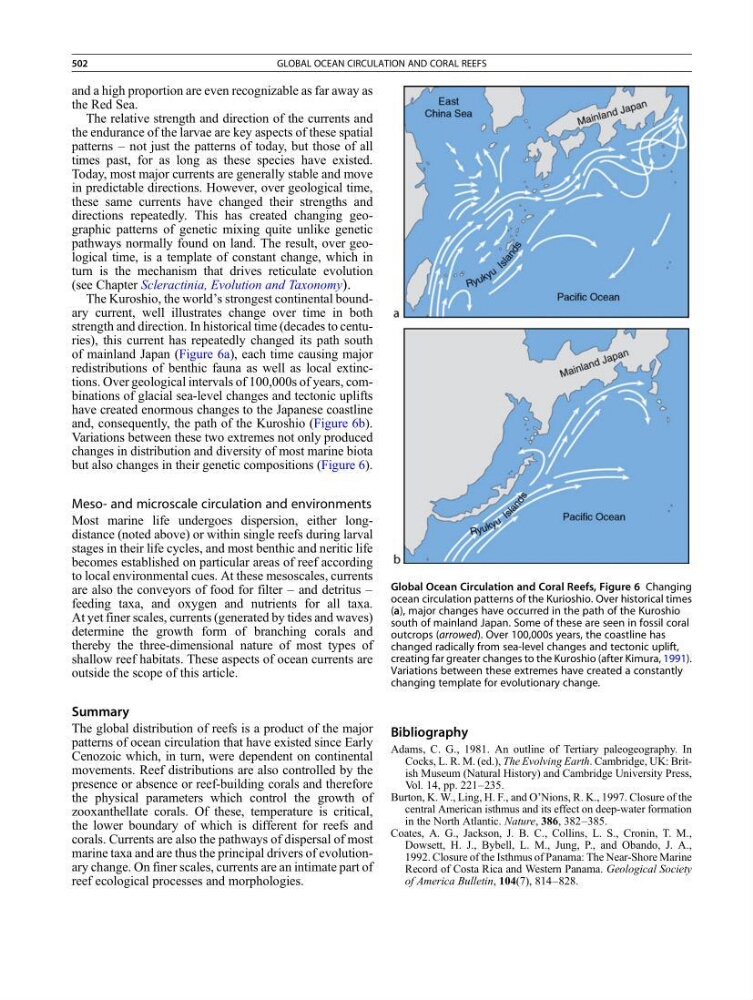
The Kuroshio, the world’s strongest continental boundary current, well illustrates change over time in both
strength and direction. In historical time (decades to centuries), this current has repeatedly changed its path south
of mainland Japan (Figure 6a), each time causing major
redistributions of benthic fauna as well as local extinctions. Over geological intervals of 100,000s of years, combinations of glacial sea-level changes and tectonic uplifts
have created enormous changes to the Japanese coastline
and, consequently, the path of the Kuroshio (Figure 6b).
Variations between these two extremes not only produced
changes in distribution and diversity of most marine biota
but also changes in their genetic compositions (Figure 6).
Meso- and microscale circulation and environments
Most marine life undergoes dispersion, either longdistance (noted above) or within single reefs during larval
stages in their life cycles, and most benthic and neritic life
becomes established on particular areas of reef according
to local environmental cues. At these mesoscales, currents
are also the conveyors of food for filter – and detritus –
feeding taxa, and oxygen and nutrients for all taxa.
At yet finer scales, currents (generated by tides and waves)
determine the growth form of branching corals and
thereby the three-dimensional nature of most types of
shallow reef habitats. These aspects of ocean currents are
outside the scope of this article.
Summary
The global distribution of reefs is a product of the major
patterns of ocean circulation that have existed since Early
Cenozoic which, in turn, were dependent on continental
movements. Reef distributions are also controlled by the
presence or absence or reef-building corals and therefore
the physical parameters which control the growth of
zooxanthellate corals. Of these, temperature is critical,
the lower boundary of which is different for reefs and
corals. Currents are also the pathways of dispersal of most
marine taxa and are thus the principal drivers of evolutionary change. On finer scales, currents are an intimate part of
reef ecological processes and morphologies.
Bibliography
Adams, C. G., 1981. An outline of Tertiary paleogeography. In
Cocks, L. R. M. (ed.), The Evolving Earth. Cambridge, UK: British Museum (Natural History) and Cambridge University Press,
Vol. 14, pp. 221–235.
Burton, K. W., Ling, H. F., and O’Nions, R. K., 1997. Closure of the
central American isthmus and its effect on deep-water formation
in the North Atlantic. Nature, 386, 382–385.
Coates, A. G., Jackson, J. B. C., Collins, L. S., Cronin, T. M.,
Dowsett, H. J., Bybell, L. M., Jung, P., and Obando, J. A.,
1992. Closure of the Isthmus of Panama: The Near-Shore Marine
Record of Costa Rica and Western Panama. Geological Society
of America Bulletin, 104(7), 814–828.
Global Ocean Circulation and Coral Reefs, Figure 6 Changing
ocean circulation patterns of the Kurioshio. Over historical times
(a), major changes have occurred in the path of the Kuroshio
south of mainland Japan. Some of these are seen in fossil coral
outcrops (arrowed). Over 100,000s years, the coastline has
changed radically from sea-level changes and tectonic uplift,
creating far greater changes to the Kuroshio (after Kimura, 1991).
Variations between these extremes have created a constantly
changing template for evolutionary change.
502
GLOBAL OCEAN CIRCULATION AND CORAL REEFS
the Red Sea.
The relative strength and direction of the currents and
the endurance of the larvae are key aspects of these spatial
patterns – not just the patterns of today, but those of all
times past, for as long as these species have existed.
Today, most major currents are generally stable and move
in predictable directions. However, over geological time,
these same currents have changed their strengths and
directions repeatedly. This has created changing geographic patterns of genetic mixing quite unlike genetic
pathways normally found on land. The result, over geological time, is a template of constant change, which in
turn is the mechanism that drives reticulate evolution
(see Chapter Scleractinia, Evolution and Taxonomy).
The Kuroshio, the world’s strongest continental boundary current, well illustrates change over time in both
strength and direction. In historical time (decades to centuries), this current has repeatedly changed its path south
of mainland Japan (Figure 6a), each time causing major
redistributions of benthic fauna as well as local extinctions. Over geological intervals of 100,000s of years, combinations of glacial sea-level changes and tectonic uplifts
have created enormous changes to the Japanese coastline
and, consequently, the path of the Kuroshio (Figure 6b).
Variations between these two extremes not only produced
changes in distribution and diversity of most marine biota
but also changes in their genetic compositions (Figure 6).
Meso- and microscale circulation and environments
Most marine life undergoes dispersion, either longdistance (noted above) or within single reefs during larval
stages in their life cycles, and most benthic and neritic life
becomes established on particular areas of reef according
to local environmental cues. At these mesoscales, currents
are also the conveyors of food for filter – and detritus –
feeding taxa, and oxygen and nutrients for all taxa.
At yet finer scales, currents (generated by tides and waves)
determine the growth form of branching corals and
thereby the three-dimensional nature of most types of
shallow reef habitats. These aspects of ocean currents are
outside the scope of this article.
Summary
The global distribution of reefs is a product of the major
patterns of ocean circulation that have existed since Early
Cenozoic which, in turn, were dependent on continental
movements. Reef distributions are also controlled by the
presence or absence or reef-building corals and therefore
the physical parameters which control the growth of
zooxanthellate corals. Of these, temperature is critical,
the lower boundary of which is different for reefs and
corals. Currents are also the pathways of dispersal of most
marine taxa and are thus the principal drivers of evolutionary change. On finer scales, currents are an intimate part of
reef ecological processes and morphologies.
Bibliography
Adams, C. G., 1981. An outline of Tertiary paleogeography. In
Cocks, L. R. M. (ed.), The Evolving Earth. Cambridge, UK: British Museum (Natural History) and Cambridge University Press,
Vol. 14, pp. 221–235.
Burton, K. W., Ling, H. F., and O’Nions, R. K., 1997. Closure of the
central American isthmus and its effect on deep-water formation
in the North Atlantic. Nature, 386, 382–385.
Coates, A. G., Jackson, J. B. C., Collins, L. S., Cronin, T. M.,
Dowsett, H. J., Bybell, L. M., Jung, P., and Obando, J. A.,
1992. Closure of the Isthmus of Panama: The Near-Shore Marine
Record of Costa Rica and Western Panama. Geological Society
of America Bulletin, 104(7), 814–828.
Global Ocean Circulation and Coral Reefs, Figure 6 Changing
ocean circulation patterns of the Kurioshio. Over historical times
(a), major changes have occurred in the path of the Kuroshio
south of mainland Japan. Some of these are seen in fossil coral
outcrops (arrowed). Over 100,000s years, the coastline has
changed radically from sea-level changes and tectonic uplift,
creating far greater changes to the Kuroshio (after Kimura, 1991).
Variations between these extremes have created a constantly
changing template for evolutionary change.
502
GLOBAL OCEAN CIRCULATION AND CORAL REEFS