

At this time, corals had yet to undergo one more major
change in their global pattern of diversity. Throughout
much of the Miocene (24–5.3 mya), but certainly by the
Late Miocene, the eastern Atlantic had become too cold
for reef corals as a result of the cold current plying along
the west African coast (Esteban, 1980). The Atlantic thus
became an isolating barrier separating the Caribbean from
the Tethys where once it was a corridor.
Ocean circulation and reef formation
It is only at oceanwide scales that there is only a clear correlation between the distribution of corals and the distribution of reefs, although surface currents play a dominant
role in both. The essential reason is that good reef development can occur in regions of low coral diversity: reef formation does not depend on a high coral diversity (Glynn
et al., 1996).
With rare exceptions (carbonate platforms built by
vermetid molluscs, serpulid worms, and non-scleractinian
corals), the presence of zooxanthellate corals is essential
for reef development. Thus, the oceanographic history
of any major part of the world, as described above,
determines the gross pattern of both reef development
and zooxanthellate coral occurrence. Both require
shallow substrata, minimal quantities of mud of terrestrial
origin, high light levels, high salinity, a suitable temperature regime, and O aragonite of 3.8 or higher (see
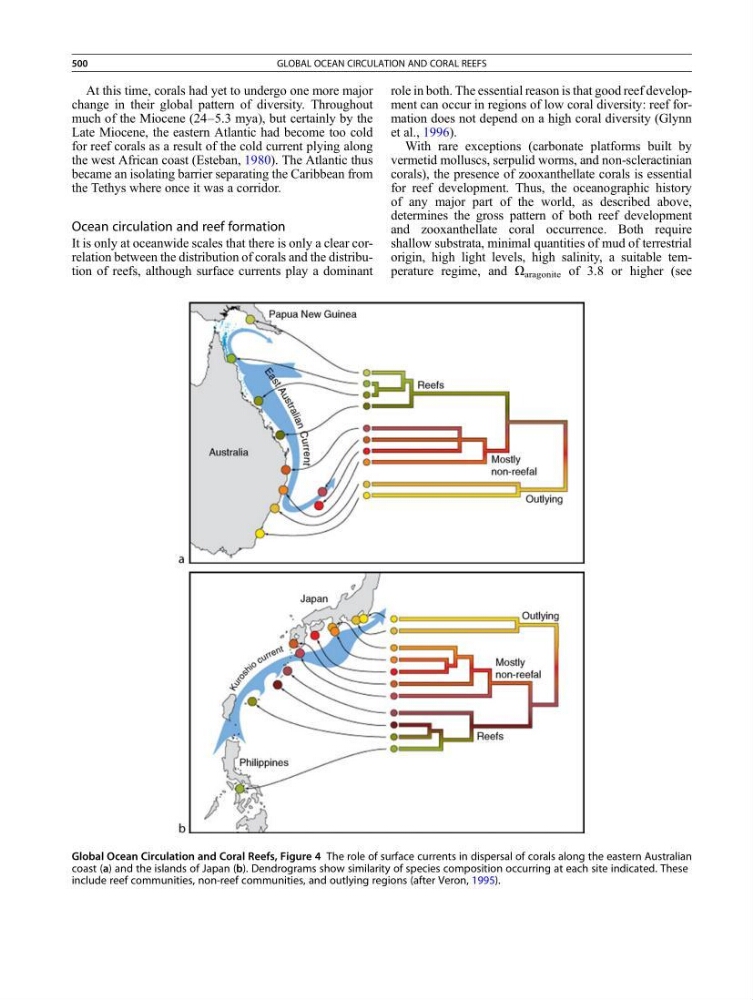
Global Ocean Circulation and Coral Reefs, Figure 4 The role of surface currents in dispersal of corals along the eastern Australian
coast (a) and the islands of Japan (b). Dendrograms show similarity of species composition occurring at each site indicated. These
include reef communities, non-reef communities, and outlying regions (after Veron, 1995).
500
GLOBAL OCEAN CIRCULATION AND CORAL REEFS
change in their global pattern of diversity. Throughout
much of the Miocene (24–5.3 mya), but certainly by the
Late Miocene, the eastern Atlantic had become too cold
for reef corals as a result of the cold current plying along
the west African coast (Esteban, 1980). The Atlantic thus
became an isolating barrier separating the Caribbean from
the Tethys where once it was a corridor.
Ocean circulation and reef formation
It is only at oceanwide scales that there is only a clear correlation between the distribution of corals and the distribution of reefs, although surface currents play a dominant
role in both. The essential reason is that good reef development can occur in regions of low coral diversity: reef formation does not depend on a high coral diversity (Glynn
et al., 1996).
With rare exceptions (carbonate platforms built by
vermetid molluscs, serpulid worms, and non-scleractinian
corals), the presence of zooxanthellate corals is essential
for reef development. Thus, the oceanographic history
of any major part of the world, as described above,
determines the gross pattern of both reef development
and zooxanthellate coral occurrence. Both require
shallow substrata, minimal quantities of mud of terrestrial
origin, high light levels, high salinity, a suitable temperature regime, and O aragonite of 3.8 or higher (see
Global Ocean Circulation and Coral Reefs, Figure 4 The role of surface currents in dispersal of corals along the eastern Australian
coast (a) and the islands of Japan (b). Dendrograms show similarity of species composition occurring at each site indicated. These
include reef communities, non-reef communities, and outlying regions (after Veron, 1995).
500
GLOBAL OCEAN CIRCULATION AND CORAL REEFS