

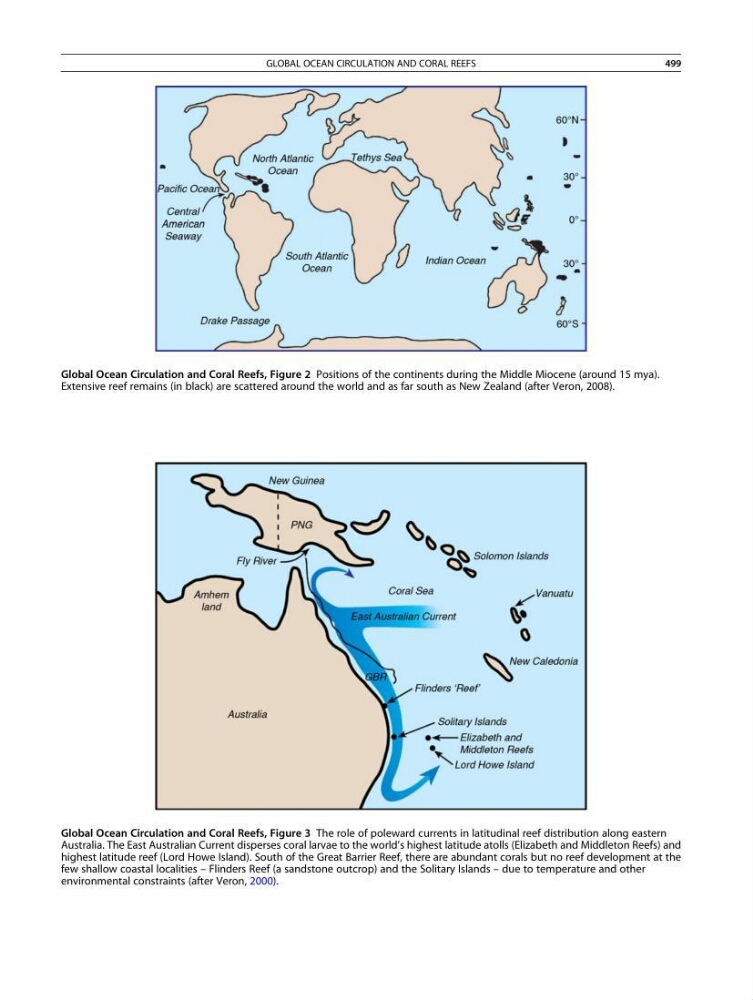
Global Ocean Circulation and Coral Reefs, Figure 2 Positions of the continents during the Middle Miocene (around 15 mya).
Extensive reef remains (in black) are scattered around the world and as far south as New Zealand (after Veron, 2008).
Global Ocean Circulation and Coral Reefs, Figure 3 The role of poleward currents in latitudinal reef distribution along eastern
Australia. The East Australian Current disperses coral larvae to the world’s highest latitude atolls (Elizabeth and Middleton Reefs) and
highest latitude reef (Lord Howe Island). South of the Great Barrier Reef, there are abundant corals but no reef development at the
few shallow coastal localities – Flinders Reef (a sandstone outcrop) and the Solitary Islands – due to temperature and other
environmental constraints (after Veron, 2000).
GLOBAL OCEAN CIRCULATION AND CORAL REEFS
499
Extensive reef remains (in black) are scattered around the world and as far south as New Zealand (after Veron, 2008).
Global Ocean Circulation and Coral Reefs, Figure 3 The role of poleward currents in latitudinal reef distribution along eastern
Australia. The East Australian Current disperses coral larvae to the world’s highest latitude atolls (Elizabeth and Middleton Reefs) and
highest latitude reef (Lord Howe Island). South of the Great Barrier Reef, there are abundant corals but no reef development at the
few shallow coastal localities – Flinders Reef (a sandstone outcrop) and the Solitary Islands – due to temperature and other
environmental constraints (after Veron, 2000).
GLOBAL OCEAN CIRCULATION AND CORAL REEFS
499